Key takeaways
- Find the best battery for Kawasaki Prairie 360 with the correct YTX14AH-BS size, 12V power, terminal layout, and CCA, plus fit checks and charging guidance.
As an Amazon Associate we earn from qualifying purchases.
Affiliate Disclosure: This article contains affiliate links. If you buy through a link on this page, we may earn a commission at no extra cost to you. Product specifications are taken from manufacturer and retailer listings, and we have not personally tested these batteries.

A Kawasaki Prairie 360 that clicks, turns over slowly, or only starts after a jump is usually telling you one simple thing: the battery is done. The frustrating part is that buying a replacement sounds easy until you meet the size codes. Prairie 360 owners are often shown YTX14-BS batteries in search results, and that code looks close enough to order. It is not the right starting point for this ATV. Fitment references for the Kawasaki KVF360 Prairie consistently point to the taller YTX14AH-BS size, which cross-references to YB14A-A2. That single letter difference changes the height of the case, and a battery that is the wrong height can sit loose, strain the hold-down, or leave the cables pulling at an awkward angle.
This guide focuses only on batteries in that correct family. Every pick below is a 12-volt ATV battery in the YTX14AH-BS size or a direct YTX14AH-BS replacement format, with the positive terminal on the left when the terminals face you. We explain what each option does well, where it falls short, and how to confirm fit on your own machine before you order. We also cover the checks that matter more than marketing claims: dimensions, cold cranking amps, activation steps, charging, and storage.
Quick picks
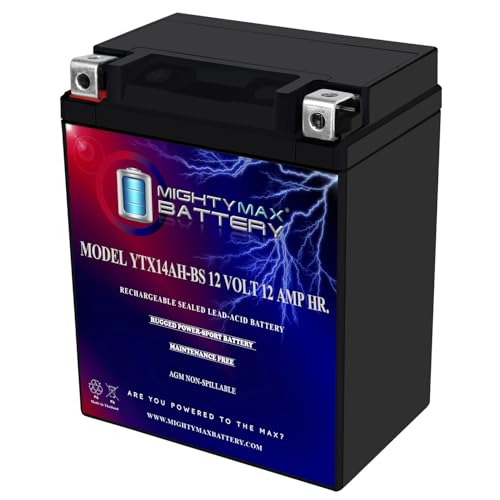
- Best all-round AGM: Mighty Max Battery YTX14AH-BS, sealed 12-volt, 12 amp-hour, rated at 210 cold cranking amps.
- Best explicit Prairie fitment listing: Battanux YTX14AH-BS, whose listing names the KVF360 Prairie directly.
- Best lightweight option: KEMIMOTO YTX14AH-BS lithium battery, a LiFePO4 replacement format supplied with fitment spacers.
- Best factory-sealed alternative: Weize YTX14AH-BS, a sealed AGM battery with dimensions matching the standard footprint.
What size battery does the Prairie 360 take?
The Prairie 360, sold as the KVF360 in Kawasaki model codes, uses a 12-volt battery in the YTX14AH-BS family. Fitment charts from Yuasa-format references list the KVF360 Prairie under YTX14AH-BS across its production years, and Kawasaki specification summaries describe the original format as a 12-volt, 14 amp-hour class battery in the YB14A-A2 format, which is the conventional flooded predecessor of the same physical size. In practice, most modern replacements you will find are sealed AGM versions rated at 12 amp-hours, and that is normal for this size code. Capacity ratings are measured under stated test conditions, so a sealed replacement marked 12 amp-hours is not automatically the wrong battery when an older reference says 14. What must match is the case size, the voltage, the terminal position, and a cranking rating that meets or exceeds the original specification.
The standard YTX14AH-BS case measures roughly 5.3 inches long, 3.5 inches wide, and 6.5 inches tall. Compare that with the shorter YTX14-BS, which is noticeably lower. That height gap is the whole story of this purchase. If you order the shorter battery, it may still connect and start the ATV, but it will not fill the tray the way the original did. Owners then improvise with foam, wood, or an over-tightened strap, none of which is a good long-term answer on a machine that vibrates and bounces over rough ground. Start with the taller code, verify the three dimensions against your old battery, and the rest of the decision becomes much simpler.
Terminal layout matters just as much. The YTX14AH-BS layout used for the Prairie places the positive terminal on the left and the negative on the right when the terminals face you. A mirrored version is sold for other machines, often with an L in the code, and fitting it means stretching cables that were never meant to reach. Every pick here uses the standard left-positive layout, but still compare the listing photograph with your old battery before ordering.
How we chose these batteries
We limited the list to batteries that meet four tests. First, the product had to be an ATV starting battery in the YTX14AH-BS size, not a car battery, a deep-cycle battery, or a smaller motorcycle size presented as close enough. Second, it had to be 12-volt with a published cranking rating suitable for a 362cc single-cylinder ATV engine. Third, the listing had to state usable specifications, including dimensions or the size code, terminal layout, and chemistry. Fourth, the battery had to be listed for sale on Amazon US under a real product listing, using only specifications that appear consistently across the indexed listing and manufacturer-format references.
We do not quote prices in this guide, because offers change often, and we excluded any battery that required modifying the tray, cutting cables, or accepting the wrong terminal polarity.
1. Mighty Max Battery YTX14AH-BS
The Mighty Max YTX14AH-BS is the most straightforward recommendation for most Prairie 360 owners. It is a sealed lead-acid battery using absorbed glass mat construction, rated at 12 volts and 12 amp-hours, with a listing-stated rating of 210 cold cranking amps. That cranking figure sits right in the range fitment references associate with this size, and it is well matched to the Prairie starter motor, which does not demand the huge cranking numbers of a large twin-cylinder machine. The battery is listed as maintenance-free and rechargeable, with the standard YTX14AH case size from the Mighty Max powersports line.
The appeal here is predictability. Sealed AGM batteries in this format arrive with the electrolyte already contained in the mats, so there is no acid bottle to handle and no vent tube to route. For an ATV that lives in a barn, gets used hard on weekends, and then sits, that sealed construction also tolerates vibration better than an old-style flooded battery. Mighty Max describes this model as a direct replacement for machines that take the YTX14AH-BS size.
There are limits to note. Like most sealed replacements in this size, the stated capacity is 12 amp-hours rather than the higher figure attached to some original-equipment references, so owners who run winches, extra lights, or a sprayer pump for long periods with the engine off should be realistic about reserve capacity. This is a starting battery first, and repeated deep discharges will shorten its life. If weight or reserve behavior is a deal-breaker, the lithium option further down addresses both, at the cost of a different charging discipline.
Best for: Prairie 360 owners who want a sealed, ready-to-fit replacement in the correct size without changing chemistry or charging habits.
2. Battanux YTX14AH-BS
The Battanux YTX14AH-BS earns its place for one specific reason: its compatibility list names the KVF360 Prairie directly. Many battery listings speak in general terms about ATVs and motorcycles, leaving the buyer to decode cross-reference numbers. This listing spells out the Kawasaki KVF360 Prairie among its ATV applications, alongside the Prairie 300 and Prairie 400, and gives the OEM cross-references for the size, including YB14-A2 and the YTX14AH-BS format. For a buyer who has already been burned by a near-miss size code, that explicit naming is genuinely useful.
The battery itself is a sealed SLA and AGM design rated at 12 volts and 12 amp-hours. The listed product dimensions are about 5.2 inches by 3.5 inches by 6.4 inches, which align with the standard case for this size, allowing for rounding in the listing. The item model number combines the YB14-A2 and YTX14AH-BS designations, which is exactly the cross-reference pair Prairie owners should expect to see. The listing describes the battery as maintenance-free and ready to install without tools beyond the normal terminal hardware.
The caution with this pick is verification. Because the listing aggregates a long compatibility list covering many brands, still do the physical checks described later in this guide: measure your old battery, confirm the positive terminal is on the left, and compare the height against the tray. A long fitment list is a starting point, not a substitute for a tape measure.
Best for: Buyers who want a listing that names the KVF360 Prairie explicitly and states the YB14-A2 cross-reference in plain terms.
3. KEMIMOTO YTX14AH-BS Lithium Battery
The KEMIMOTO lithium battery is the different answer in this guide. It is a 12-volt, 7 amp-hour LiFePO4 battery built as a replacement for the YTX14AH-BS format, with its OEM part number list including YTX14AH-BS and YB14-A2. KEMIMOTO supplies the battery pre-charged and includes four universal-fit EVA spacers, which exist because a lithium battery in this class is smaller and much lighter than the lead-acid case it replaces. The spacers take up the extra room in the tray so the battery can be secured properly instead of sliding around.
For a Prairie 360, the practical advantages are weight and shelf behavior. A lithium iron phosphate battery in this size weighs a fraction of a lead-acid equivalent, which makes the awkward lift into the ATV battery compartment noticeably easier. LiFePO4 batteries also hold charge well in storage and tolerate partial-state-of-charge sitting better than lead-acid, which suits an ATV that may stand for weeks between rides. The listing positions the battery for motorcycles, ATVs, and similar powersports machines, and the included spacers acknowledge the fitment reality honestly rather than pretending the case is identical.
The trade-offs are real. Lithium batteries need a charger with a lithium mode, or at minimum one that does not run a high-voltage desulfation cycle, and cold-weather starting behavior differs from lead-acid. The usable capacity figure is also lower on paper, which matters if you lean on the battery for winching, and the spacer-based fit means you must arrange the foam correctly and confirm the hold-down is snug. If you want a drop-in lead-acid experience with zero new habits, choose one of the AGM picks instead.
Best for: Owners who value light weight and storage tolerance, and who are willing to use a lithium-compatible charger.
4. Weize YTX14AH-BS
The Weize YTX14AH-BS is the factory-sealed AGM alternative for buyers who like the traditional format but want a widely distributed brand. Listing data for this battery gives the dimensions as 5.28 inches long, 3.50 inches wide, and 6.54 inches tall, with a weight of just over nine pounds, a capacity of 12 amp-hours at the ten-hour rate, and a rating of 210 cold cranking amps. The terminal layout is stated plainly: positive on the left in red, negative on the right in black. The same listing describes compatibility with Kawasaki machines in the 360cc class among a broad range of ATV applications.
Weize describes this battery as sealed, charged, and ready to install, which removes the acid-filling step that comes with dry-charged batteries supplied with an acid pack. That matters for Prairie owners doing the swap at home, because filling and first-charging a dry battery correctly takes time, ventilation, and care. A factory-sealed unit reduces the job to removing the old battery, cleaning the terminals, and bolting the new one in. The AGM construction also means the battery can handle the tilted, jarring environment of an ATV better than a conventional flooded design.
The honest limitation is that this listing covers a very wide range of machines and engine sizes, so the generic compatibility language should not be your only check. Use the stated dimensions and terminal layout, which are the parts of the listing that map directly onto the Prairie tray. We were unable to confirm a single canonical ASIN for this exact listing variant during research, because the same model is sold under rotating listing variants, so we do not print an ASIN for it here rather than risk pointing you to the wrong variant. Search the exact model name on Amazon US and match the dimensions and terminal layout stated above before ordering.
Best for: Buyers who want a factory-sealed, ready-to-install AGM battery and are comfortable confirming the variant by dimensions.
ASIN: N/A — the exact YTX14AH-BS listing variant could not be tied to one stable ASIN from the indexed listings reviewed, so no code is printed rather than risk a wrong-variant link.
Buying guide: how to choose the right Prairie 360 battery
Confirm the size code on your old battery
Before anything else, lift the seat or open the battery compartment and read the label on the battery you already have. You are looking for YTX14AH-BS, YB14A-A2, or a cross-reference to one of those codes. Photograph the label, the terminal positions, and the cable routing. If your old battery carries the shorter YTX14-BS code, a previous owner may have fitted the wrong size, which is worth knowing before you copy it. Measure the case in all three dimensions and write the numbers down. Those three measurements settle more arguments than any compatibility chart.
Understand cold cranking amps without overbuying
Cold cranking amps describe how much current a battery can deliver for starting at a standardized cold temperature. For the Prairie 360, batteries in this size cluster around 190 to 220 cold cranking amps, and that is the right neighborhood. A rating far below that range risks slow cranking on cold mornings, especially as the battery ages. A much higher rating is not automatically better, because the figure is only comparable when measured the same way. Treat the number as a threshold to meet, not a score to maximize.
Choose a chemistry you will actually maintain
Sealed AGM is the default choice for this ATV, and for most owners it is the right one: no watering, no spills, good vibration resistance, and compatibility with ordinary chargers. Dry-charged batteries supplied with an acid pack can offer excellent service life, but only if filling and the first charge are done carefully. Lithium iron phosphate saves significant weight and stores well, but asks for a compatible charger. Pick the chemistry that matches the charger already on your workbench.
Check activation and first charge
A sealed battery that arrives ready to install still benefits from a voltmeter check before fitting. A healthy, rested 12-volt lead-acid battery should read in the mid-twelve-volt range. If it reads low, charge it fully before the first start rather than letting the ATV alternator do the heavy lifting, because a small ATV charging system is designed to maintain a charged battery, not rescue a depleted one.
Fit it properly
Disconnect the negative cable first and reconnect it last. Clean the terminals and cable ends until the metal is bright, seat the battery fully in the tray, and secure the hold-down so the case cannot move. Route the cables without sharp bends or tension, tighten the bolts firmly without over-torquing them, and start the ATV to confirm it cranks briskly before you refit all the bodywork.
Charging and storage habits that extend battery life
Most Prairie batteries do not die from one dramatic event. They fade because the ATV sits. A lead-acid battery slowly self-discharges, and leaving it partially discharged for months allows sulfation to harden on the plates, permanently reducing capacity. If the ATV will stand for more than a few weeks, connect a quality maintenance charger designed for small AGM batteries, or remove the battery and charge it periodically. Keep terminals tight and avoid repeated deep discharges from running accessories with the engine off.
Heat is the other quiet enemy: a battery stored in a hot shed ages faster than one kept in a cool, stable environment. When a battery begins to crank slowly even after a full charge, test it honestly rather than nursing it along until it strands you at the far end of a trail. Replacement at the first reliable sign of weakness is cheaper than a recovery trip.
Frequently asked questions
Can I use a YTX14-BS battery in a Prairie 360?
It is not the recommended size. The YTX14-BS case is shorter than the YTX14AH-BS the Prairie 360 specifies, so it will not fill the tray correctly and may sit insecurely. Even if the ATV starts, the loose fit can damage terminals and cables over time. Order the taller YTX14AH-BS size instead.
What are the correct battery dimensions?
The standard case for this size is approximately 5.3 inches long, 3.5 inches wide, and 6.5 inches tall, with the positive terminal on the left. Always compare those figures with your old battery, because listings round dimensions slightly differently.
Do I need a special charger?
For AGM and other lead-acid batteries, use a charger with a mode suitable for small sealed batteries and automatic maintenance charging for storage. For a lithium iron phosphate battery, use a charger with a dedicated lithium mode and avoid chargers that apply desulfation pulses. Never use a large automotive fast charger at a high rate on a small powersports battery.
The bottom line
For most Prairie 360 owners, the Mighty Max YTX14AH-BS is the cleanest answer: the correct taller size, sealed AGM construction, and a cranking rating matched to the machine. Choose the Battanux if you want a listing that names the KVF360 Prairie directly, the KEMIMOTO if light weight matters enough to switch to lithium with the right charger, and the Weize if you prefer a factory-sealed AGM and will confirm the variant by its stated dimensions. Whichever you choose, measure the old battery, confirm left-positive terminals, and charge the new battery fully before its first start.