We independently review everything we recommend. When you buy through our links, we may earn a commission. As an Amazon Associate we earn from qualifying purchases.
4 Best Men’s Gardening Gloves for Yard Work (November 2026)
Four men's gardening gloves compared on listing specs: coated knit pairs for weeding, leather gauntlets for thorn work, and sizing for larger hands.
Four men's gardening gloves compared on listing specs: coated knit pairs for weeding, leather gauntlets for thorn work, and sizing for larger hands.
The real decision with men’s gardening gloves is matching construction to the work your hands actually do. A rubber-coated knit pair grips wet stems and hand tools all morning, yet a rose cane pushes straight through it. A leather gauntlet turns thorns aside but feels clumsy when you are transplanting seedlings. Fit matters just as much: men’s hands run wider, and a glove borrowed from a women’s or unisex size chart often splits at the seams or bunches at the fingers.
This roundup is for men who weed and plant every week, men who prune roses and fruit canes, and men clearing brush at the edge of a property. Each pick below was chosen from its Amazon listing, using the material, size range and cuff length printed there, so the four options split cleanly between light coated gloves for soil work and leather gauntlets built for thorn protection.
Quick Picks
As an Amazon Associate we earn from qualifying purchases.
Product
Best for
Key spec from title
COOLJOB Gardening Gloves for Men, 2 Pairs
Everyday weeding, planting and tool work
Rubber-coated polyester knit
Legacy Gardens Leather Gardening Gloves
Rose pruning with a flexible palm
Goatskin palm, cowhide gauntlet
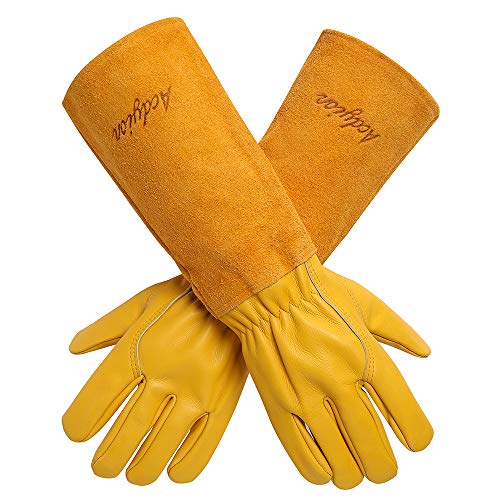
Acdyion Thorn Proof Gardening Gloves
Heavy thorn and bramble clearing
Thick cowhide, elbow-length cuff
HANDLANDY Rose Pruning Gloves
Long pruning sessions in warm weather
Pigskin leather, 14-inch gauntlet
How to Choose
Start With the Material, Not the Brand
Material decides both protection and feel. Coated knit gloves pair a breathable polyester back with a rubber layer over the palm and fingers, which gives wet grip for tools and roots while staying light enough for hours of weeding. Leather splits three ways: cowhide is the thickest and stiffest, goatskin stays flexible in the fingers, and pigskin breathes through its natural pores. If your work is mostly soil and hand tools, coating beats hide. If thorns are the hazard, only leather belongs on the shortlist, and the thicker the hide, the less a cane tip can reach skin.
Measure Your Hand Before Trusting the Size Label
A men’s Large is not a fixed measurement. Brands print their own charts, and the listings show how far apart they sit: one gauntlet maker ties its Large to a hand size range of 9 to 9.5 inches, while stretch knit pairs forgive a wider span because the fabric gives. Wrap a tape around your knuckles, note the number, and match it to the chart on the listing rather than ordering the size you wear in shirts. Between sizes, go up for leather, which barely stretches, and down for coated knit, which loosens with wear.
Pick the Cuff for the Plants You Handle
Cuff length is a safety choice disguised as a style choice. A short elastic wrist keeps soil and grit out of the glove during bed work and stays cool, but it leaves the forearm bare. A gauntlet that runs to the elbow covers the skin you push into rose bushes, blackberry canes and cactus pads, which is where most scratches actually land. The trade is heat and bulk: a long cuff feels clumsy for transplanting seedlings and warm on still days. Match the cuff to the tallest, sharpest plant you handle regularly, not to the average task.
Check Grip Texture and How the Glove Is Cleaned
Grip comes from the palm surface, and listings describe it plainly: a dipped rubber coating, a smooth leather palm, or silicone dots scattered across the fingers. Dots and coatings hold wet pruner handles better; smooth leather slides less against dry wood but can slip on slick stems. Care divides the field just as sharply. Coated knit pairs rinse clean and air dry in hours, so a rotation of two pairs works well. Leather should dry slowly away from direct heat and stays supple longer when it is not left damp in a shed between jobs.
This is the everyday pair most men will wear out first. The box holds two pairs, so one can dry on a hook while the other works, and the rubber coating over the palm and fingers grips damp stems, muddy roots and tool handles without the stiffness of leather. The knit back breathes during long weeding sessions, and the sizing is cut for men rather than scaled up from a women’s pattern. It is a soil-and-tools glove through and through: planting, digging, raking and hauling bags are its home ground, and the second pair in the pack covers the midweek wash cycle.
Legacy Gardens splits the build in a way that suits pruning: an A-grade goatskin palm keeps enough finger feel to tie, clip and sort canes, while the cowhide gauntlet covers the forearm you push into the bush. Padding and double stitching sit on the thumb, index and middle fingers, the three digits that take the load when you grip a cane and cut. An elastic wrist seals the opening against dirt. This listing is the Large in Brown, and the goatskin starts firm, then softens into the shape of your hand over the first few sessions in the garden.
When the job is blackberries, cactus or an overgrown rose bed, this is the heavy option. The hand and the elbow-length gauntlet are cut from thick natural cowhide, with reinforced patches at the palm and fingertips where canes press hardest. The brand prints a full size chart on the listing: the Large runs 16.6 inches in total length and fits a hand size of 9 to 9.5 inches, with sizes from XS to XL around it. That chart matters, because a stiff hide in the wrong size fights every grip. Sized right, it is the pair you pull on for clearing work and hang up when the delicate jobs start.
Pigskin is the warm-weather leather: its natural pore structure lets air move, so hands stay cooler during long pruning sessions than they do inside cowhide. HANDLANDY builds this pair from natural pigskin with reinforced padding across the palm and fingertips, a 14-inch gauntlet sleeve for forearm cover, and silicone dots on the palms and fingers to steady wet pruner handles. The listing states puncture resistance to the ASTM F2878 standard, which is a firmer claim than most brands print. This ASIN is the Medium in Beige White, model 1601, and the glove runs 16.54 inches long overall.
Specs
Natural pigskin leather per the listing
14-inch gauntlet sleeve
Reinforced padding on palms and fingertips; puncture resistance stated to ASTM F2878
Silicone grip dots on palms and fingers
Dimensions: 16.54 x 3.94 x 0.39 in; weight 6.4 ounces; model 1601
This listing: Medium, Beige White
Best for: Long pruning sessions where heat buildup is the bigger problem
Watch out for: This ASIN is the Medium in Beige White, and even with the stated puncture figure, no leather is fully thorn proof — press slowly into dense canes.
ASIN: B0DX2C4BFJ
Which One Fits Your Situation
You Weed and Plant Every Weekend
Take the COOLJOB two-pack. Bed work is a cycle of digging, pulling and gripping damp tools, and a coated knit glove handles all of it while breathing well enough for a full morning. With two pairs in the box, a muddy pair can dry while the spare works, which quietly doubles the life of both. Save the leather budget for the day thorn work enters your routine.
Your Roses Need Hard Pruning Twice a Year
Choose the Legacy Gardens gauntlets. Rose work asks for two things at once: a palm flexible enough to sort canes and work pruners, and a cuff long enough to cover the forearm reaching into the bush. The goatskin palm and cowhide cuff split that job cleanly, and the padded fingers take the squeeze of thick canes without the bulk of a full cowhide hand.
You Are Clearing Blackberries or Brush
Reach for the Acdyion cowhide gauntlets. Clearing throws canes at your forearms from every angle, and the elbow-length cuff plus the thickest hide in this roundup is the combination built for it. Use the printed size chart before ordering, since the stiff leather gives you no stretch to hide a sizing mistake, and expect a short break-in before the glove closes easily.
You Prune for Hours in Summer Heat
Pick the HANDLANDY pigskin pair. Heat, not thorns, ends most long sessions early, and pigskin’s porous surface vents better than cowhide while the 14-inch sleeve still covers the forearm. The padded palm cushions repeated pruner squeezes, and the grip dots help when handles get sweaty. It is the pair to wear when the work is steady rather than brutal.
Common Mistakes
Reaching for a coated knit glove to prune roses — the coating grips well but a cane tip passes through it, so thorn work always calls for leather.
Ordering the size you wear in shirts instead of measuring around your knuckles and matching the number to the chart printed on the listing.
Buying an elbow-length gauntlet for raised-bed planting, where the long cuff only adds heat and bulk, or a short cuff for blackberry clearing.
Leaving leather gloves damp in a shed or drying them on a heater, which stiffens and cracks the hide faster than the work itself does.
Expecting one pair to cover every job — most men end up happiest with a light coated pair for soil work and a leather gauntlet for thorns.
Frequently Asked Questions
How should men’s gardening gloves fit?
Snug at the fingers with no slack at the tips, and firm at the wrist without cutting circulation. Measure around your knuckles and match the number to the size chart on the listing, because a men’s Large varies by brand. Leather should start slightly tight, since it relaxes into your hand’s shape; stretch knit should start close, since it loosens.
Is cowhide or goatskin better for thorn work?
Cowhide is thicker and turns aside heavy canes and blackberry thorns better, which suits clearing and rough pruning. Goatskin is thinner and more flexible, so your fingers keep their feel for tying and clipping, and many gauntlets pair a goatskin palm with a cowhide cuff to get both. Choose by the plant: the thicker the cane, the stronger the case for cowhide.
Can any gardening glove completely stop thorns?
No. Leather slows and deflects thorns, and some listings state puncture resistance against a named standard, but a hard-pressed rose cane or cactus spine can still find a seam or a thin spot. Treat gloves as strong protection rather than a guarantee, grip canes below the thorns where you can, and let the gauntlet, not your forearm, take the scratches.
How do I keep leather gardening gloves in good shape?
Shake out soil after each session, let the gloves dry slowly at room temperature, and keep them out of direct heat, which cracks damp leather. A stiff pair usually softens again with wear. Store them flat or hanging in a dry spot rather than balled up in a bucket, and retire a pair once the palm wears thin enough that you can feel a cane tip through it.
K
Kissmyaster Editorial Team
We compare specs, materials and verified owner reviews before a product earns a spot. Rankings are never paid.
Affiliate disclosure. As an Amazon Associate we earn from qualifying purchases at no extra cost to you. Prices accurate as of the date shown.
Compare compact CPAP machines sold with travel bags and cases: a battery travel bundle, a humidifier model with a full kit, and a home and travel unit.
Find the best pink rims 20 inch for your car with our guide to bolt pattern, offset, and bore, plus two verified pink 20-inch wheels that fit a 5x114.3 hub.
The best 225 45 R17 tires for daily driving, compared by size, load index, and tread type. Five 225/45R17 tires in all-season and winter form for your car.
Compare five value pellet grills for backyards, from compact cookers to large-capacity models, and learn how area, controllers, and hoppers shape choice.
Three large dual-tower air CPU coolers compared by height, heatpipes, fans and socket support: Noctua NH-D15 chromax.black, Thermalright Peerless Assassin 120 SE and be quiet! Dark Rock Pro 5.