We independently review everything we recommend. When you buy through our links, we may earn a commission. As an Amazon Associate we earn from qualifying purchases.
5 Best Lawn Fertilizers for Spring in Maine (November 2026)
Five spring lawn fertilizers compared for Maine cool-season grass: listed analyses, coverage and timing for bluegrass, fescue and ryegrass lawns.
Five spring lawn fertilizers compared for Maine cool-season grass: listed analyses, coverage and timing for bluegrass, fescue and ryegrass lawns.
Spring feeding in Maine is a timing decision disguised as a shopping decision. The season starts weeks later than it does further south, the window between snowmelt and crabgrass germination is short, and the right bag depends on the job in front of you: blocking crabgrass, feeding established bluegrass and fescue, helping new seed take hold, or keeping an organic program. Buy for the wrong job and even a good fertilizer fails — a preventer put down where you plan to seed, for example, stops your seed too.
OUR TOP PICK
Scotts Turf Builder Halts Crabgrass Preventer with Lawn Food
This roundup is for Maine homeowners working with cool-season lawns — Kentucky bluegrass, fine and tall fescues, perennial ryegrass — from the coast to inland towns where the ground thaws later still. Every pick below was chosen from its Amazon listing: the printed fertilizer analysis, the coverage and bag weight, the grass types named, and the application timing in the directions. Match those four details to your own yard and the choice usually makes itself.
Quick Picks
As an Amazon Associate we earn from qualifying purchases
Product
Best for
Key spec from title
Scotts Turf Builder Halts Crabgrass Preventer with Lawn Food
Lawns with a crabgrass history
30-0-4, covers 5,000 sq. ft.
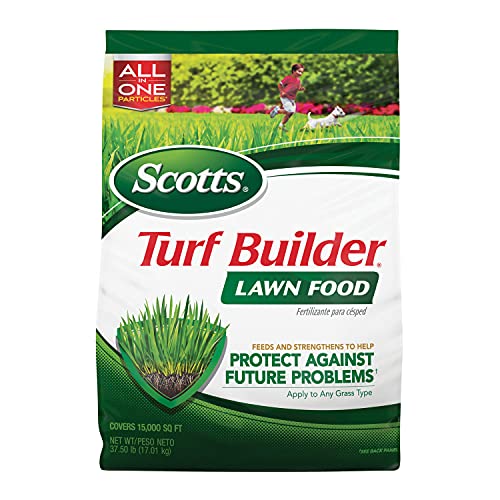
Scotts Turf Builder Lawn Food
Big established lawns on a simple feed
37.5 lb bag, covers 15,000 sq. ft.
Espoma Organic Spring Lawn Booster
Organic early-spring feeding
8-0-0 with calcium, covers 5,000 sq. ft.
Scotts Turf Builder Starter Food for New Grass
Spring seeding, overseeding and sod
24-25-4, covers 5,000 sq. ft.
The Andersons PGF Complete 16-4-8
Even, pro-style feeding with humic
16-4-8, covers 5,000 sq. ft.
How to Choose
Start with the job, not the brand
Spring bags split into four jobs, and Maine lawns rarely need all of them at once. A preventer-plus-food bag lays down a barrier against crabgrass while it feeds. A straight lawn food only feeds. A starter formula carries extra phosphorus for new seed and sod. An organic booster feeds gently with slow-release nitrogen. Maine also restricts phosphorus fertilizer on established turf to protect lakes and coastal water, so the middle number on the bag is a legal question as well as a lawn question. A soil test — available through the University of Maine Cooperative Extension — tells you which job your lawn actually needs.
Respect Maine’s late and narrow spring window
On the southern coast the lawn may wake up in April; an hour inland, frost can linger weeks longer. Fertilizer spread on dormant grass or frozen ground does little good and can wash toward ditches and streams when the ground finally thaws. Crabgrass preventer has the hardest deadline: the listing for the Scotts preventer says to apply in early spring, before the third or fourth mowing and before temperatures regularly reach the 80s. Wait too long and the barrier misses germination entirely. Decide early whether this spring is a preventing spring or a seeding spring, because the calendar will not let you do both well.
Measure the lawn, then compare coverage
Bag weight is a poor way to compare these products. The 30 lb organic bag in this roundup covers 5,000 square feet, while a 37.5 lb synthetic bag covers 15,000, because coverage follows the application rate and the strength of the analysis, not the heft of the bag. Measure your lawn — total lot minus house, driveway, beds and woods — and divide by the coverage printed in each listing. The listings also give rates per 1,000 square feet and spreader settings for common models. Buying by measured coverage prevents the two classic errors: running out mid-lawn and doubling up passes to finish a bag.
Check the release pattern and the grass list
Two bags with similar numbers can feed very differently. Quick-release nitrogen greens a lawn fast, then fades within weeks and can push soft growth ahead of what cool Maine nights support. Slow-release portions meter the food out gradually: the Andersons listing describes feeding for up to eight weeks, and the Espoma booster is built on long-lasting slow-release nitrogen. Also confirm that your grass appears in the listing’s own list. The products below name Kentucky bluegrass, tall and fine fescues and perennial ryegrass — the cool-season mix that survives Maine winters — and the preventer listing warns against use on bentgrass lawns.
If crabgrass took over the edges of your driveway last August, this is the bag built for your spring. It pairs a 30-0-4 fertilizer with a pre-emergent barrier that stops crabgrass and several other listed weeds before they sprout, and the label timing suits Maine: apply in early spring, before the third or fourth mowing and before temperatures settle into the 80s. The listed grass types read like a Maine lawn — Kentucky bluegrass, tall and fine fescue, perennial ryegrass. One catch defines it: a preventer cannot tell weed seed from grass seed, so lawns being seeded this spring need a different pick.
For an established Maine lawn that simply needs feeding after winter, this is the straightforward choice: a granular lawn food with no herbicide, listed for any grass type, in the biggest bag in this roundup. One bag covers 15,000 square feet, which suits the larger rural lots common outside Maine’s cities, and it goes down on a wet or dry lawn with the spreader settings printed in the listing. Because it carries no weed control, it is also the safe companion for spring overseeding projects — feed the lawn without blocking the new seed you plan to put down.
Espoma builds this one specifically for the first feeding of the year: an 8-0-0 natural and organic granular formula with slow-release nitrogen and added calcium, made for early spring use. The listing names the grasses that dominate Maine lawns — fescues, bluegrass and rye among them — and covers both cool- and warm-season turf. With no phosphorus and no synthetic quick hit, the green-up arrives gradually, which many Maine owners prefer on thin, sandy coastal soils where fast growth surges then fades. It is the pick for households keeping an organic program near wells, gardens and the shore.
Maine winters leave bare patches, plow damage and thin strips along the road, and spring is when many owners reseed them. This starter formula is the one designed for that job: a 24-25-4 analysis with the high middle number new roots need, listed for seeding, reseeding, sod, sprigs and plugs on any grass type. The listing directs you to apply it right before or right after planting, with a second application a few weeks later. Just remember the pairing rule — starter food and new seed belong together, while crabgrass preventer and new seed cancel each other out.
The Andersons comes from the professional side of the turf world, and it shows in the granule: PGF Complete uses a fine, uniform particle that spreads evenly and settles into the canopy instead of sitting on top. The 16-4-8 analysis blends quick- and slow-release nitrogen for feeding the listing puts at up to eight weeks, and the formula adds 7 percent humic material plus micronutrients such as iron. For Maine owners who mow tall fescue and bluegrass and want a measured, even spring feed rather than a growth surge, this is the precision option.
Which One Fits Your Situation
Crabgrass owned your driveway edges last summer
Choose the Scotts Halts bag and get it down early, while the lawn is dry and before the third or fourth mowing. The 30-0-4 food greens the lawn up after winter while the barrier forms. Accept the trade: those edges cannot be seeded until fall, because the same barrier that stops crabgrass will stop grass seed.
Plow damage and winter kill left bare strips
Skip the preventer on those areas and seed them, feeding with the Scotts Starter Food at planting time. Its 24-25-4 analysis is built for roots, not top growth, and the listing allows application right before or right after seeding. If the rest of the lawn needs feeding too, the plain Scotts Lawn Food will not interfere with the new seed.
You garden organically near a well, garden beds or the shore
The Espoma Spring Lawn Booster fits that program: an 8-0-0 organic granular with slow-release nitrogen and calcium, and no phosphorus to run toward the water. Expect a gradual green-up rather than a sudden flush, and plan on the 30 lb bag covering about 5,000 square feet of bluegrass or fescue.
You have a large inland lot and one free weekend
Coverage decides it. One Scotts Turf Builder Lawn Food bag treats 15,000 square feet, so a big lot takes one bag and one pass with the spreader settings printed in the listing. If your lawn is smaller and you would rather feed precisely, the Andersons PGF Complete covers 5,000 square feet with finer granules and a longer feeding window.
Common Mistakes
Putting down crabgrass preventer and grass seed in the same spring — the barrier blocks both, and the seeded patches fail quietly.
Fertilizing while the lawn is still dormant or the ground is frozen; in much of Maine that means waiting weeks after lawns further south are fed.
Ignoring the middle number: Maine limits phosphorus on established turf, so without a soil test or new seed in the ground, a zero-phosphorus formula is the safer buy.
Judging bags by weight instead of coverage — a 30 lb organic bag and a 37.5 lb synthetic bag in this roundup cover very different areas.
Overlapping spreader passes or skipping the water-in step the preventer listing calls for, which leaves stripes and weakens the barrier.
Frequently Asked Questions
When should I fertilize my Maine lawn in spring?
Feed once the grass is actively growing and you have mowed at least once — often late April into May on the coast, later inland. Crabgrass preventer goes down earlier in that window, before soil warms enough for weed seed to sprout. Spreading on frozen or dormant turf wastes the application.
Can I use crabgrass preventer and plant grass seed in the same spring?
Not on the same ground. A pre-emergent barrier cannot distinguish weed seed from grass seed, so newly seeded areas under a preventer will fail to establish. Pick one job per area for spring: prevent where crabgrass ruled last year, seed the bare spots, and do the bigger overseeding in early fall instead.
Why do so many spring fertilizers show a zero in the middle number?
The middle number is phosphorus. Established lawns seldom need more of it, and Maine restricts phosphorus fertilizer on turf to protect lakes, rivers and coastal water from runoff. The exceptions are a soil test showing a shortage and new lawns being seeded — which is why the starter formula in this roundup carries a high middle number.
How many bags should I buy for my lawn?
Measure the area you actually mow, then divide by the coverage printed in the listing — 5,000 square feet for most bags here, 15,000 for the large Scotts bag. Bag weight misleads: the 30 lb organic bag covers the same ground as the 15 lb starter bag. When in doubt, buy to the measured area, not the lot size.
K
Kissmyaster Editorial Team
We compare specs, materials and verified owner reviews before a product earns a spot. Rankings are never paid.
Affiliate disclosure. As an Amazon Associate we earn from qualifying purchases at no extra cost to you. Prices accurate as of the date shown.
Compare compact CPAP machines sold with travel bags and cases: a battery travel bundle, a humidifier model with a full kit, and a home and travel unit.
Find the best pink rims 20 inch for your car with our guide to bolt pattern, offset, and bore, plus two verified pink 20-inch wheels that fit a 5x114.3 hub.
The best 225 45 R17 tires for daily driving, compared by size, load index, and tread type. Five 225/45R17 tires in all-season and winter form for your car.
Compare five value pellet grills for backyards, from compact cookers to large-capacity models, and learn how area, controllers, and hoppers shape choice.
Three large dual-tower air CPU coolers compared by height, heatpipes, fans and socket support: Noctua NH-D15 chromax.black, Thermalright Peerless Assassin 120 SE and be quiet! Dark Rock Pro 5.



 Scotts Turf Builder Starter Food for New Grass
 The Andersons Professional PGF Complete 16-4-8