We independently review everything we recommend. When you buy through our links, we may earn a commission. As an Amazon Associate we earn from qualifying purchases.
4 Best 12V to 110V Power Inverters (November 2026)
Compare four 12V to 110V power inverters by continuous wattage, waveform, AC outlets and USB ports, from plug-in car units to a 1000W pure sine model.
Compare four 12V to 110V power inverters by continuous wattage, waveform, AC outlets and USB ports, from plug-in car units to a 1000W pure sine model.
The real decision with a 12V to 110V converter is not whether it works, but how much power you can honestly pull from the place you plug it in. A cigarette lighter socket in most cars is fused well below what a 300W label suggests, while a battery connection can feed a much larger unit. Matching the inverter to the connection, and the connection to the load, is the choice that decides whether the setup runs all day or shuts down in minutes.
This roundup is for drivers who charge laptops and camera batteries on the road, campers and van users who run small appliances from a 12V battery, and anyone who needs household power during an outage. Each pick was chosen from its Amazon listing name and published specifications: continuous wattage, waveform, outlet count and connection method, so the four units below cover plug-in car use through to a hardwired 1000W setup.
Quick Picks
As an Amazon Associate we earn from qualifying purchases.
Product
Best for
Key spec from title
FOVAL 200W Car Power Inverter
Family road trips with many small devices
200W with 2 AC outlets and 4 USB ports
BESTEK 300W Power Inverter
Everyday laptop and phone charging in a car
300W continuous, 11 to 17V input range
BESTEK 300W Pure Sine Wave Inverter
CPAP machines and sensitive electronics
300W pure sine wave output
Renogy 1000W Pure Sine Wave Inverter P2
Campers, RVs and backup power from a battery
1000W continuous, 2000W peak
How to Choose
Start with continuous wattage, not the peak figure
The continuous wattage is the number the inverter can hold for hours, and it is the only figure worth matching to your load. Peak or surge wattage covers a few seconds of motor starting and nothing more. Add up the draw of everything you plan to run at once: a laptop brick might take 65 watts, a small fan 40, a battery charger 20. Then leave headroom, because an inverter run flat out gets hot and loud. The harder limit is the supply side. Most car accessory sockets are fused at 10 to 20 amps, which caps a plug-in unit at roughly 150 to 200 usable watts no matter what the box claims.
Decide between pure sine wave and modified sine wave
Modified sine wave units cost less and run simple loads happily: phone chargers, laptop bricks, lights and most small electronics. The stepped waveform can make motors hum, run warmer or behave oddly, and some medical devices, audio gear and variable-speed tools specify pure sine wave power in their manuals. Pure sine wave output matches household electricity closely, so anything that plugs into a wall at home runs the way its maker intended. If your load has a motor, a compressor or a control board you care about, the pure sine models in this roundup are the safer buy.
Match the connection to the wattage
How an inverter connects matters as much as its wattage figure. Lighter-plug models are the grab-and-go option: no tools, no wiring, and they move between vehicles in seconds, but the socket fuse caps them at light loads. Anything much above 200 watts continuous belongs on a direct battery connection with clamps or bolted cables sized for the current, which is why the 1000W unit here ships with heavy 4 AWG leads instead of a plug. Check what is in the box before you buy. Some plug-in models also include clamp cables, which lets one unit cover both light socket duty and occasional heavier battery work.
Count outlets, USB ports and protections
Two AC outlets is the practical minimum for most buyers, since a laptop and a second charger are the usual pairing. USB output is worth reading closely: a shared 4.8A pair charges two phones at full speed, while a single 2.1A port on a big inverter is an afterthought for one phone. Protection is the other line to check. Look for a built-in or replaceable fuse, overload and short-circuit shutdown, low-voltage cut-off that protects the vehicle battery, and a cooling fan that is thermostatically controlled rather than always on. Listings that publish these details plainly are easier to trust than ones that lead with a giant peak number.
The 4 Best Options
FOVAL 200W Car Power Inverter
Top Pick
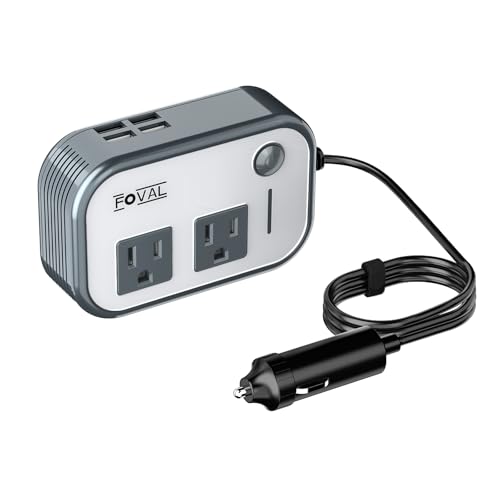
FOVAL 200W Car Power Inverter
Best for: Road trips where several phones, tablets and one laptop need power at the same time.
Continuous power: 200 watts
Input: 12 volts DC, accessory socket plug
AC output: 110 volts, 2 outlets
USB output: 4 ports, 6.2 amps total per the listing specifications
The FOVAL 200W Car Power Inverter suits the family-car end of this category: two AC outlets for a laptop and a second charger, and four USB ports so passengers are not taking turns. Its 200W figure is honest plug-in territory, sized for the accessory socket it ships with rather than a battery bank. The grey housing is small enough to live in a door pocket or glove box, and the listing’s own specification block is unusually complete, with input, output and USB figures all published in one place.
BESTEK 300W Power Inverter
Runner-Up
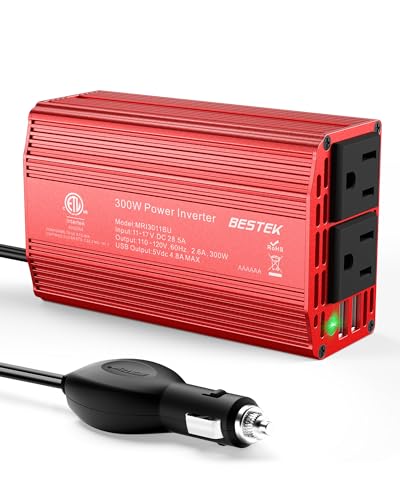
BESTEK 300W Power Inverter
Best for: Commuters and road trippers who want one compact unit that stays in the car.
The BESTEK 300W Power Inverter is the long-running default for car use, and the listing explains why: an 11 to 17 volt input range that covers ordinary 12V sockets and the higher-voltage accessory circuits in newer vehicles, plus an aluminum housing instead of thin plastic. Two AC outlets and a 4.8A USB pair cover the standard road load of a laptop, two phones and a camera charger. A 32-inch cord lets it reach from a front console socket to the back seat, which cheaper stubby units cannot do.
BESTEK 300W Pure Sine Wave Inverter
BESTEK 300W Pure Sine Wave Inverter
Best for: CPAP users and anyone running sensitive electronics from a vehicle.
Choose the BESTEK 300W Pure Sine Wave Inverter when the load itself is the reason for buying. Its pure sine wave output is the shape of power that CPAP machines, audio equipment and motor-driven devices are built for, at the same 300W continuous figure as the standard BESTEK above. The box contents widen its range: a cigarette lighter cable for everyday charging and a pair of battery clamp cables for heavier work at a campsite. Two spare fuses are included, and they are replaceable from the back of the unit.
Renogy 1000W Pure Sine Wave Inverter P2
Renogy 1000W Pure Sine Wave Inverter P2
Best for: RV, van and off-grid setups that run real appliances from a house battery.
RV, van and off-grid setups that run real appliances from a house battery.
Watch out for
It needs a proper battery installation and a battery with enough capacity; it is not a plug-in car accessory, and a single car starting battery will not feed it for long.
The Renogy 1000W Pure Sine Wave Inverter is a different class of machine: a battery-connected unit for RVs, vans, boats and home backup rather than a socket accessory. Its 1000W continuous pure sine output runs the loads the smaller units cannot, from a small fridge to power tool chargers, and the wired remote controller lets you switch it from inside the cabin while the inverter sits near the battery. Renogy includes a 3-foot 4 AWG cable set, which matters because undersized leads are the most common cause of big inverters underperforming.
Which One Fits Your Situation
A laptop and phones on a long drive
For the classic road-trip load, either plug-in BESTEK 300W unit is the right size: two AC outlets take a laptop brick and a camera charger while the USB pair handles phones. Pick the pure sine version if anything with a motor or a medical label rides along. The FOVAL 200W covers the same job when the passenger count is high and USB ports matter more than raw wattage.
A CPAP machine at a campsite
Waveform decides this one. Take the BESTEK 300W Pure Sine Wave Inverter and run it from the battery clamps rather than the socket, so the machine gets its full supply without troubling the socket fuse. Check your machine’s power brick for its watt draw, and turn the heated humidifier off if the total creeps toward the 300W ceiling.
Real appliances in an RV or during an outage
Once the load list includes a fridge, a television or tool chargers, skip the socket units entirely. The Renogy 1000W is the only pick here built for that work, wired to a house battery with the heavy cables in the box. Size the battery to the job as carefully as the inverter: 1000 watts drawn for an hour is a serious amount of stored energy.
A newer vehicle with a higher-voltage socket
Some newer vehicles, including many EVs, run their accessory circuits above the traditional 12 volts. The standard BESTEK 300W accepts an 11 to 17 volt input, the widest range in this roundup, so it keeps working where a strict 12V unit would shut down or refuse to start. Check your vehicle manual for the socket voltage before ordering any plug-in inverter.
Common Mistakes
Sizing by the peak number on the box instead of the continuous wattage your loads actually draw.
Plugging a 300W inverter into a fused accessory socket and expecting the full 300 watts.
Running a CPAP machine, audio gear or a variable-speed tool on a modified sine wave unit.
Leaving the inverter switched on with the engine off until the vehicle battery is flat.
Wiring a large inverter with thin cables, then blaming the unit for low output and shutdowns.
Frequently Asked Questions
Can a 12V to 110V converter run a microwave or kettle?
No plug-in car inverter can. A small microwave draws 600 to 1000 watts and a kettle more, which is several times what a socket-fed unit supplies and beyond most of them entirely. The Renogy 1000W sits at the bottom edge of microwave territory on a proper battery connection, but a kettle or heater belongs on household power, not on a vehicle battery.
Will an inverter drain my car battery?
It can, given time. An inverter draws current whenever it is switched on, even with nothing plugged in, and a running load flattens a starting battery far faster than most people expect. Run heavier loads with the engine on, switch the unit off when you park, and look for a low-voltage cut-off that shuts the inverter down before the battery is too weak to start the car.
Do I need pure sine wave for a laptop?
Usually not. Laptop power bricks are tolerant loads and run happily on the modified sine wave output of the standard BESTEK and FOVAL units here. Pure sine wave earns its place with medical devices, motors, compressors, audio equipment and anything whose manual names it. If your load list is chargers and lights, the simpler waveform is fine and costs less to buy.
Why does my inverter keep shutting down?
Shutdowns are usually the protection circuits doing their job. The combined load may exceed the continuous figure, the socket fuse may be limiting a plug-in unit well below its label, or the battery voltage may sag under load until the low-voltage cut-off trips. Add up the load again, move heavy work to a battery connection, and check that cables and plugs are tight and undamaged.
K
Kissmyaster Editorial Team
We compare specs, materials and verified owner reviews before a product earns a spot. Rankings are never paid.
Affiliate disclosure. As an Amazon Associate we earn from qualifying purchases at no extra cost to you. Prices accurate as of the date shown.
OWB holsters ride outside the waistband on a belt. Learn how they are built, how they differ from IWB, main styles, and what to check before choosing one.
Four IWB holsters whose listings name the Kimber K6s, in steerhide, crazy horse leather and clipless synthetics, with fit notes for each barrel length.


 Renogy 1000W Pure Sine Wave Inverter P2