Key takeaways
- Compare the best video doorbell options for front door security, covering battery and wired power, video quality, storage, and smart home fit.
A video doorbell turns an ordinary front door into a watched, recorded entry point, letting household members see visitors, speak to couriers, and check on packages from a phone anywhere. For front door security, the right model depends less on headline resolution and more on power options, field of view, how recordings are stored, and which smart home platform the household already uses.
This guide compares five leading choices across those practical lines. Ring and Blink suit Alexa-centered homes, Google Nest Doorbell fits Google Home households, Arlo offers a wide view and broad platform support, and Eufy stands out for local storage without a required plan.
As an Amazon Associate, we earn from qualifying purchases.
Quick answer
For most homes, the Ring Battery Doorbell is the simplest video doorbell to own, with easy setup and a mature app. Google Nest Doorbell suits Google Home households, Blink keeps costs and battery demands low, Arlo gives the widest view, and Eufy Video Doorbell E340 is the pick for dual-camera package coverage with local storage and no required subscription.
Ring Battery Doorbell

The Ring Battery Doorbell, in its current generation, is the default recommendation for households that want a proven video doorbell with minimal fuss. It records head-to-toe video, so the frame covers a standing visitor and packages left at the step, and it adds live view, two-way talk, and motion detection with phone alerts. The built-in rechargeable battery charges over USB-C and removes the need for existing doorbell wiring, while an optional hardwired connection can keep it topped up.
Ring ownership centers on the Ring app and Alexa integration, which makes it natural for Echo households that want doorbell announcements and live views on smart displays. Recorded video history and richer alert features sit behind a Ring subscription plan, so buyers should factor that ongoing cost into the decision rather than judging on hardware alone. Without a plan, live viewing and real-time alerts still work, but past events are not saved for review.
Installation is friendly for renters and for doors without wiring, since the unit mounts with basic tools and can move when the household moves. Battery life varies with motion activity, weather, and settings, so busy streets may mean more frequent charging. For a straightforward, widely supported front door upgrade, this remains the benchmark against which the rest of this list is measured.
Blink Video Doorbell

The Blink Video Doorbell, in its newest generation system form with the Sync Module Core included, is the efficiency pick in this group. It offers a head-to-toe HD view, two-way talk, and motion alerts, and Blink rates battery life at up to two years from its included lithium batteries under default settings. That long interval between battery changes is a genuine quality-of-life advantage for doors where removing and servicing the unit is awkward.
Blink keeps its hardware and plans simple, and the doorbell can also connect to existing doorbell wiring. Video recording for later review requires a Blink subscription plan on the system configuration covered here, because the included Sync Module Core does not store clips locally the way an older Sync Module with a USB drive could. Buyers who want local recording should confirm which module a given bundle contains before ordering, since Blink sells several configurations.
The Blink app and Alexa support cover the essentials well, though the experience is more basic than the Ring or Nest ecosystems. For households that mainly want reliable motion alerts, a clear live view, and a doorbell that rarely asks for attention, that simplicity is a strength.
Arlo Essential Video Doorbell

The Arlo Essential Video Doorbell, in its wire-free form, distinguishes itself with a wide 180-degree viewing angle and a square, head-to-toe picture that shows more of the porch than narrower rivals. That broad view helps on wide entries, corner placements, and doors close to a driveway, where a visitor or a delivery may not stand neatly centered. The unit connects directly to Wi-Fi with no hub required and can run wire-free on its rechargeable battery or connect to existing wiring.
Arlo supports Alexa, Google Assistant, and SmartThings, giving it broader platform flexibility than single-ecosystem rivals, and recorded video and advanced object detection are handled through an Arlo Secure plan. Buyers should review what the plan includes at the time of purchase, since detection categories and history length are plan features rather than hardware features. A built-in siren that can be triggered from the app adds an active deterrent the other battery models here handle differently.
The trade-offs are a larger body and battery life that depends heavily on how much activity the wide lens captures. Placement and activity zones matter: aimed at a busy street, it will record often and need charging sooner. Tuned carefully, it rewards owners with one of the most complete views of the front step available in a battery doorbell.
Google Nest Doorbell (Battery)

The Google Nest Doorbell (Battery) is the natural video doorbell for Google Home households. It runs on a built-in rechargeable battery or on existing doorbell wires, records HDR video in a tall format shaped for people and packages, and uses on-device intelligence to distinguish people, packages, animals, and vehicles, with those familiar-face and history features extended by an optional Nest Aware plan. A short window of recent event history is included without a plan, which softens the subscription dependence compared with some rivals.
Setup and daily use run through the Google Home app, and the doorbell pairs smoothly with Google Assistant displays for visitor announcements and live views. Households invested in Google services will find the activity timeline and alert categories clear and well organized. Buyers should note that this battery model does not provide continuous around-the-clock recording even when wired and subscribed; it records events, which suits most front doors but not every monitoring goal.
Design is a quiet strength, with a clean look that suits modern entries, and the battery design means almost any door can host it. Cold weather and heavy traffic shorten the interval between charges, as with every battery rival here. For Google-centered homes that value smart, specific alerts over raw recording volume, it is the most coherent choice in this guide.
Eufy Video Doorbell E340
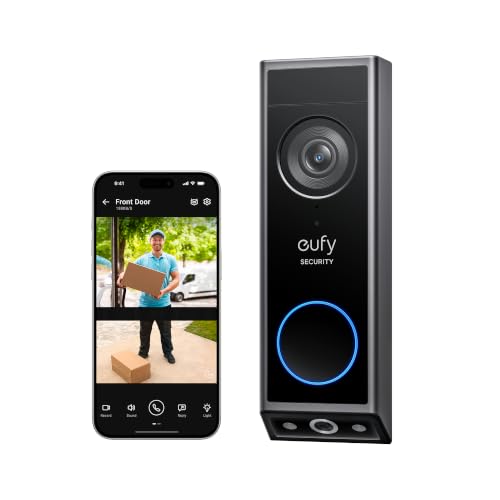
The Eufy Video Doorbell E340 solves the package problem with hardware rather than software: it carries two cameras, one facing forward for visitors and one angled down at the doorstep, so deliveries stay in view where single-lens models cut them off. It records in 2K, adds color night vision, two-way talk, and detection for people, packages, and motion, and it runs on a removable rechargeable battery or on existing doorbell wiring.
Storage is the second headline. The E340 keeps recordings on built-in local storage with no monthly fee required for core use, which appeals to buyers who reject subscriptions on principle or on budget. It can also work with Eufy HomeBase units for expanded storage, and it supports Alexa and Google Assistant for announcements and displays. Buyers should confirm chime options for their setup, since indoor chime arrangements vary by bundle and by whether existing wiring is used.
The dual-camera body is larger than single-lens rivals, and local storage, while fee-free, is finite and overwrites older clips as it fills. Households that need very long video histories may still prefer a cloud plan model. For delivery-heavy homes that want complete step coverage and no required plan, the E340 is the most distinctive pick in this guide.
How to choose
Start with power. If the door has working doorbell wiring, a wired or wire-optional model avoids charging chores; if not, every pick here can run on battery, but placement should allow easy removal for charging. Check the transformer rating when wiring an older home, because undersized transformers are a common cause of unreliable doorbells.
Next, decide how recordings should be stored. Ring, Blink, Arlo, and Nest tie recorded history mainly to subscription plans, while Eufy records locally without a required fee. Neither route is wrong, but the choice should be deliberate, since it shapes ongoing cost and how long footage remains available. Then match the ecosystem: Alexa homes lean Ring or Blink, Google homes lean Nest, mixed-platform homes lean Arlo or Eufy.
Finally, judge the view against the actual entry. Tall head-to-toe framing suits package monitoring, Arlo wider angle suits broad porches, and Eufy downward camera suits delivery-heavy doors. Confirm Wi-Fi strength at the door before buying any model, because a weak signal undermines live view and alerts on even the best hardware, and consider a mesh node or extender if the entry sits far from the router.
Who should skip
Renters whose leases forbid drilling or wiring changes should skip hardwired plans and choose a battery model with an approved mount, or skip a doorbell entirely if the lease bars cameras. Households without reliable Wi-Fi at the front door should also pass for now, because every model here depends on that connection for alerts and live view, and no camera fixes a dead zone on its own.
Buyers who require continuous recording should skip this entire battery-focused list and shop wired models built for that duty, since none of these picks records around the clock. Shoppers who refuse any app account or cloud sign-up should likewise look elsewhere, because setup for all five runs through a maker account. A simple wireless chime bell, with no camera, may serve those households better.
FAQ
Does a video doorbell work without a subscription?
Live view, doorbell rings, and motion alerts generally work without a plan on the models in this guide. What changes is recorded history: Ring, Blink, Arlo, and Nest reserve most saved video for plan members, while the Eufy E340 records to local storage with no required fee. Check the exact plan terms before buying.
How long do doorbell batteries usually last?
Battery life depends on motion volume, temperature, signal strength, and recording settings, so makers quote ranges rather than promises. Blink rates its doorbell at up to two years under default settings, while busier doors with Ring, Arlo, Nest, or Eufy units should expect charging several times a year. Wiring the doorbell, where possible, removes the chore.
Can a video doorbell use an existing indoor chime?
Many wired installations can ring an existing mechanical chime, but compatibility varies by model and transformer, and battery-only installs usually rely on phone alerts or a plug-in chime accessory. Eufy and Ring both sell chime options, and Alexa or Google displays can announce visitors. Confirm chime support for the exact model and wiring before ordering.
Where should a video doorbell be mounted?
Mount the doorbell at about chest height beside the door, angled to cover the step and the approach rather than the street. Use the wedge mounts many makers include to correct side angles on corner entries. Test the live view in the app before final tightening, and set activity zones to reduce alerts from passing traffic.
Final verdict
There is no single best video doorbell here, only a best match for a given door and household. Choose Ring for the easiest all-round ownership, Blink for long battery intervals and simplicity, Arlo for the widest view and flexible platforms, Nest for Google Home intelligence, and Eufy E340 for dual-camera package coverage without a required plan. Confirm power, storage, and Wi-Fi at the door first, and any of these five will strengthen front door security.