Key takeaways
- Learn how to choose a water softener for hard water, size grain capacity, compare salt based and salt free systems, and protect pipes and appliances.
Hard water leaves white scale on faucets, spots on dishes, and a chalky film inside kettles, water heaters, and washing machines. Over time that buildup can narrow pipes, reduce appliance efficiency, and make soap and detergent harder to rinse away. A correctly sized water softener addresses the cause by removing calcium and magnesium at the point where water enters the home, rather than treating one faucet at a time.
Choosing a system starts with a water test, a realistic count of bathrooms and occupants, and a clear decision about salt based softening versus salt free conditioning. The five systems below cover the main approaches sold for residential use, from a metered ion exchange softener for a typical family home to a dual tank design for continuous supply and an electronic descaler for homes that cannot use salt.
As an Amazon Associate, we earn from qualifying purchases.
Quick answer
Start by testing hardness in grains per gallon, then multiply daily household use by hardness to estimate the grain capacity needed between regenerations. For most three and four bathroom homes, a metered salt based softener in the mid capacity range is the balanced choice. Choose a dual tank system for nonstop demand, and consider a salt free descaler only where scale prevention matters more than true softening.
Aquasure Harmony Series 48,000 Grain Water Softener

The Aquasure Harmony Series 48,000 grain model is a salt based ion exchange softener built around a digital metered control head. Metered regeneration means the system tracks water use and regenerates when the resin approaches exhaustion, rather than running on a fixed timer. That approach saves salt and water compared with older time clock designs, especially in homes where weekday and weekend use differ.
Aquasure positions this size for homes with three to four bathrooms, which matches the capacity class. The listing describes a separate resin tank and brine tank, a bypass valve, and a prefilled resin bed, so the main installation work is connecting the unit to the main line, a drain, and a nearby power outlet. A sediment prefilter in some bundle configurations helps protect the resin from sand and rust particles on well water, although a dedicated iron filter is still the better answer when iron is high.
For buyers comparing cabinet and two tank designs, the Harmony layout keeps the brine tank accessible for salt loading and cleaning. The digital head allows settings for hardness, regeneration time, and salt dose, giving owners control without needing a service visit for routine adjustments.
AFWFilters Fleck 5600SXT 48,000 Grain Water Softener
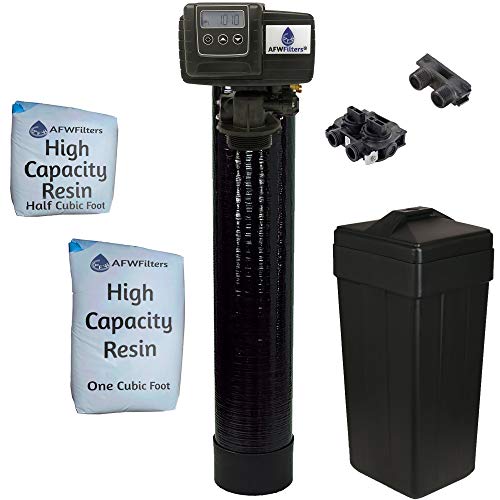
The AFWFilters system built on the Fleck 5600SXT valve is the traditional choice for owners who value a proven control valve and ready access to replacement parts. The 5600SXT is a digital metered valve from Pentair Fleck, a name long used in residential and light commercial softening. AFWFilters pairs it with a 48,000 grain resin tank and, in the premium listing, upgraded crosslink resin intended for longer life in chlorinated city water.
Metered demand operation, a backlit display, and programmable regeneration cycles are central to this design. The valve stores settings during a power outage and allows adjustments to salt dose and cycle times, which matters when hardness changes seasonally or when a home adds occupants. The separate brine tank includes a safety float, and the bypass and yoke connections are sized for standard residential plumbing.
This system suits owners comfortable with a more component based purchase, where the valve, tank, and resin specification matter as much as the brand on the carton. Because the Fleck platform is so widely installed, local plumbers commonly recognize the valve and stock seals, pistons, and injectors.
GE Smart Water Softener 45,000 Grain GXSH45W
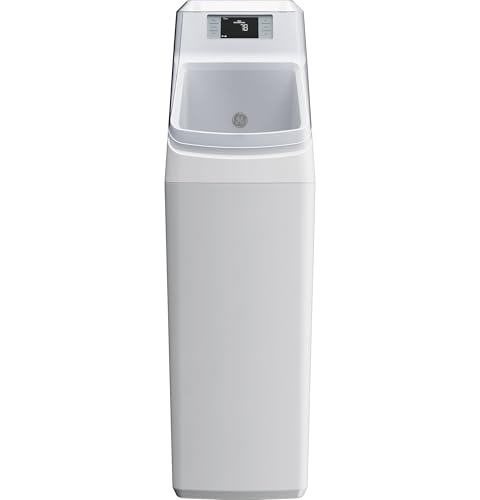
The GE Smart Water Softener in the 45,000 grain class takes a cabinet approach, housing the resin and salt storage in a single compact unit with electronic controls on top. Cabinet models appeal where floor space is tight, such as a utility closet, a garage corner, or a basement with limited clearance beside the water heater. The smart designation reflects electronic monitoring features described for the line, including alerts linked to salt level and water use patterns.
Capacity in this range fits many homes with two to four bathrooms, depending on hardness and the number of occupants. GE describes demand based regeneration for its smart softener line, so the unit learns household patterns and schedules regeneration to match use rather than running every night. A built in sediment filter function is also part of the GE cabinet concept, helping reduce sediment reaching the resin, though cartridge or housing changes still form part of routine care.
Buyers who prefer a recognized appliance brand and a single footprint will find this format approachable. Installation still requires a main line connection, drain access, and power, and the cabinet must be level and accessible for salt refills.
iSpring ED2000 Whole House Water Descaler

The iSpring ED2000 is different from the salt based softeners in this guide, and the listing states that distinction plainly. It is an electronic descaler and conditioner, not an ion exchange softener. Two antenna cables wrap around the incoming pipe and the unit applies a frequency modulated signal intended to change how scale forming crystals behave, so deposits are less likely to stick to pipes and heating elements. It does not remove calcium and magnesium from the water, and a hardness test after installation will still show hard water.
That trade off brings clear benefits for the right home. There is no salt to buy, no brine discharge, no drain connection, and no plumbing cut for most installations, because the coils wrap around copper, PEX, or PVC pipe and the control box plugs into a standard outlet. Renters with landlord permission, homes on septic systems where brine discharge is a concern, and owners in areas with softener discharge restrictions often look at this category first.
Expectations need to stay aligned with the technology. The ED2000 will not deliver the slippery feel, spot free rinse, or soap savings associated with true softening. For a household whose main complaint is limescale crust on a water heater element and shower head, the low maintenance format can be a sensible alternative.
Pentair Fleck 9100SXT Dual Tank 64,000 Grain Water Softener

The Pentair Fleck 9100SXT system uses two resin tanks in an alternating twin configuration, so one tank can supply soft water while the other regenerates or stands ready. That design removes the brief window in a single tank system when regeneration is running and soft water output is limited or bypassed. For large households, homes with guests, multi unit residences, and light commercial settings with round the clock demand, continuous supply is the main reason to choose a twin tank model.
The listed capacity is 64,000 grains, and the 9100SXT digital metered control manages switching between tanks based on measured use. Aplus Water, a Pentair Fleck dealer on the listing, supplies the complete package with resin tanks, control valve, brine tank with safety float, and bypass. The footprint and plumbing work are larger than a cabinet softener, so measuring the installation space and confirming drain and power access in advance is essential.
Running costs follow the same salt based logic as other ion exchange systems, with each tank regenerating only when its capacity is used. Owners should plan for more upfront complexity and more connections to check for leaks. In return, the home avoids hard water breakthrough during regeneration and gains headroom for peak mornings and laundry days.
How to choose
Start with a measured hardness number, not a guess from scale on a kettle. Test strips give a rough range, while a titration kit or a municipal water report gives a firmer grains per gallon figure to size against. Add a separate allowance when clear water iron is present, because iron consumes softener capacity, and confirm whether the home uses city water or well water before selecting resin type.
Next, estimate daily demand. A common sizing method multiplies the number of people by average daily gallons per person, then multiplies that total by hardness to find grains to remove each day. Choose a system that can run several days between regenerations at an efficient salt dose, rather than the smallest unit that meets the math on paper.
Then decide on softening method. Salt based ion exchange is the only approach in this guide that actually removes hardness minerals and changes a hardness test result. Salt free conditioning and electronic descaling aim to reduce scale adhesion without removing minerals. Local rules on brine discharge, septic capacity, and drain access can settle this choice early.
Finally, check installation realities. Measure doorways and the planned location, confirm pipe size, locate a drain within reach, and ensure a grounded outlet is nearby. Include bypass access so the system can be serviced without shutting off water to the whole house for an extended period.
Who should skip
Homeowners with already soft municipal water should skip a softener entirely, because adding ion exchange where hardness is low brings cost and maintenance without a clear benefit.
Renters without written permission to alter plumbing should skip a plumbed in softener and look only at non invasive options that a landlord approves, or at point of use treatments for a single shower or faucet. Likewise, households unwilling to lift salt bags, clean a brine tank, or monitor a control head should avoid a conventional salt based system and consider whether scale prevention alone meets the actual complaint.
Homes with high iron, manganese, sulfur odor, or sediment loads should not rely on a standard softener alone. Those conditions call for dedicated filtration ahead of the softener, and in some cases a water test from a laboratory and a dealer designed treatment train. Buying a softener first and hoping it will handle every well water issue often leads to fouled resin and disappointment.
FAQ
Does a water softener remove iron from well water?
A standard softener can handle low levels of clear water iron as a secondary benefit, but higher iron levels foul resin and need a dedicated iron filter installed ahead of the softener for reliable results.
How often does a salt based softener regenerate?
Regeneration frequency depends on hardness, household water use, capacity, and salt dose settings. A correctly sized metered system typically regenerates every few days, triggered by measured use rather than a fixed daily schedule.
Will soft water change the taste of drinking water?
Softening replaces calcium and magnesium with a small amount of sodium or potassium, which can slightly change taste. Many households keep a separate unsoftened cold line or a reverse osmosis tap for drinking water preference.
Can a softener be installed outdoors?
Outdoor installation depends on climate and the manufacturer instructions for the specific model. Valves, electronics, and brine tanks need protection from freezing, direct sun, and standing water, so an indoor or sheltered location is usually preferred.
Final verdict
For most hard water homes, a metered salt based softener sized from a real hardness test is the dependable path, with the Aquasure Harmony and the Fleck 5600SXT systems representing the mainstream two tank approach. The GE cabinet model suits tighter spaces, the Pentair Fleck twin tank serves homes that cannot pause for regeneration, and the iSpring ED2000 offers a no salt scale prevention route. Match capacity to measured demand, and the chosen system should deliver softer water with predictable upkeep.