Key takeaways
- Compare the best fire extinguisher options for home, kitchen and garage use, with ABC ratings, rechargeable picks and placement guidance for every room.
A fire extinguisher only helps if it matches the fire in front of you, sits within easy reach, and is large enough to finish the job. Homes face a mix of risks: wood, paper and fabric in living areas, cooking oil and appliances in the kitchen, and fuel, solvents and power tools in the garage. This guide compares five proven models, explains what the class letters and rating numbers mean, and shows how to place and maintain each type.
As an Amazon Associate, we earn from qualifying purchases.
Quick answer
For most houses, start with a rechargeable ABC fire extinguisher rated at least 1-A:10-B:C on each floor, then add a higher-rated 5 lb ABC unit for the garage. The First Alert HOME1 suits general rooms, the Amerex B500 and Kidde Pro 210 suit garages and workshops, the Kidde FA110 suits smaller spaces, and the compact Amerex B417 suits secondary locations.
First Alert HOME1 Standard Home Fire Extinguisher
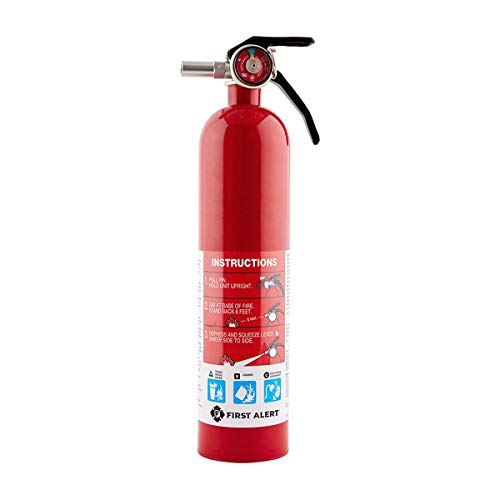
The First Alert HOME1 is the straightforward starting point for general household protection. It is UL rated 1-A:10-B:C, which means it is listed for ordinary combustibles such as wood, paper and fabric, for flammable liquids, and for energized electrical equipment. That ABC coverage matches the most common mix of small fires in bedrooms, living rooms, hallways and laundry areas.
Construction is a step above basic disposable units. The HOME1 uses all-metal construction with a commercial-grade metal valve and trigger, a pressure gauge for at-a-glance readiness checks, and a mounting bracket for wall placement near an exit path. It is rechargeable by a certified professional after any discharge, so a brief use to stop a small fire does not automatically mean replacing the whole unit.
Size is the main trade-off. The 1-A rating gives less Class A capacity than the larger 5 lb models in this guide. In practice, the HOME1 is a sound primary extinguisher for apartments and for individual floors of a house, while garages and workshops benefit from pairing it with a larger ABC model nearby. Place it where it can be grabbed on the way out of a room, not deep beside the stove or furnace where flames could block access.
Amerex B500 ABC Dry Chemical Fire Extinguisher
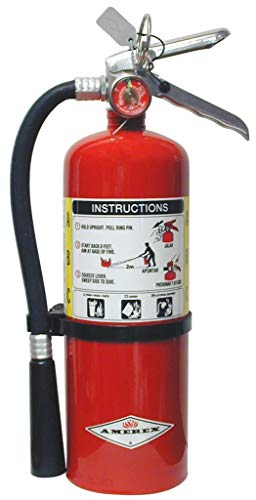
The Amerex B500 is a 5 lb ABC dry chemical extinguisher built around a drawn steel cylinder and an all-metal valve assembly. It is rated 2-A:10-B:C and uses monoammonium phosphate, the standard multipurpose agent that coats Class A materials, smothers Class B liquid fires and remains non-conductive on Class C electrical fires. Discharge time is listed at about 14 seconds, with an effective range of roughly 12 to 18 feet, giving the operator useful standoff distance in a garage or workshop.
This is the natural garage pick in the group. Garages combine cardboard, timber and fabrics with gasoline, oil, paint and solvents, plus chargers, power tools and vehicle electrics. A 5 lb rechargeable steel unit handles that mix better than a compact hallway model, and professional servicing keeps it in use for years. Mounting matters here: an extinguisher stored behind paint cans loses the seconds it was bought to save, so use the wall bracket near a door. Note the weight, though: every adult in the household should be able to lift, pull the pin and sweep a full 5 lb unit comfortably before it becomes the main garage extinguisher.
Kidde FA110 Multi-Purpose Fire Extinguisher

The Kidde FA110, sold as the FA110G, is a compact multipurpose extinguisher rated 1-A:10-B:C. It uses dry chemical agent suitable for trash, wood and paper fires, flammable liquid fires and electrical equipment fires, covering the same three classes as the HOME1 in a widely available, easy-to-store format. A pressure gauge, a metal pull pin with a safety seal and clear operating instructions on the label keep routine checks simple.
The FA110 fits best where space is tight or where a second extinguisher is needed to shorten travel distance: a home office, a dorm room, a small apartment, a utility room or an upper-floor landing. In larger houses, travel distance is often the hidden problem. An extinguisher that is technically adequate but sits two rooms and a staircase away is less useful than a slightly smaller unit mounted in the room where a fire is most likely to start.
Like the HOME1, the FA110 is a light-duty primary unit rather than a garage workhorse. Its rating suits incipient-stage fires that have just started and have not spread beyond the first item involved. Any fire that has reached curtains, cabinets or a ceiling is beyond extinguisher range: leave, close doors behind you and call emergency services from outside.
Amerex B417 ABC Dry Chemical Fire Extinguisher
The Amerex B417 is the compact member of the Amerex ABC line, holding 2.5 lb of dry chemical and rated 1-A:10-B:C. It shares the family traits that matter for long service: a steel cylinder, an anodized aluminum valve, a pressure gauge and a wall bracket, in a size that mounts easily in a hallway, a pantry, an RV or a vehicle. Discharge time is about 10 seconds, with a range of roughly 9 to 15 feet.
That smaller capacity defines its role. The B417 is a secondary extinguisher, placed to cut response time in a specific spot rather than to serve as the only protection for a whole floor. Good placements include near a garage side door, beside a workshop bench, in a utility room, or on an upper floor where the main extinguisher is downstairs. Its light weight also helps users who find a 5 lb unit hard to aim steadily, because an extinguisher that can be controlled with a proper sweeping motion at the base of a fire outperforms a larger one that cannot be held on target.
Because the agent supply is limited, technique matters even more with the B417. Aim at the base of the flames, squeeze steadily and sweep side to side, and stop and evacuate if the fire is not clearly shrinking within the first seconds. After any use, even a short burst, the unit needs professional recharge or replacement.
Kidde Pro 210 Rechargeable Fire Extinguisher
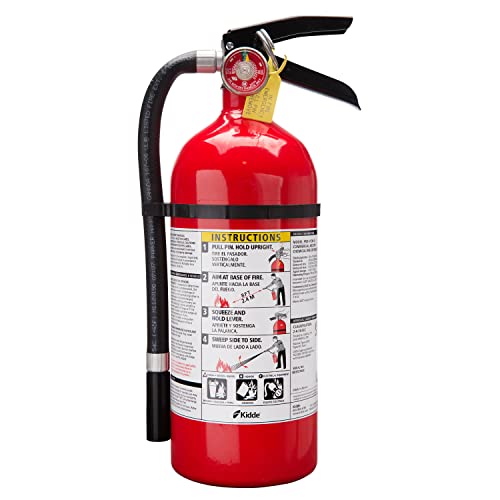
The Kidde Pro 210 steps up to a 2-A:10-B:C rating with 4 lb of monoammonium phosphate agent, giving it double the Class A rating of the 1-A models in this guide. It is rechargeable, fitted with a pressure gauge that shows readiness at a glance, and supplied with a mounting bracket. The valve and handle construction is metal, aimed at repeated professional servicing rather than single-use disposal.
That combination makes the Pro 210 a strong single purchase for a main floor or a garage that does not quite need a full 5 lb unit. The higher A rating helps with the ordinary combustibles that dominate house fires, including furniture, stored boxes, timber and fabrics, while the ABC agent still covers flammable liquids and electrical equipment. For a two-storey home, a Pro 210 on the ground floor paired with a HOME1 or FA110 upstairs keeps a rated unit within a short walk of every room. Mount it near an exit, check the gauge monthly, and arrange professional service as marked on the cylinder.
How to choose
Start with fire classes. Class A covers ordinary combustibles such as wood, paper, cloth and many plastics. Class B covers flammable liquids and gases, including gasoline, oil, paint and cooking oils in a pan. Class C covers energized electrical equipment, and Class K covers commercial cooking media, a specialist category beyond most home kitchens. For general home use, an ABC extinguisher covers the three classes a household is most likely to face, which is why every model in this guide is an ABC unit.
Next, read the rating numbers. In a rating such as 2-A:10-B:C, the number before A indicates relative Class A capacity, the number before B indicates the approximate area of a flammable-liquid fire the unit can handle in trained hands, and C carries no number because it simply confirms the agent is non-conductive. Higher numbers mean more capacity, but also usually a larger and heavier cylinder. Match the rating to the room: 1-A:10-B:C is a reasonable floor minimum for living areas, while garages and workshops justify 2-A or higher in a size the household can handle.
Then decide on rechargeable versus single-use. Rechargeable metal-valve models such as the HOME1, B500, B417 and Pro 210 can be refilled after use and inspected professionally. Single-use models are simpler, but any discharge, however brief, means replacement. Either way, check the pressure gauge monthly and keep access unobstructed. Plan placement before buying: one extinguisher per floor, one for the garage, and a unit near but not inside the highest-risk spot in the kitchen.
Who should skip
Skip an extinguisher purchase as a substitute for working smoke alarms and an escape plan; detection and evacuation come first, and an extinguisher is only for a small fire in its earliest stage with a clear exit behind you. Skip the largest 5 lb models if the main users cannot lift and sweep them confidently, and skip compact 2.5 lb units as the sole protection for a garage or workshop. Anyone running a commercial kitchen, a rental property with code requirements or a business premises should skip consumer picks and follow the local fire code and insurer rules. If a fire involves a large volume of cooking oil or has spread beyond the appliance where it started, skip extinguisher use altogether and evacuate.
FAQ
How many fire extinguishers does a home need?
A practical minimum is one ABC extinguisher on each floor, plus one in the garage. Larger homes benefit from an additional compact unit on upper floors and near the main cooking area, mounted on the exit side of the room so it can be reached without passing the fire.
Where should a kitchen fire extinguisher be placed?
Place it near a kitchen exit, reachable without leaning over the stove or crossing in front of a burning pan. A wall bracket in an adjacent hallway or near the door works well. Never store it directly above or beside the cooktop, where flames and heat can block access.
How often should a fire extinguisher be checked or replaced?
Check the pressure gauge and access monthly, confirm the pin and safety seal are intact, and look for corrosion or damage. Rechargeable units need professional service after any discharge and periodic inspection as marked on the cylinder. Single-use units should be replaced after any use and by the expiry guidance on the label.
Can an ABC extinguisher be used on a grease fire?
An ABC dry chemical extinguisher is listed for Class B flammable-liquid fires and can be used on a small pan fire in its earliest stage, aiming at the base with the exit behind you. Never use water on burning oil. If the fire is spreading or produces heavy smoke, leave immediately instead.
Final verdict
For a balanced home setup, the First Alert HOME1 covers general rooms with rechargeable, all-metal construction, while the Kidde Pro 210 adds a higher Class A rating for a main floor or mid-size garage. The Amerex B500 is the garage choice where a full 5 lb steel ABC unit is justified, the Kidde FA110 fills smaller spaces and second-unit roles, and the Amerex B417 provides a light secondary extinguisher for hallways, vehicles and upper floors.