Key takeaways
- Find the best heavy duty extension cord for workshops and yards, with guidance on gauge, length, jacket ratings, lighted ends and retractable reels.
A heavy duty extension cord fails in predictable ways: a table saw bogs down at the far end of a long, thin cord, a jacket stiffens and cracks in winter, or a plug pulls apart after being dragged across a driveway. The fix is not a thicker-looking cable, it is the right combination of wire gauge, length, jacket rating, and plug construction for the tool and the distance involved. Workshops punish cords with oil, abrasion, and repeated coiling, while yards add sunlight, moisture, and long runs to mowers, blowers, and pressure washers. This guide covers five proven options for those jobs, including a retractable reel, and explains how to size a cord so the tool at its end receives the voltage it was designed for.
As an Amazon Associate, we earn from qualifying purchases.
Quick answer
For most workshops and yards, choose a fifty-foot, twelve-gauge, three-conductor cord with an SJTW jacket and a lighted end, and step up to ten-gauge for very long runs or demanding tools. Keep the cord as short as the job allows, fully uncoil it under load, and mount a retractable reel when power is always needed in one place.
US Wire and Cable 74050 Outdoor Extension Cord
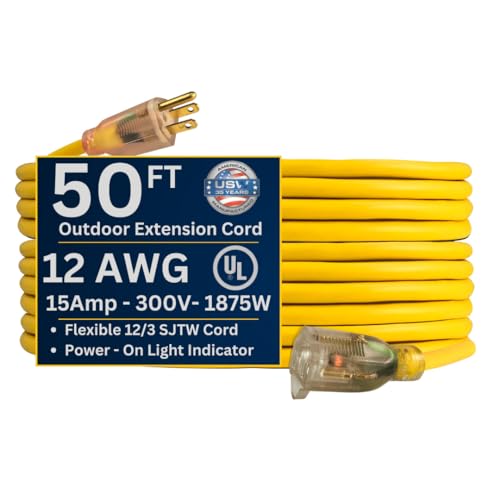
The US Wire and Cable 74050 is a fifty-foot, twelve-gauge, three-conductor outdoor cord rated at fifteen amps and 1,875 watts, and it has been a reference point in this category for years. Its SJTW vinyl jacket stays flexible and resists cracking in cold weather, with a low-temperature rating well below freezing, which matters for a cord that lives in an unheated garage. The bright yellow jacket is easy to see across a lawn or shop floor, reducing trip hazards and the chance of a mower crossing it unnoticed.
Both ends are molded and the female end carries a power indicator light, which saves time when a tool stops and the question is whether the cord, outlet, or tool is at fault. The cord meets OSHA requirements for jobsite use, and its weight reflects genuine twelve-gauge copper conductors rather than thinner wire in a fat jacket, a substitution buyers should watch for generally.
Fifty feet in twelve gauge is the sweet spot for a single general-purpose cord: it covers most driveways, patios, and shop layouts while holding voltage drop to a level fifteen-amp tools tolerate well. Owners who regularly work farther away should use a ten-gauge hundred-foot cord rather than joining two cords together.
Southwire 2588SW0002 Outdoor Extension Cord

The Southwire 2588SW0002 is another fifty-foot, twelve-gauge SJTW cord, with straightforward, jobsite-grade construction from one of the largest wire makers in North America. The vinyl jacket resists moisture, abrasion, and sunlight, the blades are reinforced against bending when the plug is knocked or stepped on, and the lighted female end shows when power is present. It is rated at fifteen amps, 125 volts, and 1,875 watts, matching a standard household circuit.
Southwire lists this model for indoor and outdoor use across landscaping, gardening, workshop, and appliance duty, and the visible yellow jacket suits shared workspaces where several people move around one cord. The molded ends survive rough handling better than bargain cords, though gripping the plug itself remains the better habit.
Compared with the US Wire cord above, the differences are small and come down to jacket feel, end design, and maker preference; both occupy the same twelve-gauge, fifty-foot class and either can serve as the main cord in a home shop.
Iron Forge Cable Outdoor Extension Cord, 50 Foot, 10 Gauge

The Iron Forge Cable fifty-foot cord steps up to ten-gauge conductors, the thickest wire in this guide, and that single change defines its role. Ten-gauge wire carries fifteen amps over fifty feet with noticeably less voltage drop than twelve-gauge, so motors start harder, run cooler, and are less likely to suffer the slow damage chronic undervoltage causes in compressors and table saws. For a hundred-foot run to the back of a yard, this gauge class is the correct starting point rather than an upgrade.
The cord uses an SJTW weatherproof jacket in high-visibility yellow, a three-prong grounded plug, and a lighted end. Iron Forge Cable is a veteran-owned American business, and the cord is built as a contractor-style product rather than a seasonal lighting cord, with ends sized for gloved hands. The honest trade-off is weight and stiffness: a ten-gauge fifty-foot cord is a heavy coil to carry and hang, and it never drapes as easily as a thinner cord.
Choose this cord when the work justifies it: long runs, or a fifteen-amp saw or compressor at the far end. For short runs to a drill or sander, it is more cord than the job needs, and a lighter twelve-gauge cord will be handled more and complained about less.
DEWENWILS Retractable Extension Cord Reel, 40 Foot

The DEWENWILS retractable reel takes a different approach: instead of a loose cord that gets coiled, dragged, and stored in a pile, it mounts to a wall or ceiling and pays out up to forty feet of twelve-gauge, three-conductor SJTOW cord only as far as the work requires. The housing swivels, an adjustable stopper sets how much cord stays out, and spring retraction pulls the cord back when the job is done. For a shop where power is needed in the same bay every day, that convenience changes habits: the cord is used properly because using it properly is effortless.
The SJTOW jacket deserves attention: the O means oil resistance, which suits workshop floors and automotive work where a standard vinyl jacket degrades faster. At the end of the cord is a lighted triple tap, so a tool, a light, and a charger can share one drop within the fifteen-amp total the built-in circuit breaker enforces. That breaker is a genuine safety feature on a reel, because a coiled cord under heavy load builds heat.
The limits are equally clear. Forty feet is the whole reach, the reel serves one room rather than the far yard, and it should be fully extended for sustained heavy loads so heat can dissipate. As a fixed installation, though, it solves the storage, tangling, and trip-hazard problems loose cords create.
Coleman Cable 02548 USA-Made Extension Cord by Southwire

The Coleman Cable 02548, sold under Southwire as model 2548SWUSA1, is a fifty-foot, twelve-gauge contractor-grade cord distinguished by its American-made construction and its red, white, and blue jacket. Under the colors it is a serious work cord: twelve-gauge, three-conductor wire, an SJTW water-resistant jacket that stays flexible in cold weather, a lighted end, and a fifteen-amp, 1,875-watt rating for household and jobsite tools.
Coleman Cable became part of Southwire, which is why the same cord appears under both names in listings; the two labels are one product family, not competing cords. The jacket resists abrasion, moisture, and sunlight, and the molded ends are reinforced for jobsite handling. The color scheme is practical too: a cord that does not look like every other yellow cord on a shared site is easier to track and to spot across grass, gravel, or a crowded shop floor.
This is the cord for buyers who want the standard fifty-foot, twelve-gauge specification and care about domestic manufacturing. It covers the same ground as the other twelve-gauge cords here, so the decision comes down to build details and origin rather than electrical capability.
How to choose
Gauge and length decide performance together, and gauge works in reverse: the lower the number, the thicker the wire and the more current it carries without voltage drop. Sixteen-gauge suits lights and small garden tools on short runs. Fourteen-gauge suits medium loads at moderate distances. Twelve-gauge is the correct default for fifteen-amp workshop tools at fifty feet, and ten-gauge is the choice for hundred-foot runs or the most demanding tools. When in doubt, buy thicker and shorter.
Read the jacket letters before buying. SJTW is the common heavy duty outdoor rating: hard service, thermoplastic, and weather resistant. SJTOW adds oil resistance for garage work. SJEOW and TPE jackets stay flexible in deeper cold than standard vinyl. A cord without a W in its rating is an indoor cord and should stay there.
Check the ends. Look for molded, reinforced plugs, a lighted female end, and a grounded three-prong design; never remove the ground pin to fit an older outlet. Match the cord amp rating to the tool nameplate, remembering that a household circuit tops out at fifteen amps, so a cord rated below that becomes the weak link.
Handle cords safely. Uncoil fully for heavy sustained loads, keep connections off wet ground, never run a cord through a doorway where it will be pinched, and never join two cords to fake a longer one for a big tool. Replace any cord with a cut jacket, loose plug, or heat damage.
Who should skip
Anyone working within a few feet of an outlet should skip a fifty-foot heavy duty cord; a short shop cord is lighter and safer. Owners who only hang seasonal lights or run a small trimmer should likewise skip ten and twelve-gauge cords and buy a lighter outdoor cord matched to those small loads, since wrestling an oversized cord for tiny jobs leads to it being left behind.
A retractable reel is the wrong purchase for renters who cannot mount hardware, for work that moves between sites, and for anyone whose main need is a long run across a yard. Heavy duty cords should also be skipped as a permanent substitute for wiring: a cord run under a rug or through a wall belongs on an electrician list, not in a shopping cart, and space heaters deserve a direct wall outlet.
FAQ
Is a twelve-gauge or fourteen-gauge cord better for power tools?
For fifteen-amp tools such as table saws, miter saws, and compressors, twelve-gauge is the safer default, especially at fifty feet or more, because it limits the voltage drop that makes motors run hot. Fourteen-gauge is acceptable for smaller tools and shorter runs, but a workshop buying one main cord should buy twelve-gauge.
Can two extension cords be plugged together to reach farther?
Joining cords adds resistance at the connection, creates a point where water and dirt can enter, and often pairs a heavy cord with a thinner one that becomes the bottleneck. For a long run to a demanding tool, a single cord of the correct length and thicker gauge is the safer choice.
What does SJTW mean on a cord jacket?
The letters describe the construction: hard service use, a thermoplastic jacket, and weather resistance for outdoor use. Variations add information, such as an O for oil resistance in SJTOW. The W is the key letter for anyone planning to use a cord outside.
How should a heavy duty cord be stored?
Store it loosely coiled, hung on a wide hook or reel, indoors. Tight winding and sharp kinks damage conductors and jackets over time. A mounted retractable reel handles storage automatically for cords used in one place.
Final verdict
The US Wire and Cable 74050 and the Southwire 2588SW0002 define the dependable middle of this category: fifty feet of twelve-gauge SJTW cord with lighted ends, suitable for nearly every workshop and yard task. The Iron Forge Cable ten-gauge cord is the pick when distance or a demanding motor makes voltage drop the real enemy, and the DEWENWILS reel is the best answer when work always happens in the same bay. Buy gauge for the longest, heaviest job the cord will face.