Key takeaways
- Learn how to choose a moisture meter for wood and drywall, comparing pin, pinless and combo models by range, depth, accuracy and material settings.
A moisture meter answers two different questions around a home. In wood, it tells whether lumber, flooring, or firewood is dry enough to mill, install, glue, or burn without warping, cupping, or smoking. In drywall, it helps locate damp areas after a leak or plumbing failure, and confirm that a wall has dried before paint or tile goes back on. Choosing well starts with the sensing method, because pin, pinless, and combination meters read differently, leave different marks, and suit different materials. The five models below cover each approach.
As an Amazon Associate, we earn from qualifying purchases.
Quick answer
Choose a pin meter for a specific numeric reading at a known spot in wood, a pinless meter for fast, mark-free scanning of drywall, flooring, and finished surfaces, and a combination meter when both jobs matter. Match the meter to the material settings, reading depth, and range for the work, rather than buying the widest range on the box.
General Tools MMD4E pin moisture meter
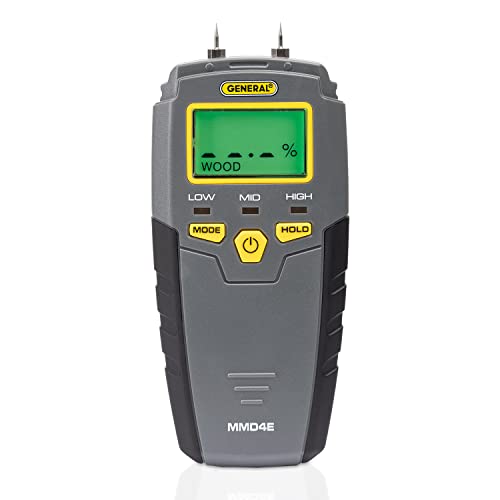
The General Tools MMD4E is a pin-type meter built for direct spot checks. Two stainless steel pins are pushed into the material, and the meter measures electrical resistance between them. Resistance falls as moisture rises, so the reading reflects the wood or building material between the pin tips. That makes the MMD4E useful when a single location matters most, such as the end grain of a board, a suspect stud bay, or a section of subfloor exposed during a repair.
The meter offers separate scales for wood and for building materials, a backlit digital display, and visual and audible alerts that sort readings into low, medium, and high bands. A protective cap covers the pins when the meter is stored in a tool bag, and the pins are replaceable in principle if they bend or dull. Because the pins only sample a small area, good technique matters: take several readings across a board, avoid knots and surface water, and push the pins to a consistent depth along the grain.
For drywall, the MMD4E can confirm a damp spot found by touch or staining, but each check leaves two small holes. That trade-off is acceptable in a garage, utility room, or area already scheduled for patching, and less welcome on a finished living room wall. For firewood and rough lumber, where marks do not matter, it is a straightforward and instructive first meter.
Klein Tools ET140 pinless moisture meter

The Klein Tools ET140 takes the opposite approach. It is pinless, using an electromagnetic sensor pad held flat against the surface to detect relative moisture up to three quarters of an inch below the surface. Nothing is punctured, so the ET140 can scan a painted drywall ceiling, a finished floor, or a masonry wall quickly and repeatedly without repair work afterward.
Klein calibrates the ET140 for four material groups: drywall, masonry, hardwood, and softwood. A reverse-contrast display shows the numeric relative reading, while a row of LED bars and an audible alert give a fast sense of whether an area is drier or wetter than its surroundings. That relative strength is the main reason to choose this meter for leak hunting. A homeowner can grid a wall, mark where readings climb, and narrow a hidden leak to a smaller area before opening anything up.
The limits follow from the method. Pinless readings on drywall and masonry are comparative rather than a laboratory value for that exact material, and metal behind the surface, foil-backed products, or very uneven contact can distort results. The ET140 is also not the tool for certifying that a specific board sits at a precise target before a glue-up. Used as a scanner and mapper, though, it is the most practical drywall-first option in this group, with drop protection suited to regular job site handling.
Proster wood moisture meter
The Proster wood moisture meter, model PST050, is a compact pin-type meter aimed at wood, firewood, paper, and floor checks. Like the MMD4E, it uses two probe pins and resistance measurement, with a digital LCD that presents the reading for the material selected. Its appeal is simplicity: a small body, a clear display, and a hold style workflow that suits quick checks around a woodpile, a lumber rack, or a room before flooring work begins.
For firewood, the correct method is to split a piece and test the freshly exposed face near the center, rather than testing bark or an end dried in the sun. For lumber, readings near the middle of a board and away from metal fasteners give a fairer picture. The Proster covers those everyday tasks without the complexity of species-corrected professional meters.
Buyers should set expectations accordingly. A basic pin meter does not offer deep scanning, dual-depth readings, or an extensive species library, and its building material use is best treated as spot confirmation rather than whole-wall mapping. As an entry point for wood-focused use, it keeps the decision simple.
Wagner Meters Orion 950 pinless meter
The Wagner Meters Orion 950 is the premium wood-focused option in this lineup. It is pinless, so it reads without damaging finished stock, and it offers dual-depth measurement, with a shallow mode for thinner material and a deeper mode that reads further into thicker boards. That matters because surface dryness can mislead: a board can feel dry on the outside while retaining more moisture inside, and a dual-depth meter helps separate those two conditions.
The Orion line is known for species settings that adjust for wood density, which is central to pinless accuracy. Selecting the correct species group improves the reading far more than scanning quickly with a generic setting. The Orion 950 adds data-oriented features for users who track readings across a project, along with on-meter calibration checking using its calibrator, a backlit display, and a rubber boot for protection. Wagner backs the Orion series with a long warranty period for a handheld meter.
This meter is aimed at wood and wood products. It is not presented as a drywall and masonry scanner in the way the Klein ET140 is, so a buyer whose main problem is tracing damp in walls should not assume the same material scales apply. For flooring installers, cabinet shops, and serious hobbyists who need repeatable wood readings without pin holes, it is the most capable choice here.
Dr.Meter MD918 inductive moisture meter
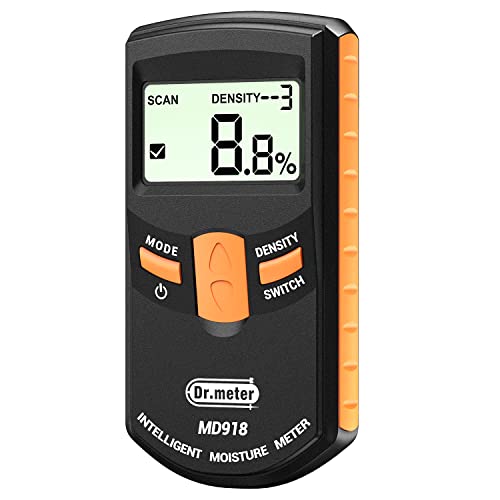
The Dr.Meter MD918 is an inductive pinless meter designed for wood. It sits flat on the surface and reads through electromagnetic sensing, so it can check finished or delicate stock without pin marks. Its distinguishing feature is a set of ten timber density grades. The user selects the grade that best matches the species being measured, and the meter adjusts its reading for that density group, which is a meaningful step up from a single generic wood setting.
The stated wood range is broad, running from low single digits up to a high level suited to green or wet timber, with fine resolution in the display. That breadth makes the MD918 useful across firewood, rough lumber, and workshop stock, provided the density grade is chosen carefully. A large LCD, data hold, and automatic shutoff support routine use, and the meter runs on common AAA batteries.
The MD918 is a wood meter first. It does not replace a drywall-calibrated pinless scanner for wall surveys, and pinless readings still depend on flat contact, adequate material thickness, and distance from metal. Thin stock backed by a bench or another material can skew a reading, so the back side of the sensor should have air or a consistent setup behind the piece. For woodworkers who want density adjustment without moving to a premium dual-depth system, it fills a clear middle role.
How to choose
Start with the sensing method. Pin meters measure at the pin tips and give a direct reading for that spot, which suits lumber acceptance checks, firewood checks on a fresh split, and confirming one damp location. They leave holes and sample a small area. Pinless meters scan a larger area without damage and are faster for walls, floors, and finished wood, but they report relative values on many building materials and need correct material or species settings on wood. Combination meters, such as pin and pinless designs from makers like Extech, try to cover both workflows in one body, at the cost of more modes to learn.
Next, match depth to the job. A pinless depth of about three quarters of an inch covers standard drywall and many flooring checks. Dual-depth meters add a shallow mode for veneer and thin stock. Pin depth is shallower and more localized, which is fine for spot confirmation.
Then check material settings. For drywall, look for a named drywall mode rather than a generic building scale. For wood, species or density settings improve accuracy more than a wider headline range. Consider display readability, audible alerts, hold functions, battery type, and whether a meter can be checked against a reference block or built-in calibration test.
Who should skip
Skip a moisture meter purchase if the problem is an active leak that is still spreading, a sagging ceiling, or visible mold across a large area. Those situations call for stopping the water source and, where needed, a remediation or building professional, not a handheld reading. Skip pin meters if the surfaces are finished and cannot be marked, and skip wood-only pinless meters if the main task is drywall surveying. Renters who cannot open walls or alter finishes may also get limited value, beyond documenting a problem for a landlord. A meter informs a decision; it does not dry a wall or fix plumbing.
FAQ
Is a pin or pinless moisture meter better for drywall?
Pinless is usually better for drywall surveys because it scans quickly and leaves no holes, which suits painted walls and ceilings. A pin meter can then confirm a specific damp spot where small holes are acceptable, such as inside a closet or an area already planned for repair.
What moisture level is acceptable for wood flooring and lumber?
Acceptable levels depend on the species, the product maker guidance, and the indoor conditions the wood will live in. Flooring should be acclimated to the room and checked against the subfloor and the maker instructions before installation. A meter helps compare boards to each other and to those instructions, rather than relying on a single universal number.
Why do two readings on the same wall differ?
Pinless meters average moisture through their sensing depth, so framing, metal, pipes, or a drier surface layer can change a result a short distance away. Pin meters read only between the pins. Technique, material setting, temperature, and surface water also affect readings, so repeat checks in a grid and look for patterns.
Can a moisture meter detect mold?
No. A meter measures moisture, not mold. It can find damp areas where mold is more likely to grow and can confirm whether drying is working, but identifying mold and deciding on cleanup requires visual inspection and, in larger cases, professional assessment.
Final verdict
For most homeowners, the Klein Tools ET140 is the easiest starting point for wall scanning, with a pin meter such as the General Tools MMD4E for spot confirmation where holes do not matter. Woodworkers should look first at the Dr.Meter MD918 for density adjustment or step up to the Wagner Orion 950 for dual-depth readings and species settings. The Proster suits simple firewood and lumber checks.