Key takeaways
- Sump pump buying guide covering horsepower, float switches, cast iron builds, battery backup and combo systems for reliable basement flood protection.
A sump pump only earns its place when it starts reliably, moves water faster than the pit fills, and keeps working through the storm that caused the problem. Choosing one is less about chasing the biggest headline flow number and more about matching horsepower, switch type, housing material, and backup protection to the pit, the lift height, and the way water enters the home. A shallow pit with modest seepage needs a different pump from a deep basement below a high water table, and a home that loses power during heavy rain needs a backup plan as much as a strong primary pump.
As an Amazon Associate, we earn from qualifying purchases.
Quick answer
For heavy inflow and higher lift, choose a cast iron primary pump in the one-half to three-quarter horsepower range with a vertical float for narrow pits. For typical basements, a one-third horsepower cast iron pump is enough. Add a battery backup or a combination system when outages coincide with storms, and always confirm flow at ten feet of lift, not at zero.
Wayne CDU980E Cast Iron Sump Pump

The Wayne CDU980E is the high-capacity primary pump in this guide, built around a three-quarter horsepower motor, a cast iron and stainless steel housing, and an integrated vertical float switch. It is rated to move up to 5,490 gallons per hour at zero lift, with output falling as lift rises, which is why the ten-foot figure matters more for real basements. That headroom suits homes where the pit fills quickly during sustained rain, or where a smaller pump cycles almost continuously in spring.
The vertical float is a practical advantage in narrower pits because it travels alongside the pump body instead of swinging out on a tether that needs extra room and can catch on the pit wall or inlet pipe. Cast iron adds weight, which helps the pump stay planted and dissipates motor heat into the surrounding water better than thermoplastic housings. The trade-off is handling: a heavier pump takes more care to lower into the pit and set squarely on a flat base.
For buyers replacing a failed one-third horsepower pump after a flood, the CDU980E is the straightforward step up. Its top suction intake helps reduce clogging from small debris on the pit floor. It is a primary pump only, so outage protection must come from a separate backup pump or a generator plan.
Zoeller M53 Mighty-Mate Sump Pump
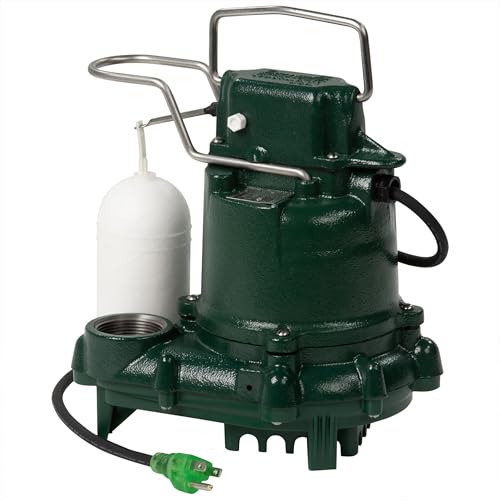
The Zoeller M53 Mighty-Mate is a long-running one-third horsepower primary pump and a useful benchmark for what a typical basement needs. Its cast iron motor housing, oil-filled motor, and vortex impeller are designed for steady, repeated cycling rather than occasional emergency use. The vortex impeller passes small solids up to one-half inch, reducing the chance that grit in the pit will stall the pump, and the screenless intake keeps the flow path simple.
The M53 uses an integral snap-action float switch with a float guard, protecting the switch from debris and from resting against the pit wall. That matters because switch failure, not motor failure, is a common reason pumps stop starting. Output at ten feet of lift suits most discharge runs where inflow is moderate rather than severe.
Installation is conventional: a one and one-half inch discharge, and a check valve above the pit. Homes with a modest water table and no history of overflow will generally find this class of pump sufficient, and the all-metal construction supports a long service life.
Wayne ESP25 Battery Backup Sump Pump System

The Wayne ESP25 addresses the failure mode a primary pump cannot: loss of power, a tripped breaker, or a primary that stops during the worst part of a storm. It is a twelve-volt battery backup system with its own pump, charger, audible alarm, and indicator lights showing when the backup has run and how the battery charge stands. Its float sits slightly higher than the primary float, so it only starts when water rises past the level the primary should have handled.
Wayne rates the ESP25 pump at up to 2,700 gallons per hour at zero lift, and describes up to 10,000 gallons removed on a single charge with its recommended seventy-five amp-hour battery. Real runtime depends on cycling frequency, lift height, and battery condition, so read those figures as capacity under favorable conditions rather than a promise for every storm. The battery is sold separately and should be counted as part of the system from the start.
The housing combines epoxy-coated steel and a cast iron base, a step up from all-plastic backup pumps, and the top suction design helps avoid air lock and clogging. This is a backup-only system, so it makes most sense alongside a primary pump that is still sound.
Basement Watchdog Big Combo CONNECT CITS-50 Combination System

The Basement Watchdog Big Combo CONNECT, model CITS-50, is the current combination system in the Basement Watchdog line, succeeding the earlier BW4000 combination model. It arrives preassembled, with primary and battery backup pumps already mounted and plumbed together, which removes the guesswork of fitting two pumps, two floats, and a shared discharge into one pit. It is designed for pits as small as twelve inches in diameter, a genuine constraint in older homes.
The primary pump uses cast iron and cast aluminum construction in the one-half horsepower class, while the backup runs from a twelve-volt deep-cycle battery, sold separately. The controller monitors both pumps, charges the battery, and sounds alarms for a failed primary, a weak battery, or high water. A WiFi module can be added for remote alerts, suiting owners who travel or keep a finished basement.
Combination systems trade flexibility for convenience: the paired pumps are matched to the shared plumbing, so a later upgrade usually means replacing the unit as a system. For a first installation, or a home where primary and backup are both due at once, that trade is usually worth making, and the monitoring controller is the feature most appreciated between storms.
Liberty Pumps PC257-441 Combination System

The Liberty Pumps PC257-441 pairs the Liberty Model 257 primary pump with the Model 441 battery backup pump in one preassembled PC-Series unit. The Model 257 is a one-third horsepower, cast iron primary pump known for its vertical magnetic float switch, often shortened to VMF. Instead of a mechanical arm moving through a seal, the VMF uses a magnetically operated float traveling on a rod, a design favored for narrow pits when the 257 is used on its own.
In combination format, Liberty specifies a minimum pit of fifteen inches across and eighteen inches deep, because both pumps share the basin. The primary moves up to fifty gallons per minute under low lift, handles solids up to one-half inch, and uses a quick-disconnect power cord so a damaged cord can be replaced without disturbing motor seals. Each pump has its own check valve, and a rubber coupler lets the backup be removed for service without cutting pipe.
The Model 441 backup runs from a twelve-volt Group 27 or Group 31 deep-cycle battery, sold separately, in wet cell or AGM form. Liberty describes runtime in days under light cycling and in hours under continuous running, underlining the rule for every backup here: real storm runtime depends on inflow.
How to choose
Start with lift and inflow, not the biggest motor on the shelf. Measure the vertical distance from the pit water level to where the discharge leaves the house, then compare pumps by flow at that height, usually quoted at ten feet. A pump that looks strong at zero lift can lose a large share of its output by the top of a basement wall, and elbows add further resistance.
Match horsepower to that job. One-third horsepower handles most homes with moderate seepage and standard lift. One-half adds margin for faster inflow or longer runs. Three-quarter horsepower is for high water tables, deep basements, and pits that fill quickly. Oversizing for a small, slow pit causes short, frequent cycles that wear the switch and motor, so bigger is only better when water volume justifies it.
Choose the switch for the pit. Vertical and vertical magnetic floats fit narrow pits and are less likely to hang up. Tethered wide-angle floats need a wider pit but allow a longer pumping range. Whichever type is chosen, the float must travel freely without touching the pit wall, pump, or inlet pipe.
Decide on backup protection honestly. If outages and storms arrive together, or the basement is finished, a backup or combination system is the second half of the installation, not an accessory. Budget for the battery, replace it every few years, and test the backup by unplugging the primary and filling the pit until the backup starts.
Finish with the unglamorous details: fit a check valve, drill the relief hole specified below it where required, set the pump flat on the pit floor, and use a grounded outlet, never an extension cord.
Who should skip
Homeowners without a sump pit, and with no history of groundwater entering the basement, should skip a purchase until drainage and grading have been assessed, because a pump treats water that has already arrived rather than stopping it outside. Owners planning a pit replacement should also hold off, since dimensions must match the finished basin.
A battery backup alone is wrong when the primary pump is already failing or undersized. A high-capacity primary is likewise a poor buy for a tiny pit with slow seepage, where short cycling shortens its life. Anyone whose flooding comes from a backed-up sewer or burst supply line should skip this category until that separate problem is fixed, because a sump pump is built for groundwater in a pit, not sewage or pressurized plumbing failures.
FAQ
How long should a sump pump last?
A cast iron primary pump in a clean pit commonly serves for many years, while switches and check valves often wear sooner than motors. Test the pump each season by lifting the float or adding water, and replace a pump that sounds strained or starts unreliably.
What size sump pump does a typical basement need?
Most basements are served by a one-third or one-half horsepower pump, judged by flow at the actual lift height rather than the zero-lift headline figure. Homes with high water tables, deep pits, or a record of near overflow should step up in capacity and add battery backup.
Does a battery backup pump replace the primary pump?
No. A backup is a smaller, battery-powered second pump set to start when the primary fails or power is lost. Its job is to hold the line for hours, not to match a primary indefinitely. Combination systems package both pumps together, preassembled, with a controller managing the backup battery.
How often should the system be checked?
Check the pit and floats a few times a year, clear debris from the intake, confirm the check valve holds, and run both pumps through a real cycle with water. Check the backup battery charge and condition on the same schedule, and replace it before it weakens.
Final verdict
For a strong primary replacement, the Wayne CDU980E offers the most capacity here, while the Zoeller M53 remains the measured choice for ordinary basements. Outage protection changes the decision: the Wayne ESP25 adds backup coverage to a sound primary, and the Basement Watchdog CITS-50 and Liberty PC257-441 each deliver a complete, monitored, preassembled system. Choose by lift, pit size, and outage risk.