Key takeaways
- Compare the best chalk line reels for framing, drywall and concrete layout, with gear ratios, line thickness, case materials and chalk capacity explained.
A chalk line reel is one of the simplest layout tools on a job site, and one of the easiest to buy badly. A reel with a thin, fuzzy line slows down framing and flooring work, a slow crank wastes time on every pull, and a case that leaks chalk dust into a tool bag is a daily annoyance. The differences between reels are concrete and easy to compare: line length and thickness, gear ratio, case material, fill-door design and chalk capacity. This guide compares five proven reels, from a jam-resistant professional favorite to a giant-string model built for concrete work, and explains which one fits the way you lay out lines.
As an Amazon Associate, we earn from qualifying purchases.
Quick answer
For most carpenters and remodelers, the Tajima Chalk-Rite Jam Free is the reel to buy first: its extra bold 1.0 mm braided line snaps a crisp mark and the five-gear drive rewinds fast without tangling. Budget buyers should pick the Irwin Strait-Line Classic in aluminum, speed-focused users the Irwin Speedline Pro, and anyone marking concrete should look at the Keson G100 Little Giant and its oversized string.
Tajima Chalk-Rite Jam Free (CR301JF)

Tajima built its reputation on snap lines, and the Chalk-Rite Jam Free shows why. The spool and line path are designed so the braided line feeds and rewinds without the bird’s-nest tangles that plague cheaper boxes, which is the single most common reason chalk reels get thrown across a job site. The line itself is an extra bold 1.0 mm braided cord, so the mark it leaves is thick, dark and easy to follow with a saw or a sheet of drywall, even on rough lumber and dusty subfloor.
Retrieval runs through a five-gear drive, so the full 100 feet of line comes back with far fewer crank turns than a direct-drive reel. A large fill neck makes topping up the roughly 3.5-ounce chalk reservoir less of a spill-prone chore, and a line lock holds tension while you walk the line out. The case is high-impact ABS rather than metal, which keeps weight down and shrugs off drops without denting.
The trade-offs are modest. ABS will never match a die-cast case for outright crush resistance, and the bold line is wider than finish carpenters want for cabinet-grade work. For framing, roofing, tile backer board and general layout, though, this is the most complete package in the group: fast, jam-resistant and consistently readable at a glance.
Irwin Strait-Line Speedline Pro (1932887)
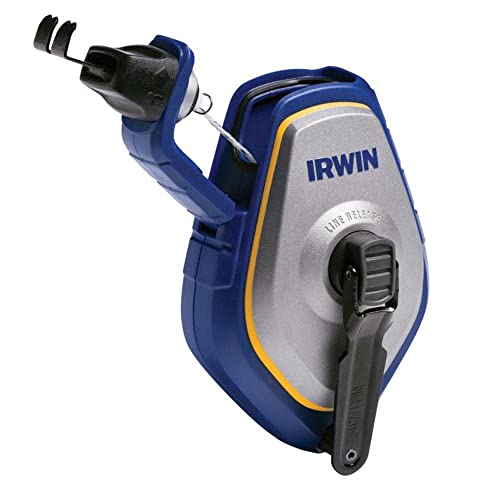
The Speedline Pro is Irwin’s answer for users who snap lines all day and want the refill and rewind steps to disappear. Its 3:1 gear ratio pulls 100 feet of line back in about a third of the cranking of a traditional reel, and the planetary-style drive feels smooth rather than notchy. The 100-foot line is an abrasion-resistant polyester cord rated by Irwin for multiple strikes per pull, so one chalking covers several snaps before the mark fades.
Refilling is the headline feature. The fill door on this generation is more than 70 percent larger than the one on the older Speedline design, which means a chalk bottle nozzle actually fits, spills drop, and the door seals shut instead of dribbling dust. The ABS case carries an overmold grip panel, and the hook nests into the body so it does not snag on a tool belt or pouch webbing.
Choose the Speedline Pro if layout is a constant part of your day and small frictions add up. Skip it if you prefer a metal case on principle, or if your work is mostly short interior marks where rewind speed never becomes a factor.
Stanley FatMax Chalk Line Reel (47-140L)

The FatMax reel takes a different approach to durability: instead of a metal shell, it uses a water-resistant, high-impact ABS case wrapped with rubber grips. That matters more than it sounds, because a reel that lives in a truck bed or gets used on damp foundation walls benefits from a case that shrugs off moisture instead of corroding, and the rubber overmold keeps it in a gloved hand.
Inside, a 3:1 gear ratio rewinds the 100-foot line three times faster than a standard reel, and a quick gear release stops the crank from spinning while you pull line out, a small detail that prevents skinned knuckles. A locking button holds the line at length while you position the hook. The case holds a full 4-ounce bottle of chalk, refills through an easy screw cap, and a long-wearing felt gasket hugs the line on its way out so the chalk coat stays even from the first snap to the fiftieth.
Stanley rates the line at twice the tensile strength of a traditional chalk line, which suits users who pull long lines tight across joists and slabs. The FatMax is the sensible middle pick: tougher and faster than a basic reel, without paying for professional Japanese hardware.
Irwin Strait-Line Classic (IWHT48441BC)

The Classic is the reel design that has been on job sites for decades, updated in a die-cast-style aluminum housing. It uses a traditional 1:1 direct drive, so rewinding 100 feet takes more crank turns than the geared reels above. In exchange you get a simple mechanism with very little to wear out, a slim metal case that slides into a pouch, and a line path that is easy to open up and clean when chalk cakes inside.
The 100-foot abrasion-resistant poly line anchors with a hook that docks into a nested recess on the case, so it does not dangle and catch. A wide fill door makes chalk loading quick, and the center line can hang free and double as a plumb bob for checking walls and posts, a genuinely useful trick on small jobs where a separate bob is one more tool to carry. This listing is the kit version, which ships with blue chalk included, so it is ready to work out of the package.
The Classic is the right buy for homeowners, occasional remodelers and anyone who wants a metal reel that will still be working in twenty years. Daily production framers will feel the slow rewind, and that is the honest reason to step up to a geared model.
Keson G100 Little Giant

Everything about the G100 is scaled up for outdoor layout. Where standard reels carry a thin cord, the Little Giant runs a giant braided string that lays down a heavy, bold mark, the kind that stays visible on concrete, gravel and dirt where a fine line disappears. The case holds up to 12 ounces of chalk, several times the capacity of a typical reel, so foundation, flatwork and parking-lot layout do not turn into a refill exercise every hour.
Filling happens through Keson’s BigMouth grommet, a round opening sized to match chalk bottle necks, with a stopper that seals securely instead of sliding open in a bag. The one-piece steel crank is built for gloved hands, the rewind is a simple 1:1 drive, and the full 100 feet comes back in about a minute of steady cranking. Keson makes this reel in the USA, and it hooks onto a tool belt when it is not stretched across a slab.
The compromises follow from the size. This is a big, heavy reel that is overkill for interior trim, and its bold mark is far too wide for finish work. For site layout, concrete forms and long exterior runs, nothing else here puts down as visible a line or carries as much chalk between refills.
How to choose
Start with line length. Nearly every reel in this class carries 100 feet, which covers framing, flooring and foundation work; shorter 30-foot compact reels exist for cabinet and tile work, and longer giant reels exist for site layout. Match the line to the longest run you snap regularly, because a line stretched to its limit coats unevenly near the end.
Line thickness decides how the mark reads. Bold lines around 1.0 mm and up are easy to see on rough lumber, concrete and subfloor, and they are the right default for framing and exterior work. Fine lines around 0.5 mm suit finish carpentry, tile and anywhere a wide chalk mark would swallow a pencil line’s worth of tolerance.
Gear ratio is about time. A 1:1 reel is simple and nearly indestructible but slow to rewind. Ratios of 3:1 and higher, up to the five-gear drive on the Tajima, cut rewind effort dramatically across a day of layout. If you snap a handful of lines per project, ignore gearing; if you snap lines hourly, it is the feature you will feel most.
Then look at the case and the fill system. Aluminum cases dent but survive crushing loads; ABS cases resist water and weigh less. A large, well-sealed fill door or grommet matters more than it appears, because chalk dust escapes through weak closures and coats everything in a tool bag. Finally, consider chalk capacity and color: big reservoirs suit exterior crews, and chalk permanence ranges from temporary blue that brushes off to red and black mixes that survive weather, so buy the color for the surface and the schedule, not by habit.
Who should skip
Skip this entire category if your layout work is short, indoor and infrequent: a tape measure, a pencil and a good straightedge handle most single-room jobs, and a compact laser line covers repetitive interior work like cabinet runs and tile grids faster than snapping and re-chalking. Skip the bold-line and giant-string reels if you do finish carpentry, since their marks are wider than your tolerances. Skip high-ratio geared reels if the tool will live in a damp truck box for years between uses, where a simple 1:1 mechanism is the one most likely to still turn freely. And skip chalk altogether for marks that must survive rain for weeks; paint markers and inverted marking paint are the right tools there.
FAQ
What gear ratio is best for a chalk line reel?
For occasional use, a 1:1 direct drive is fine and the mechanism is the simplest to maintain. For regular layout work, 3:1 is the sweet spot, rewinding a 100-foot line quickly without fragile gearing. Five-gear and 6:1 designs suit professionals who rewind dozens of times a day.
Which chalk color should I use?
Blue is the general-purpose choice: visible on lumber, drywall and concrete, and it brushes off most surfaces. White works on dark materials. Red and black mixes are progressively more permanent and weather-resistant, so reserve them for exterior work where the line must survive, and never use them on finished surfaces you cannot afford to stain.
Why does my chalk line keep coming out faint or uneven?
Usually the line is under-chalked or the chalk in the case has absorbed moisture and clumped. Refill with dry chalk, shake the reel, and pull the line out and rewind it a few times to coat it evenly. Snapping technique matters too: pull the line straight up from the middle and release it cleanly rather than letting it slide sideways.
Can a chalk reel replace a plumb bob and a level?
Partly. Some reels, including the Irwin Classic, let the line hang from the case so it works as a plumb bob for vertical checks. A chalk line is not a level, though: it marks a straight line between two points, and on long spans the line can sag, so establish your endpoints with a level or laser first, then snap between them.
Final verdict
Buy the Tajima Chalk-Rite Jam Free if you want one reel that does everything well: bold readable lines, fast jam-resistant rewinding and easy refills. Buy the Irwin Speedline Pro for the quickest refills and rewinds in a workday tool, the Stanley FatMax for a water-resistant case and strong value, and the Irwin Classic if you want a simple aluminum reel that will outlast trends. Keep the Keson G100 for the work the others cannot do: long, bold, high-visibility layout on concrete and open ground. Any of the five will serve well; the right choice is the one matched to your surfaces, your span lengths and how many lines you snap in a day.
Product and ASIN Reference
| Product | ASIN |
|---|---|
| Tajima Chalk-Rite Jam Free (CR301JF) | B001TH8DIO |
| Irwin Strait-Line Speedline Pro (1932887) | B017G5GB5E |
| Stanley FatMax Chalk Line Reel (47-140L) | B00005QVQE |
| Irwin Strait-Line Classic (IWHT48441BC) | B0BWL62GNJ |
| Keson G100 Little Giant | B0002YU36K |