Key takeaways
- The best rivet guns and hand riveters for home workshops compared, from a one-hand swivel-head tool to a long-handle model that sets stainless rivets.
A blind rivet joins two pieces of material from one side only, which is why a hand riveter earns its place in a home workshop: it fastens sheet metal, gutter sections, ductwork, brackets, and thin stock where the back of the joint is out of reach for a nut and bolt. The tools look similar at a glance, but they differ in the ways that matter once you start pulling handles. Head design decides whether you can work inside a duct or cabinet. Handle length and hinge geometry decide whether a stainless rivet sets cleanly or stalls halfway. Jaw quality decides whether the tool still grips mandrels firmly after years of use or starts slipping.
This guide compares five manual riveters that cover the realistic range of home and light trade work: a professional-grade standard tool, a swivel-head model for awkward angles, a long-handle tool built for large stainless rivets, a contractor-grade generalist, and a starter kit that bundles its first rivets in the box. Every pick sets the common blind rivet sizes used around a house and workshop.
As an Amazon Associate, we earn from qualifying purchases.
Quick answer
For most home workshops, the Marson 39000 HP-2 is the riveter to buy once: it sets aluminum and steel rivets from 3/32 to 3/16 inch, plus stainless up to 5/32 inch, in a light forged tool that lasts for decades. Choose the Arrow RHT300 instead when the work sits in tight corners, and the Astro 1423 when large stainless rivets are the job.
Marson 39000 HP-2 Professional Hand Riveter
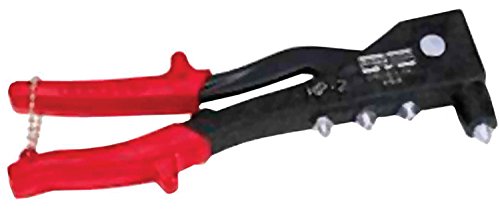
The HP-2 has been the reference point for hand riveters for decades, and the design explains why. The body is high-strength aluminum alloy, which keeps the tool at about a pound, while the upper handle is drop-forged carbon steel, so the part that takes the squeezing load is the part built to survive it. At just over ten inches long, it is compact enough for a tool belt pouch yet rigid enough that the handles do not flex when a steel rivet reaches the hard part of the pull.
Capacity covers the sizes a home shop actually meets: aluminum and steel blind rivets from 3/32 through 3/16 inch, and stainless steel up to 5/32 inch, using four interchangeable nosepieces. A detail worth knowing is the square-shoulder fulcrum pin, made from cold-formed, heat-treated steel. On cheaper riveters the round fulcrum pin can rotate in its holes over time, elongating them and loosening the linkage; the square shoulder locks the pin against rotation, which is a large part of why these tools stay tight after years of service. Cushion-molded vinyl grips keep the handles comfortable through a long run of rivets.
The trade-offs are modest. The HP-2 is a standard-length tool, so the largest stainless rivets ask for a strong grip, and it ships as a tool only, with no rivet assortment in the box.
Arrow RHT300 One-Handed Swivel Rivet Tool

The RHT300 solves the problem that stops ordinary riveters: access. Its head swivels, rotating the nosepiece so you can set a rivet where the handles cannot swing straight, such as inside ductwork, along a gutter seam, behind a cabinet rail, or anywhere a joint sits at an angle to the only direction your hand can approach from. For repair work on existing structures, where the workpiece rarely presents itself at a convenient angle, that rotating head is often the difference between setting the rivet and giving up on the location.
Construction is rugged all steel, with spring-loaded handles that make loading the next rivet quicker, soft vinyl grips, and four nosepieces with a nose-changing wrench. A handle lock keeps it closed and compact in a drawer. The capacity needs one honest note: the RHT300 handles 3/32, 1/8, and 5/32 inch rivets in aluminum or steel, but at 3/16 inch it is rated for aluminum only, and stainless rivets are outside its stated range entirely.
If your riveting is mostly flat, open work in steel or stainless, the Marson or the Astro below will serve you better. If your projects keep putting joints in corners and channels, this is the tool designed around exactly that frustration.
Astro Pneumatic Tool 1423 Heavy Duty 13-Inch Hand Riveter
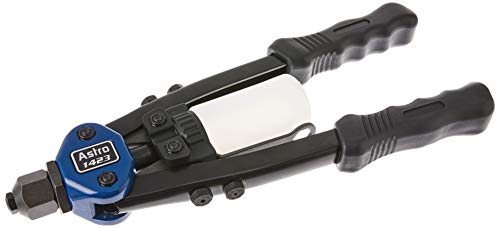
Despite the brand name, the 1423 is a manual tool, and it exists for the rivets that defeat standard riveters. Its patented structure uses double compound hinges to multiply hand force, so the handles stay comparatively short for a long-arm tool while delivering the leverage that large mandrels demand. Astro rates it for blind rivets up to 1/4 inch, including 1/4 inch stainless steel, which is the top of the range for a hand tool and well beyond the 3/16 inch ceiling of typical riveters.
That leverage matters in practice. A stainless rivet that a compact tool sets with a two-handed strain and a partial pull, the 1423 sets in a controlled squeeze, producing a fully drawn rivet instead of a loose one. Jaw engagement is adjustable: threading the top hex head out tightens the grip on the mandrel, threading it in opens the jaws for larger rivets, and the maker advises keeping the jaws clean for long service. Interchangeable nosepieces cover the smaller sizes too, so it can serve as a shop’s only riveter if the work skews heavy.
The compromise is size. At thirteen inches it is the bulkiest tool here, it will not fit where the Arrow’s swivel head goes, and for a handful of small aluminum rivets it is more tool than the job requires. For trailer, marine, and farm equipment work with large rivets, it is the right kind of overbuilt.
Stanley MR100CG Contractor Grade Riveter

The MR100CG is the straightforward contractor-grade option: a die-cast metal body, a long handle for leverage, and a capacity that spans 3/32, 1/8, 5/32, and 3/16 inch rivets through four included nosepieces, with a wrench included for swapping them. It is built for repeated fastening across metalworking and mechanical repair rather than for any single specialty, and the die-cast construction gives it a solid, flex-free feel that stamped-steel bargain tools do not match.
One practical feature deserves attention: the removable ejector spring. After a rivet sets, the spent mandrel stem has to clear the jaws before the next rivet loads, and on many tools that means shaking or picking the stem out. The ejector spring pushes spent shanks clear, keeping a long run of rivets moving at a steady rhythm.
The honest limit is stainless steel. Stanley rates this tool for stainless only at 1/8 and 5/32 inch, so the larger stainless sizes belong to the Astro or, at 5/32 inch and below, the Marson. Within aluminum and steel, though, the MR100CG covers the full common range with leverage to spare, and it does so at the simpler end of this lineup in both design and upkeep.
TEKTON 6555 Rivet Gun with 40-Piece Rivets

The TEKTON 6555 is the pick for a first riveter, because it arrives ready to work. The box includes a 40-piece assortment of aluminum rivets alongside the tool, so a new owner can fasten a gutter, a duct joint, or a bracket the same day instead of making a second purchase to get started. The rivets supplied are rust-proof aluminum, the sensible starting material for household repairs.
The tool itself is sensibly built rather than stripped down: all-steel construction with a durable black wrinkle finish, nonslip cushioned grips, and a thoughtful storage detail in that the interchangeable nosepieces and the nosepiece wrench store inside the handle. Loose nosepieces are the part of every riveter kit that migrates to the bottom of a toolbox and vanishes; keeping them in the handle means the size you need stays with the tool.
As a starter tool it has starter limits. The bundled assortment is aluminum only, and anyone moving on to regular steel work, stainless rivets, or large diameters should step up to the Marson, Stanley, or Astro. As a complete first kit for finding out whether riveting belongs in your workflow, it is well judged.
How to choose
Start with the rivets, not the tool. Match the nosepiece to the rivet diameter, and drill the hole to the rivet size, because an oversized hole lets the rivet body tilt and set crooked. Most household work uses 1/8 inch rivets, with 5/32 and 3/16 inch for heavier stock, and grip range matters as much as diameter: the rivet must be long enough to pass through both layers and still form a proper bulge on the blind side.
Then be honest about material. Aluminum rivets set easily in any tool here. Steel takes noticeably more hand force. Stainless steel is the real dividing line, and each tool states its own ceiling: the Marson handles stainless to 5/32 inch, the Stanley to 5/32 inch in its two smaller sizes, the Arrow does not rate stainless at all, and the Astro 1423 stands alone in setting stainless up to 1/4 inch. Buying a tool whose stated capacity covers your hardest planned rivet is the single most important decision in this category.
Finally, match the format to the work. A compact standard tool like the HP-2 suits bench and open work. A swivel head earns its keep on repairs in place, inside channels and corners. A long-handle compound tool trades portability for leverage on large rivets. And keep the jaws clean of the metal dust that mandrels shed; dirty jaws are the usual cause of slipping stems.
Who should skip
Skip hand riveters entirely if your work is high volume. Setting hundreds of rivets a day is a job for a cordless or pneumatic rivet tool, and no amount of handle leverage makes a manual tool the right choice for production pace. Also skip this category if what you actually need is threaded inserts: a rivet nut tool, which sets internal threads in sheet material, is a different instrument, and none of these pop riveters can do that job. Finally, pass on blind rivets for structural or safety-critical joints that call for solid rivets, bolts, or welds; a blind rivet is a light and medium duty fastener, and joints designed around other hardware should keep it.
FAQ
What size rivets do most home projects use?
The 1/8 inch diameter rivet covers the majority of household work, including ductwork, gutters, and light brackets. Step up to 5/32 or 3/16 inch for thicker stock or heavier loads, and always match the rivet length to the combined thickness of the layers being joined.
Can a hand riveter set stainless steel rivets?
Yes, within the limits each maker states. Stainless mandrels need far more pulling force than aluminum, so capacity varies by tool: some models rate stainless only in smaller diameters, the Arrow RHT300 does not rate it at all, and a compound-leverage tool like the Astro 1423 sets stainless up to 1/4 inch.
What is the difference between a rivet gun and a rivet nut tool?
A rivet gun sets blind rivets, which permanently clamp two layers together. A rivet nut tool installs a threaded insert into a single sheet, leaving a nut-like thread that accepts a bolt or screw and can be fastened and unfastened repeatedly. The tools and the fasteners are not interchangeable.
Why does the mandrel stem sometimes stick or slip in the jaws?
Usually the nosepiece does not match the rivet diameter, the jaws are worn, or metal debris has built up around the jaw mechanism. Fit the nosepiece to the rivet size, keep the jaws clean, and on tools with adjustable jaw engagement, set the grip tighter for stems that slip.
Final verdict
Buy the Marson 39000 HP-2 if you want one riveter that covers nearly everything a home workshop meets, for decades. Buy the Arrow RHT300 when the work lives in corners and channels, the Astro 1423 when large stainless rivets are routine, the Stanley MR100CG for contractor-grade general use, and the TEKTON 6555 as a complete first kit. Match stated capacity to your hardest rivet, and any of these five will set rivets cleanly for years.
Product and ASIN Reference
| Product | ASIN |
|---|---|
| Marson 39000 HP-2 Professional Hand Riveter | B00063Y1F6 |
| Arrow RHT300 One-Handed Swivel Rivet Tool | B00004Z2JM |
| Astro Pneumatic Tool 1423 Heavy Duty 13-Inch Hand Riveter | B0039697ME |
| Stanley MR100CG Contractor Grade Riveter | B000BR7JUG |
| TEKTON 6555 Rivet Gun with 40-Piece Rivets | B000NPT74C |