Key takeaways
- Compare five auto-darkening welding helmets for MIG, TIG and stick work, judged on optical clarity, viewing area, arc sensors, shade range and headgear.
A welding helmet is the one tool you wear for every second of arc time, and it also protects your eyes from ultraviolet and infrared light whether the lens is dark or clear. A good auto-darkening helmet darkens in a fraction of a millisecond when the arc strikes, then returns to a light shade so you can reposition the work without lifting the hood. A poor one leaves you squinting through a green, blurry window, guessing where the puddle ends.
This guide compares five auto-darkening helmets that cover the range a home shop or small fabrication bench actually needs: a professional flagship, a digital helmet built for low-amp TIG and outdoor work, a low-profile touchscreen model for tight spaces, a simple mid-range hood, and a large-view budget helmet with true-color optics. Every model here meets ANSI Z87.1 and is sold by an established welding brand with replacement cover lenses and headgear parts available.
As an Amazon Associate, we earn from qualifying purchases.
Quick answer
For most home-shop welders, the Lincoln VIKING 3350 offers the clearest view and the largest window. The Miller Digital Elite adds electromagnetic X-Mode sensing for outdoor and low-amp TIG work. The ESAB Sentinel A50 suits tight spaces, the Hobart Inventor covers weekend MIG work, and the YESWELDER LYG-M800H delivers a big true-color window for less.
Lincoln Electric VIKING 3350 (K3034-4)
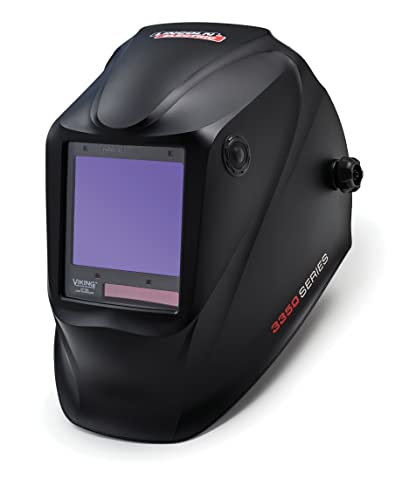
The VIKING 3350 is the helmet to buy when optical clarity is the priority. Its 4C lens earns a 1/1/1/1 optical rating, the highest score across the four EN 379 clarity measures, so the edges of the window read as clearly as the center. The viewing area is 3.74 by 3.34 inches, about 12.5 square inches, which lets you see the joint ahead of the puddle without moving your head.
The variable shade runs from 5 to 13 with an internal control, and a low-profile external button switches to grind mode, so you can go from welding to cleanup without lifting the hood. Four arc sensors watch for the arc, the lens switches in 1/25,000 of a second, and Lincoln rates the sensing down to 2 amps on AC and DC TIG, covering the low-current starts that make lesser helmets flicker. Power comes from a solar cell backed by a replaceable CR2450 battery.
Comfort is handled by the X6 headgear, which spreads the roughly 21-ounce load across six contact points instead of hanging it off your forehead. Replacement cover lenses and headgear are stocked widely. The trade-offs are size and control placement: the extra-large shell is bulky in tight corners, and shade adjustments sit inside the shell.
Miller Digital Elite, Stars and Stripes III (ClearLight 2.0)

Miller built the Digital Elite around difficult sensing conditions. Alongside four arc sensors, its X-Mode detects the weld electromagnetically rather than by light alone, so the lens still darkens when a sensor is blocked by a flange, when you are welding inside a cavity, or when bright sunlight would fool an optical-only helmet. Miller rates it for TIG at 5 amps and below, the range where auto-darkening lenses most often fail to trigger.
The ClearLight 2.0 lens gives a 9.2-square-inch viewing area with a 1/1/1/2 optical rating and a brighter light state, so colors read closer to natural before and after the arc. Four operating modes cover the bench: weld at shades 8 to 13, cut at 5 to 8, grind at shade 3, and X-Mode for obstructed or outdoor work. Digital controls set shade, sensitivity, and delay in half-shade steps, and switching runs about 1/20,000 of a second.
This listing is the Stars and Stripes III graphic version of the Digital Elite; the same helmet is sold in plain black and other graphics under different listings, so confirm the shell design on the product page before ordering.
ESAB Sentinel A50 (0700000800)

The Sentinel A50 takes a different approach to fit. Its low-profile, rounded nylon shell sits close to the head, which matters when you are welding inside a vehicle frame or anywhere a full-size hood keeps banging into the work. The color touchscreen panel is easy to use, with settings for shade, sensitivity, delay, and grind mode, plus memory slots for favorite combinations.
The viewing area is 3.93 by 2.36 inches with a 1/1/1/2 optical rating. Dark shades split into two ranges, 5 to 8 and 9 to 13, over a shade 3 light state, and an external grind button lets you switch modes without reaching inside. Four sensors trigger the lens, switching runs as fast as 0.04 milliseconds at operating temperature, and ESAB rates TIG sensing down to 2 amps AC and DC. Power is solar with two replaceable CR2450 batteries.
The HALO headgear is the comfort story here: it adjusts in many small increments and balances the roughly 1.4-pound helmet evenly. The compromises are the smaller window compared with the largest helmets here and a touchscreen that needs bare fingers for fine adjustments. Replacement cover lenses are ESAB-specific parts, so keep the part numbers from the manual.
Hobart Inventor 770890
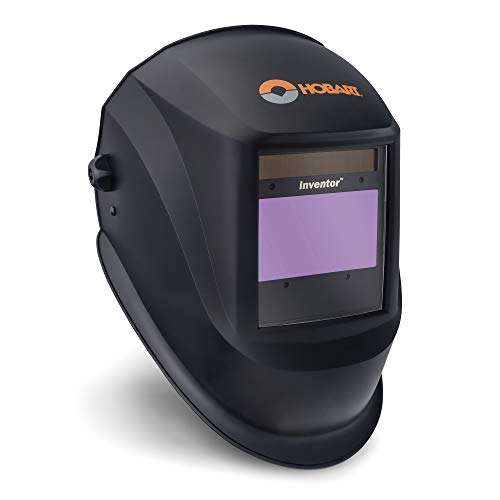
The Inventor is the straightforward pick for a home MIG welder who wants a wide view and simple controls from a brand with a long dealer network. Its PureColor lens covers a 3.94 by 2.36-inch viewing field, about 9.3 square inches, which makes it easier to track a bead across a wide joint. The variable shade runs 9 to 13, and a grind mode is built in for cleanup work.
Four independent arc sensors handle triggering, and the controls are analog knobs rather than a digital menu: shade, sensitivity, and delay can be set by feel and stay where you left them. The helmet meets ANSI Z87.1, power is auto on and off with a replaceable lithium battery, and at about 1.25 pounds it is a light full-size hood.
Hobart does not publish an optical clarity rating for this model, and the shade range starting at 9 rules it out for shade 5 to 8 cutting work, so plasma cutting needs a different helmet. What you get instead is a wide window, simple controls, a two-year warranty, and easy parts availability. For weekend fabrication, trailer repairs, and general MIG work, that trade suits a lot of buyers.
YESWELDER LYG-M800H
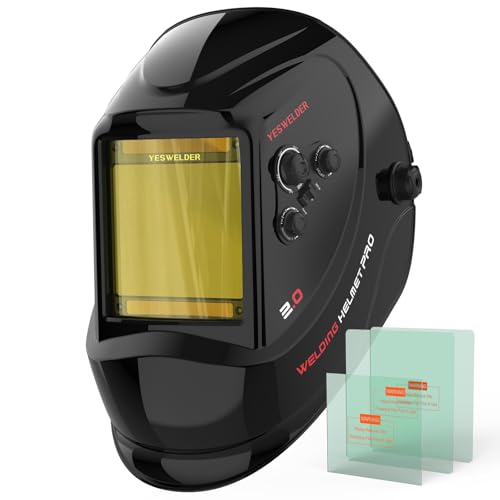
The LYG-M800H is the value pick, and its headline is the window: 3.93 by 3.66 inches, the largest viewing area in this guide, in a true-color lens rated 1/1/1/1. That combination used to be reserved for far pricier helmets, and it makes a real difference when you are learning to read a puddle, because the joint, the wire, and the surrounding metal all stay visible at once.
Dark shades split into 5 to 9 and 9 to 13 ranges over a DIN 3 light state, with a grind mode included, so the helmet covers TIG, MIG, stick, plasma cutting, and grinding. Four arc sensors trigger the lens, with a quoted switching speed of 1/30,000 of a second. Shade controls sit outside the shell, power comes from a solar cell with a replaceable CR2450 battery, and the box includes spare cover lenses and a storage bag.
The compromises are in build rather than optics. The polypropylene shell and headgear feel less substantial than the professional helmets above, owner feedback on durability is more mixed, and parts support runs through the seller rather than a dealer network. For a first helmet, a second helmet for a helper, or a bench that sees occasional fabrication, the viewing area is hard to argue with.
How to choose
Start with optical clarity. The four-number rating, scored under EN 379 and carried into ANSI listings, grades blurriness, light diffusion, shade consistency, and angular dependence. A 1/1/1/1 lens is the clearest available; a 1/1/1/2 lens gives up a little uniformity at extreme angles.
Next, match the viewing area to your work. Large windows, roughly 9 square inches and up, help on pipe, structural, and out-of-position work where you cannot move your head freely. Then check the sensors and TIG rating. Four sensors are the practical minimum for awkward positions, and anyone running TIG below about 10 amps should look for a published low-amp rating or an electromagnetic sensing mode, because optical sensors can miss a faint arc behind an obstruction.
Shade range decides versatility. A range that starts at 5 covers plasma cutting and gouging; a helmet that starts at 9 is weld and grind only. Finally, weigh comfort and consumables: headgear design matters more than a small weight difference over a long session, and a helmet is only a good buy if its cover lenses, sweatbands, and batteries are easy to replace. Confirm ANSI Z87.1 marking on any helmet you consider, and treat an unpublished optical rating as a question to ask, not a detail to skip.
Who should skip
Skip auto-darkening entirely if you only strike an arc a few times a year; a quality fixed-shade hood costs less and never has a dead battery, though you give up keeping the hood down between welds. Skip the premium helmets here if your work is all short bench welds in good light, since the mid-range picks cover that ground well.
Skip any helmet without a published low-amp TIG rating if delicate TIG is your main work, and skip helmets whose shade range starts at 9 if you plan to plasma cut. Production welders working full shifts in confined or regulated environments should look beyond this list to helmets with powered air-purifying respirators and employer-specified approvals. And if a listing does not state ANSI Z87.1 compliance, an optical rating, or a sensor count, skip it.
FAQ
What shade should I use for MIG welding?
Most MIG work on mild steel runs at shade 10 to 12 depending on amperage, with higher current needing a darker shade. Start at shade 11 for general home-shop MIG, then adjust one step at a time: if you cannot see the joint edges, go lighter; if you see spots after looking away, go darker. The shade guide printed in the helmet manual gives ranges by process and current.
Why does my helmet flash me during TIG welding?
A flash usually means the sensors did not see the arc: a hand, clamp, or the workpiece blocked them, the sensitivity was set too low, or the arc current was below what the sensors can detect. Raise the sensitivity, clean the cover lens, and check the batteries. For very low-amp TIG, choose a helmet with a published low-amp rating or an electromagnetic sensing mode, which does not depend on line of sight to the arc.
How long do auto-darkening helmet batteries last?
Solar-assisted helmets with a replaceable coin cell typically run for years of hobby use before the battery needs changing, because the solar cell carries much of the load while welding. A low-battery indicator or sluggish switching signals a weak cell. Replace it with the exact type listed in the manual, and store the helmet out of direct sunlight so the lens ages slowly.
Can I use a welding helmet for plasma cutting and grinding?
Yes, if the helmet covers the shade range and modes involved. Plasma cutting usually needs shades 5 to 8, so the helmet must offer a cut mode or a range that reaches that low, and grind mode holds the lens at its light shade so it does not darken under sparks. Check that the model lists cutting in its modes first, and wear safety glasses under the hood for grinding, since the light-state lens is not impact protection on its own.
Final verdict
For most buyers, the Lincoln VIKING 3350 is the safest recommendation: the clearest optics, a large window, a published low-amp TIG rating, and parts everywhere. Choose the Miller Digital Elite if you weld outdoors or run low-amp TIG and want sensing that does not depend on the sensors seeing the arc. The ESAB Sentinel A50 fits tight spaces and long sessions, the Hobart Inventor is the simple wide-view option for weekend MIG work, and the YESWELDER LYG-M800H gives beginners a genuinely large, clear window at the lowest commitment.
Product and ASIN Reference
| Product | ASIN |
|---|---|
| Lincoln Electric VIKING 3350 (K3034-4) | B07V9G94NK |
| Miller Digital Elite, Stars and Stripes III (ClearLight 2.0) | B0B4VR72B7 |
| ESAB Sentinel A50 (0700000800) | B06XRYV3N3 |
| Hobart Inventor 770890 | B07MKRYWMD |
| YESWELDER LYG-M800H | B07M5WKCYX |