We independently review everything we recommend. When you buy through our links, we may earn a commission. As an Amazon Associate we earn from qualifying purchases.
Best Locking Lug Nuts 2: 5 Wheel Locks That Fit Common Thread Sizes
Best locking lug nuts 2: five chrome and black wheel locks for common thread sizes, with seat styles, key patterns and fitment checks explained before you buy.
Best locking lug nuts 2: five chrome and black wheel locks for common thread sizes, with seat styles, key patterns and fitment checks explained before you buy.
Disclosure: As an Amazon Associate, this site may earn from qualifying purchases made through links on this page.
A wheel lock is a lug nut with a key pattern that no ordinary socket can turn. One lock on each wheel turns a quick wheel theft into a slow, noisy job, and that delay is the whole point. This roundup covers five locking lug nut sets that are live on Amazon US right now, all from the two makers that dominate the wheel lock market: McGard and Gorilla. Four picks are McGard and one is Gorilla, because McGard makes the widest range of thread sizes and seat styles in this category, and that concentration reflects the market rather than a preference for one brand.
Every pick here is a set of four locks, which puts one lock on each wheel of the car. The remaining lug positions on each wheel keep standard lug nuts. That is the usual setup: one lock per wheel, not one lock per lug position. If the car has five lugs per wheel, the four locks still cover all four wheels, one lock each, and the other sixteen positions use the nuts already on the car.
Thread size comes first. A lock must match the thread on the wheel studs exactly, and the seat shape must match the wheel. Get either one wrong and the lock will not seat, no matter how good the lock itself is. Cone seat, tuner cone seat, shank seat, and acorn styles are all represented, so the guide below walks through which seat fits which wheel before the picks begin.
At a Glance
Best all-round cone seat lock: McGard 24137 — M12 x 1.5, chrome, 60-degree cone seat, four locks plus one key.
Best M14 x 1.5 cone seat lock: McGard 24210 — same cone seat family in the larger metric thread.
Best tuner style lock: McGard 25110 — narrow tuner body for aftermarket wheels with tight lug holes.
Best shank seat lock: McGard 21120 — 1/2-20 shank with washers for custom aluminum wheels.
Best non-McGard option: Gorilla Automotive 61631 — M12 x 1.50 acorn lock with a dual hex key.
Every pick is a set of four locks, which covers one lock per wheel on a four-wheel car.
Every pick includes its own key tool. Keep the key and the ID card that comes with it in a safe place, separate from the car if possible.
How to Choose
Match the thread size first. The thread size is written on the listing and on the current lug nuts. Common sizes are M12 x 1.5, M14 x 1.5, M14 x 2.0, and 1/2-20. A lock with the wrong thread will not turn onto the stud at all, and forcing it damages the stud. Check the owner’s manual or read the size off a lug nut already on the car before ordering. If the car uses M12 x 1.5 studs, only M12 x 1.5 locks fit, even if an M14 lock looks identical.
Match the seat shape second. The seat is the part of the nut that touches the wheel. A cone seat nut has a 60-degree taper that centers the wheel on the stud. A shank seat nut has a straight shank that passes through the wheel hole and sits on a washer. An acorn nut is a cone seat nut with a closed, domed end. A cone seat lock on a wheel made for shank nuts will not seat, and a shank lock on a cone seat wheel will not center the wheel. The listing states the seat style, and the picks below name it for each lock.
Count the locks per wheel. One lock per wheel is the usual setup, and a set of four covers a four-wheel car. A set of five exists for drivers who want a lock on every lug position of one wheel, but that is uncommon. Five-lug wheels still use one lock each with a four-pack, and the other positions use standard nuts. Buy the set size that matches the plan, not the lug count.
Check the overall length. A lock that is too long can bottom out on the stud or stick out past the wheel face. A lock that is too short may not engage enough thread. The listings below give overall length where the maker publishes it: 1.46 inches for the McGard 24137 and 1.38 inches for the McGard 21120. Compare that length with the current lug nuts before ordering.
Tuner wheels need tuner locks. Aftermarket wheels often have narrow lug holes that a standard lock cannot enter. Tuner style locks have a slim body and a special key that fits inside the hole. If the wheels are aftermarket with tight lug holes, choose a tuner style lock and confirm the key fits the hole depth. Standard locks suit factory wheels and most steel wheels.
Keep the key safe. Every set here includes one key tool with a unique pattern, and McGard sets include an ID card with a key code. A lost key means the locks cannot come off without a removal tool, so store the key where it can be found in a hurry, and keep the ID card somewhere other than the glovebox. A photo of the code, kept off the car, is a sensible backup.
Torque by hand. Wheel locks go on with a hand wrench and a torque wrench set to the vehicle figure in the owner’s manual. Never use an impact wrench on a lock: the hammering can split the key pattern and round off the lock. Tighten in a crisscross pattern, the same as with standard lug nuts, and re-check the torque after the first short drive.
The McGard 24137 is the default cone seat lock for the most common metric thread on cars. It fits M12 x 1.5 studs, uses a 60-degree tapered cone seat, and comes as a set of four locks plus one key. Overall length is 1.46 inches, and the hex is a dual 19mm and 21mm size, so the key works with either socket size. The body is alloy steel with a chrome finish.
The listing states the set is for steel or aluminum wheels that use lug nuts with a 60-degree tapered cone seat at the bottom. That covers a wide range of factory wheels on cars with M12 x 1.5 studs. McGard uses computer-generated key designs, which the listing says allow for an infinite number of key patterns, so the key pattern on one set does not match the pattern on another set. The kit includes the wheel locks, the unique key tool, and an ID card.
Buy this pick when the car has M12 x 1.5 studs and factory or aftermarket wheels with a cone seat. It is the broadest fit in this roundup, and the dual hex key is a practical touch: either a 19mm or a 21mm socket turns the key. Keep the ID card with the key code, since that code is what McGard uses to cut a replacement key.
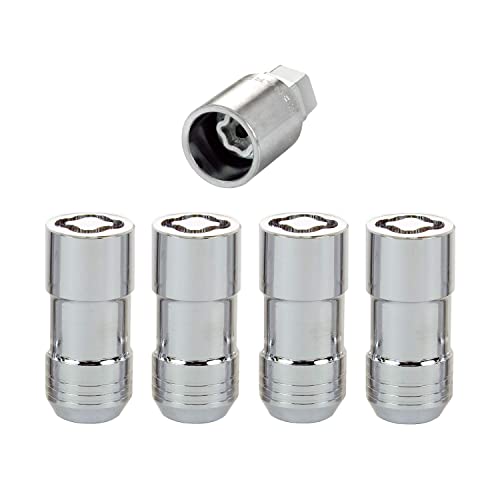
The McGard 24210 is the same cone seat lock as Pick 1, built for the larger M14 x 1.5 thread. It is a set of four chrome locks with a cone seat, made from alloy steel, with a machined exterior finish. The thread size is the only meaningful difference from the 24137: M14 x 1.5 instead of M12 x 1.5.
M14 x 1.5 studs appear on many larger cars and light trucks, so this pick covers the drivers that Pick 1 cannot. The cone seat is the same 60-degree taper, and the set includes the key tool with its own unique pattern. Check the thread on the current lug nuts before ordering, because M14 x 1.5 and M12 x 1.5 locks look alike at a glance and do not interchange.
Buy this pick when the studs are M14 x 1.5 and the wheels take a cone seat nut. It is the direct M14 counterpart to Pick 1, with the same chrome finish and the same four-lock layout.
The McGard 25110 is a tuner style lock for M14 x 1.5 studs. It keeps the cone seat of Picks 1 and 2, but the body is slim, so it fits through the narrow lug holes on aftermarket tuner wheels where a standard lock cannot enter. The set is four chrome locks in alloy steel, with the tuner key pattern.
Tuner wheels are the reason this pick exists. Aftermarket wheels often drill small lug holes for a clean look, and a standard diameter lock will not pass through the hole. The slim tuner body solves that, and the key is a narrow tool that reaches down the hole. The trade-off is that the key is specific to the tuner pattern, so keep it with the car and keep the ID card elsewhere.
Buy this pick when the wheels are aftermarket tuner wheels with tight lug holes and the studs are M14 x 1.5. Measure the lug hole diameter first: if a standard lock passes through the hole with room to spare, Pick 2 fits and the tuner body is unnecessary.
The McGard 21120 is the shank seat lock in this roundup. It fits 1/2-20 studs, has an overall length of 1.38 inches, and uses a 13/16 hex. The set includes four locks, one key, and four washers. The washers are polished stainless steel, and the body is alloy steel with a chrome finish.
Shank locks are for custom aluminum wheels that are between 11/16 inch and 7/8 inch thick at the wheel stud hole and use flat seat lug nuts. The shank passes through the hole and the washer spreads the load across the flat seat. The listing notes that regular 0.580 inch shank locks match regular 0.746 inch shank lug nuts, and the reverse, so the shank length pairs with the matching lug nut size. Measure the wheel thickness at the stud hole before ordering: a wheel thinner than 11/16 inch or thicker than 7/8 inch needs a different shank length.
Buy this pick when the wheels are custom aluminum with flat seats and 1/2-20 studs, and the wheel thickness at the stud hole falls inside the 11/16 to 7/8 inch range. It is the only shank pick here because shank locks are a narrower application than cone seat locks.
The Gorilla 61631 is the non-McGard pick in this roundup. It is an acorn style lock for 12mm x 1.50 studs, sold as a pack of four in chrome over alloy steel. The key is a dual 3/4 inch and 13/16 inch hex, and the listing calls the lock weather resistant. Gorilla lists the recommended use as securing wheels and preventing theft.
Acorn locks are cone seat locks with a closed domed end, so the stud tip stays covered. That closed end keeps water and road grit off the stud threads, which matters on cars that see rain and road salt. The dual hex key works with either a 3/4 inch or a 13/16 inch socket, the same practical touch as the McGard dual hex picks.
Buy this pick when the studs are M12 x 1.50, the wheels take a cone seat nut, and a closed acorn end is wanted for weather protection. It is the only Gorilla pick here, and it breaks up an otherwise all-McGard lineup with a different key system.
Comparison Table
Pick
Thread Size
Seat Style
Finish
In the Box
McGard 24137
M12 x 1.5
Cone seat, 60-degree taper
Chrome
4 locks, 1 key, ID card
McGard 24210
M14 x 1.5
Cone seat
Chrome
4 locks, 1 key
McGard 25110
M14 x 1.5
Tuner cone seat
Chrome
4 locks, 1 key
McGard 21120
1/2-20
Regular shank
Chrome
4 locks, 1 key, 4 washers
Gorilla 61631
12mm x 1.50
Acorn, cone seat
Chrome
4 locks, 1 key
Which One Fits Your Situation
Factory wheels on a car with M12 x 1.5 studs: Pick 1, the McGard 24137. It is the standard cone seat lock for the most common metric thread, with a dual hex key and an ID card for replacement keys.
Larger car or light truck with M14 x 1.5 studs and factory wheels: Pick 2, the McGard 24210. Same cone seat family as Pick 1, built for the larger thread.
Aftermarket tuner wheels with narrow lug holes: Pick 3, the McGard 25110. The slim tuner body passes through tight lug holes that stop a standard lock. Confirm the studs are M14 x 1.5 and measure the hole diameter first.
Custom aluminum wheels with flat seats and 1/2-20 studs: Pick 4, the McGard 21120. It is the only shank pick here, with washers included. Measure the wheel thickness at the stud hole and confirm it falls between 11/16 inch and 7/8 inch.
M12 x 1.50 studs with a closed acorn end wanted: Pick 5, the Gorilla 61631. The domed end covers the stud tip, and the dual hex key works with two socket sizes.
Unsure of the thread size: Do not guess. Read the size off a lug nut already on the car or check the owner’s manual, then match the pick to that size. Thread size and seat shape are the two facts that decide the purchase, and every other feature is secondary.
FAQ
How many wheel locks go on each wheel?
One lock per wheel is the usual setup. A set of four covers all four wheels, and the other lug positions on each wheel use standard lug nuts. A car with five lugs per wheel still uses one lock per wheel with a four-pack.
What happens if I lose the key?
The locks cannot come off with an ordinary socket, so a lost key means a removal tool or a trip to a shop. McGard sets include an ID card with a key code: keep that card somewhere other than the car, and the code lets McGard cut a replacement key. A photo of the code, kept off the car, is a sensible backup.
Can I use an impact wrench on wheel locks?
No. Tighten wheel locks by hand with a torque wrench set to the vehicle figure in the owner’s manual. An impact wrench can split the key pattern and round off the lock. Tighten in a crisscross pattern and re-check the torque after the first short drive.
Do wheel locks fit steel and aluminum wheels?
It depends on the seat shape, not the wheel material. The McGard 24137 listing states it is for steel or aluminum wheels that use a 60-degree tapered cone seat. Match the seat shape to the wheel, and the material takes care of itself.
What is the difference between a cone seat lock and a shank lock?
A cone seat lock has a 60-degree taper that centers the wheel on the stud. A shank lock has a straight shank that passes through the wheel hole and sits on a washer against a flat seat. Use the seat shape the wheel was made for; the two do not interchange.
Do tuner locks fit factory wheels?
A tuner lock fits any wheel with the matching thread and a cone seat, but the slim body is made for narrow aftermarket lug holes. On a factory wheel with wide lug holes, a standard lock such as Pick 1 or Pick 2 is the simpler choice.
Final Take
Thread size first, seat shape second, and everything else after that. The McGard 24137 covers the most common metric thread with a cone seat, the McGard 24210 covers the larger M14 x 1.5 thread, the McGard 25110 covers tuner wheels with tight lug holes, the McGard 21120 covers custom aluminum wheels with flat seats, and the Gorilla 61631 gives M12 x 1.50 drivers a closed acorn option. All five are sets of four, which puts one lock on each wheel, and all five include their own key tool. Match the thread and the seat to the car, keep the key and the ID card safe, torque by hand, and the locks do their job quietly for years.
K
Kissmyaster Editorial Team
We compare specs, materials and verified owner reviews before a product earns a spot. Rankings are never paid.
Affiliate disclosure. As an Amazon Associate we earn from qualifying purchases at no extra cost to you. Prices accurate as of the date shown.
Best shocks for SUV 2: five strut and shock kits for Highlander, RX, Expedition, Santa Fe, and Tahoe-class SUVs, with fitment and install notes inside.
Best camper trailer tow hitch: five weight distribution hitches with sway control for camper trailers, 10,000 to 15,000 lb, with shank and install notes.
Best 49cc mini chopper motorcycle: four live mini chopper bikes, all 40cc-class — no 49cc chopper listing found live. Size, engine, and rider notes inside.
Compare the best value business class laptops for work, travel, and everyday office use. Find durable ThinkPad, Latitude, ProBook, and ExpertBook picks.
Best one step compound and polish 2: five one-step compounds that cut swirls and leave gloss in a single pass, compared by cut, finish and bottle size.
Best battery jumper with air compressor 3: five jump packs with built-in inflators, from 1200 to 4000 peak amps, compared by engine range, PSI and weight.
Searching for the best air suspension for towing 5? Compare 5 rear helper air spring kits for F-150, Silverado, Sierra and Super Duty trucks that level loads.

 Pick 1: McGard 24137 Chrome Cone Seat Wheel Locks
 Pick 2: McGard 24210 Chrome Cone Seat Wheel Locks
 Pick 3: McGard 25110 Chrome Tuner Style Cone Seat Wheel Locks
 Pick 4: McGard 21120 Chrome Regular Shank Wheel Locks
 Pick 5: Gorilla Automotive 61631 Acorn Gorilla Guard Locks