Key takeaways
- Compare the best self propelled gas lawn mowers for large yards by deck width, engine size, drive type and bag capacity to finish big lawns sooner.
A large lawn changes what matters in a walk-behind mower. On a small patch of grass, almost any machine will do. On half an acre or more, every pass counts, the bag fills again and again, and a weak drive system turns a routine chore into a long afternoon of pushing. The mowers that suit big properties share a few traits: a wide cutting deck, an engine with enough displacement to hold speed in thick growth, a driven axle that pulls the machine forward at a pace you can sustain, and a fuel tank and grass catcher sized so you are not stopping every few rows.


This guide compares five self-propelled gas mowers that fit that brief and are sold through Amazon in the United States. The widest decks here cut 22 inches at a time, the engines run from 170cc to 201cc, and each model offers mulching, bagging and side discharge so you can match the clipping method to the season. They differ in drive layout, speed control and height adjustment, and those differences decide which one belongs on your lawn, so each pick below is labelled by the job it does best.
As an Amazon Associate, we earn from qualifying purchases.
Quick answer
For most large lawns, the YARDMAX YG2860 is the pick to beat: a 22-inch deck, a 201cc engine and a six-speed CVT drive that lets you set a working pace and hold it across long runs. If your ground slopes or your grass grows thick, the rear-wheel-drive SENIX 201cc Variable Speed is the stronger climber.
YARDMAX YG2860 — best overall for large lawns
The YARDMAX YG2860 is built around the two numbers that matter most on a big property: deck width and engine size. Its 22-inch steel deck is the widest in this guide, and every extra inch removes passes from a long mowing session. Under the deck sits a 201cc overhead-valve engine, the joint-largest displacement here, which gives the blade the torque to keep turning through dense patches instead of slowing and leaving stragglers behind.
What sets the YG2860 apart is its Select PACE transmission. Most self-propelled mowers offer one fixed ground speed or a squeeze lever with vague response. This one uses a continuously variable transmission with six speed settings, so you can dial in a slow, careful pace along borders and a brisker one across open ground, then let the front-wheel drive pull the mower along while you steer. Front-wheel drive also makes the machine easy to tip back and pivot at the end of a row, which matters when a large lawn has beds, trees and fence lines breaking up the runs.
Daily upkeep is simple. A single lever sets seven cutting heights from 1.38 to 3.55 inches, a deck cleanout port lets you rinse clippings from the underside with a hose, and the 3-in-1 deck mulches, bags into a large rear catcher or discharges to the side. At roughly 85 pounds it is not light, but the drive does the moving for you, and retailer guidance rates the model for lawns up to about an acre, which is exactly the territory this guide covers.
Key specs
- Cutting width: 22 inches, steel deck
- Engine: 201cc 4-cycle OHV
- Drive: front-wheel drive, Select PACE 6-speed CVT
- Cutting heights: 7 positions, 1.38 to 3.55 inches, single lever
- Clipping options: mulch, rear bag, side discharge
- Wheels: 8-inch front, 11-inch rear
- Extras: deck cleanout port, folding handle
SENIX 22-Inch 201cc Variable Speed — best for slopes and thick grass
Where the YARDMAX drives its front wheels, this SENIX drives the rear pair, and that layout is the better choice when the ground rises or the grass grows heavy. Rear-wheel drive keeps weight over the driven axle as the bag fills, so the mower keeps gripping on inclines instead of spinning a front wheel and asking you to push. The variable-speed control lets you ease off on a slope and open up again on the flat, which is how a long, uneven lawn actually gets mowed.
The engine is a 201cc four-cycle OHV unit, matching the largest displacement in this guide, and the 22-inch steel deck ties for the widest cut. Six cutting heights run from 1.25 to 4 inches on a single lever, and that tall top setting is useful in late spring, when a large lawn can get away from you between cuts and needs taking down in stages rather than scalped in one pass. Eleven-inch rear wheels roll over ruts and mole runs more calmly than small wheels do.
Clippings can be mulched, side-discharged or collected in the rear bag, so the mower covers spring growth, summer tidiness and autumn leaf season without extra attachments. At about 79 pounds it is a touch lighter than the YARDMAX, though with rear drive it asks for a firmer hand when you pivot at the end of a row. For a big lawn with any real gradient, that trade is worth making.
Key specs
- Cutting width: 22 inches, steel deck
- Engine: 201cc 4-cycle OHV
- Drive: rear-wheel drive, variable speed
- Cutting heights: 6 positions, 1.25 to 4 inches, single lever
- Clipping options: mulch, rear bag, side discharge
- Wheels: 11-inch rear wheels
- Weight: about 79 pounds
BILT HARD 21-Inch 201cc Self-Propelled — best heavy-duty torque

The BILT HARD entry trades one inch of deck width for the strongest stated pulling power in this guide. Its 201cc four-stroke OHV engine is rated at 9.0 foot-pounds of torque, a figure the maker publishes where many rivals stay silent, and torque is what carries a blade through wet, heavy grass at the far end of a large lawn when a smaller engine would bog down and stall the cut.
The 21-inch steel deck runs a 3-in-1 system covering bagging, mulching and side discharge, and height adjustment is the most granular here: eight positions spanning 1.2 to 3.75 inches. That fine spread suits owners who mow more than one grass type across a big property, or who keep a rough outer area longer while cutting the ground near the house shorter. The self-propelled drive takes the pushing out of long sessions, and the recoil ignition follows the simple pull-cord pattern common to this class.
This is a utilitarian machine rather than a refined one. It lacks the multi-speed pace control of the YARDMAX and the tall rear wheels of the SENIX models, so it rewards an owner who values engine strength and height range over drive sophistication. If your large lawn is mostly flat but the grass is coarse, dense or often cut late, the torque figure is the argument that matters.
Key specs
- Cutting width: 21 inches, steel deck
- Engine: 201cc 4-stroke OHV, 9.0 ft-lb stated torque
- Drive: self-propelled
- Cutting heights: 8 positions, 1.2 to 3.75 inches
- Clipping options: mulch, rear bag, side discharge
- Ignition: recoil pull cord
PowerSmart 21-Inch 170cc Self-Propelled (DB8621PRX) — best for simpler upkeep

Not every large lawn is rough ground. If your property is big but flat, open and mown weekly, the PowerSmart DB8621PRX covers it with a simpler, lighter package. The 170cc four-cycle OHV engine gives up some displacement to the 201cc models above, but on maintained grass cut at a sensible height it has ample power, and the 21-inch deck still clears ground at a good rate when the drive is doing the walking.
The specification is deliberately uncomplicated: a 3-in-1 deck for mulching, bagging or side discharge, and five cutting-height positions adjusted without tools. Fewer settings mean faster changes when you move between the front lawn and a shadier side strip, and there is less hardware to keep clean. PowerSmart mowers of this family are widely sold through Amazon in the United States, so filters, blades and bags are easy to source when wear items come due.
Choose this one when the lawn is large in area but kind in character, and when you would rather have a mower that is easy to live with than one built for the worst week of the growing season. If your grass regularly goes two weeks between cuts or your ground tilts, step up to one of the 201cc rear-drive picks instead.
Key specs
- Cutting width: 21 inches
- Engine: 170cc 4-cycle OHV
- Drive: self-propelled
- Cutting heights: 5 adjustable positions
- Clipping options: mulch, rear bag, side discharge
- Model: DB8621PRX
SENIX 22-Inch 170cc — best budget route to a wide deck
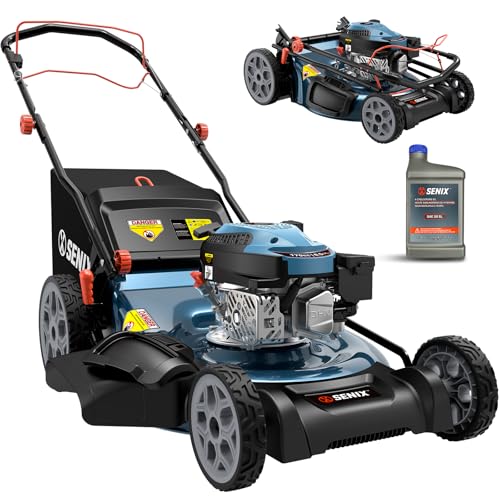
The second SENIX in this guide keeps the wide deck and drops the engine size, which is the right compromise for buyers who want to cover ground quickly without paying for power they will not use. The 22-inch deck matches the widest cut here, while the 170cc four-cycle OHV engine delivers a stated 3.8 horsepower, enough for large lawns that are cut on schedule rather than rescued after a fortnight of growth.
Drive is by the rear wheels at a single ground speed. That fixed pace is the main concession: you walk at the mower’s speed, not your own, which suits a steady, methodical mowing pattern across open ground but can feel hurried in tight corners. In return you get the traction layout that works best as the bag fills, a single-lever control for six cutting heights from 1.25 to 4 inches, and a generous 19-gallon rear bag that means fewer emptying trips on a long session.
The 3-in-1 deck mulches, bags or side-discharges, and the handle folds for storage against a garage wall. For a large, mostly level lawn where the grass rarely gets out of hand, this is the most ground covered per purchase in the guide, and the money saved against the 201cc models can go toward fuel, blades and a spare air filter for the season.
Key specs
- Cutting width: 22 inches
- Engine: 170cc 4-cycle OHV, 3.8 HP stated
- Drive: rear-wheel drive, single speed
- Cutting heights: 6 positions, 1.25 to 4 inches, single lever
- Clipping options: mulch, rear bag, side discharge
- Grass bag: 19 gallons
- Extras: folding handle
How to choose
Deck width is the first decision, because it sets how long the job takes. On a large lawn, a 22-inch deck removes roughly one pass in twenty compared with a 21-inch model, and far more compared with the narrow decks on small-lawn mowers. Width only pays off if the engine can drive the bigger blade, which is why every mower here pairs its deck with at least 170cc, and why thick or sloping ground argues for the 201cc models.
Drive layout comes next. Rear-wheel drive grips better on slopes and as the bag fills, because the load sits over the driven wheels; it is the safer choice for any lawn with a real incline. Front-wheel drive pivots more easily around beds and trees, since you can tip the front wheels off the ground to turn. Speed control matters over distance: a variable or multi-speed drive lets you match the mower to your stride for an hour at a time, while a single-speed drive fixes the pace for you.
Then look at the working details. A single lever that moves all four wheels at once saves minutes at every height change. A taller top cutting setting, up to 4 inches on the SENIX models, lets you take overgrown grass down in two passes instead of forcing one cut. Bag capacity decides how often you stop, so a large catcher earns its keep on big lawns, and a deck washout port, like the one on the YARDMAX, shortens the end-of-session cleanup. Finally, plan fuel stops honestly: walk-behind tanks in this class hold well under a gallon, so on the largest lawns you will refuel mid-job whichever model you choose, and a mower that is easy to handle at walking pace matters more than any single figure on the box.
Who should skip
Skip this whole category if your lawn is larger than about an acre and a half of open ground. At that size a riding mower or lawn tractor finishes in a fraction of the time, and even the widest walk-behind deck becomes the slow option. These machines are the answer for the ground below that threshold, where a rider is hard to justify or cannot reach.
Skip gas entirely if you dislike engine upkeep. Every mower here needs oil changes, air filter care, fresh fuel management and a pull cord on cold mornings. A large battery mower covers a modest large lawn without any of that, though usually with a narrower deck. Also skip the single-speed and front-drive models if your property is steep: a fixed pace on a slope is tiring, and front wheels lose grip exactly when the bag gets heavy. Finally, if your lawn is large only in total but broken into small fenced sections with narrow gates, measure the gate before choosing a 22-inch deck, because a wide mower that cannot reach the back lawn is no bargain.
Frequently Asked Questions
How wide a deck do I need for a large lawn?
For lawns from half an acre to about an acre, a 21- or 22-inch deck is the practical range for a walk-behind mower. Each extra inch removes passes across a long session, but very wide decks need stronger engines and are harder to steer around beds and trees, which is why the picks here cluster at 21 and 22 inches.
Is rear-wheel or front-wheel drive better on a big lawn?
Rear-wheel drive is better on slopes and when bagging, because the weight of a filling bag sits over the driven wheels and preserves grip. Front-wheel drive turns more easily at the end of a row and around obstacles. On a flat, open lawn either works; on a sloping one, choose rear drive.
How much engine does a self-propelled mower need for thick grass?
Displacement between 170cc and 201cc covers this class. A 170cc engine handles large lawns that are cut weekly, while 201cc models hold blade speed better in tall, wet or dense grass and on inclines. Stated torque, where a maker publishes it, is the more useful figure for judging strength in heavy growth.
How often will I stop to empty the bag or refuel on a large lawn?
Expect several bag stops per session on a big lawn in spring growth, which is why a large catcher such as the 19-gallon bag on the SENIX 170cc is worth having. Fuel tanks on walk-behind mowers hold well under a gallon, so plan on one refuelling stop during a long cut on the largest properties.
Final verdict
For the broadest mix of large-lawn work, the YARDMAX YG2860 leads this guide: the widest deck, a 201cc engine and a six-speed drive that adapts to your pace across long runs. Sloping or overgrown ground points to the SENIX 201cc Variable Speed and its rear-wheel grip, while the BILT HARD answers with outright torque. The PowerSmart suits big but gentle lawns that are cut on schedule, and the SENIX 170cc delivers the same wide cut for less money where the grass stays tame. Match the drive to your ground first, and any of the five will make a large lawn feel smaller.
Product and ASIN Reference
| Product | ASIN |
|---|---|
| YARDMAX YG2860 22 in. 201cc Select PACE Self Propelled Lawn Mower | B0B136YJZM |
| SENIX 22-Inch 201cc Variable Speed Self Propelled Gas Lawn Mower | B0H93VB4HJ |
| BILT HARD 21-Inch 201cc Self Propelled Gas Lawn Mower | B0H1PDKB8D |
| PowerSmart 21-Inch 170cc Self Propelled Gas Lawn Mower (DB8621PRX) | B0C53MG5L6 |
| SENIX 22-Inch 170cc Self Propelled Gas Lawn Mower | B0FFMYSSJN |