Key takeaways
- Compare the best drum sanders for home workshops, from a 10-inch benchtop JET to 22-inch open-end models, with feed control, capacity and dust checks.
A drum sander does the one job that a thickness planer and a random orbital sander both handle badly: it flattens glued up panels, levels figured wood that tears out under planer knives, and brings thin or fragile stock to a consistent thickness without snipe. Instead of knives, a wide abrasive wrapped drum spins above a conveyor belt that carries the board through at a controlled feed rate, taking a shallow, even cut across the full width of the piece.

That makes the buying decision mostly about capacity and control. The five machines below run from a true benchtop unit that sands 10 inches in one pass to open ended floor models that handle panels twice their drum width. All five are single drum machines sold for home and small shop use, and each one runs on ordinary household current.
As an Amazon Associate, we earn from qualifying purchases.
Quick answer
For most home workshops, the JET JWDS-1632 is the drum sander to shortlist first. Its SandSmart control slows the conveyor before the drum bogs down, and the open ended frame doubles its 16 inch capacity to 32 inches in two passes. If floor space is the problem, the benchtop JET JWDS-1020 keeps the same style of control in a unit that sits on a bench.
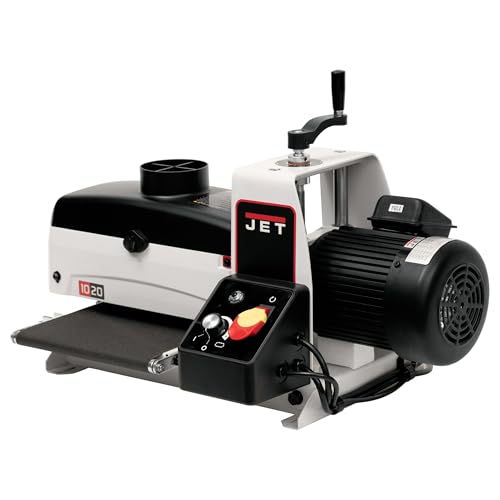
JET JWDS-1020 Benchtop Drum Sander
The JWDS-1020 is the only genuine benchtop machine in this roundup, and it is the natural pick when a drum sander has to share a small garage shop with everything else. It weighs 73 pounds, so two people can lift it onto a bench or a stand, and its footprint is roughly the size of a benchtop planer.
Capacity is better than the small frame suggests. The drum is 10 inches wide and sands boards up to 3 inches thick, and because the drum is cantilevered with an open end, a panel up to 20 inches wide can be surfaced in two passes. The 1 HP motor turns the extruded aluminum drum, which sheds heat well and helps keep abrasive wraps from loading up on resinous wood. Feed speed is infinitely variable from a standstill up to 10 feet per minute, so delicate veneer work can crawl while plain softwood moves through briskly.
A toolless parallelism adjustment lets you level the conveyor to the drum with a dial rather than shims, which matters every time you flip a wide panel for its second pass. A 4 inch dust port handles extraction, and the machine ships with an 80 grit wrap already fitted. For cutting boards, face frames, box parts and narrow glue ups, this is the drum sander most home shops will actually have room for.
JET JWDS-1632 Drum Sander with Stand
The JWDS-1632 is the machine most of the other open ended sanders get compared with, and it earns that position with its SandSmart control. The system watches the load on the drum motor and automatically regulates conveyor speed, backing the feed off when a deep cut or a hard species starts to overload the drum, then speeding back up when the load eases. That single feature prevents most of the burning, stalling and torn abrasive that frustrate first time drum sander owners.
The 1.5 HP motor drives a 16 inch drum, and the open stand design means panels up to 32 inches wide can be surfaced in two passes. Maximum stock thickness is 3 inches, feed rate is variable up to 10 feet per minute, and the reinforced steel conveyor bed keeps long boards tracking straight. JET rates the machine for a 20 amp circuit, so check your shop wiring before ordering, and the dust port is a standard 4 inch fitting that wants a collector rated around 400 CFM or better.
At roughly 180 pounds on its open stand, this is a park it and leave it machine rather than a portable one. Optional locking casters and folding infeed and outfeed tables exist for it and are worth budgeting for if you surface long stock often.
VEVOR 16-Inch Drum Sander with Stand (MS3140)

The VEVOR MS3140 matches the JET 1632 on headline capacity, 16 inches in one pass and stock up to 3 inches thick, but it takes a different route on the details. It uses two motors: a 1.5 HP motor spins the aluminum drum at 1720 RPM while a separate gear reduction motor drives the conveyor. Separating the two jobs means the feed stays steady even when the drum is working hard, and the conveyor speed is variable across its full range.
The value argument is in the crate. Extension tables and a caster kit are included rather than sold as accessories, so the machine can support longer boards and roll into a corner without extra spending. The 4 inch dust port is standard, the drum takes ordinary abrasive wraps, and the whole unit weighs about 193 pounds, which makes it a two person assembly job that then stays put.
The trade offs are the ones you would expect from a newer machinery brand: the dealer network is thinner than JET or Laguna, and fit and finish details like the height crank and belt tracking hardware reward a careful first setup. For a home workshop that wants 16 inch capacity with the tables and wheels already in the box, it is a serious alternative to the established names.
SuperMax 19-38 Drum Sander
The SuperMax 19-38, now sold under Laguna Tools, is the width step up in this group. Its 19 inch drum surfaces cabinet doors, wide drawer fronts and most table top glue ups in a single pass, and the open end design stretches that to 38 inches in two passes. The 1.75 HP motor runs on 110 volt service, and the drum turns at 1740 RPM.
SuperMax built its reputation on two features that still define this machine. IntelliSand monitors the drum load and slows the conveyor automatically when a cut gets too aggressive, protecting the abrasive and the finish. The fast adjustment lever lets you raise or lower the head quickly for big thickness changes, then dial in the final setting with the fine adjustment, which speeds up the constant small changes drum sanding involves. Height changes are precise, with a quarter turn of the knob moving the head in fine increments and no backlash to fight.
Construction is heavy cast iron and steel, and the machine weighs around 286 pounds shipped with its stand, so plan a permanent spot for it. A 4 inch dust port sits at the center of the head, and SuperMax recommends a collector in the 600 CFM range. Shops that regularly sand panels wider than 16 inches will feel the difference this machine makes on every project.
JET JWDS-2244 Drum Sander with Stand

The JWDS-2244 is the largest machine here and the one to choose when wide panels are the norm rather than the exception. The 22 inch drum flattens most dining table tops and door panels in one pass, and the open end design raises capacity to 44 inches in two passes. It also handles thicker stock than the rest of this group, up to 4 inches, which suits shops that surface live edge slabs and thick bench tops.
The 1.75 HP motor runs on 115 volt service and pairs with SandSmart load monitoring, so the conveyor slows itself before an ambitious cut can scorch the wood or trip a breaker. A digital readout reports the sanding thickness as you adjust, which makes it much easier to return to a setting or sneak up on a target dimension across several passes. Feed speed is variable up to 10 feet per minute.
This is a floor standing machine at about 216 pounds net on its open stand, and JET recommends a 20 amp circuit and a dust collector moving roughly 550 CFM. It is more sander than a small shop needs for cutting boards and boxes, but for furniture scale work it replaces a great deal of hand sanding and planer tear out repair.
How to choose
Start with width, because it decides the machine class. Add up the widest panels you realistically sand in a year. If everything is under 10 inches, a benchtop unit is enough and saves the floor space. Most furniture work fits a 16 inch drum with two pass capability, while cabinet doors and table tops push you toward 19 or 22 inches.
Open ended versus closed designs matter next. Every machine here is open ended, meaning the drum is supported from one side so stock wider than the drum can pass through in two trips. That flexibility is why open ended sanders dominate home shops, but it also means the second pass only comes out flat if the conveyor is parallel to the drum, so look for an easy parallelism adjustment and use it.
Feed control is the feature that separates frustrating sanders from pleasant ones. Load sensing systems such as SandSmart and IntelliSand slow the conveyor before the drum overloads, which prevents burned wood and shredded abrasive. Separate conveyor motors, as on the VEVOR, achieve steady feeding a different way. Either approach beats a fixed feed rate.
Check the supporting details before buying. Drum sanders make fine dust in volume, so a 4 inch port connected to a real dust collector is not optional equipment. Confirm the circuit the machine wants, since several of these run best on a 20 amp line. Finally, price in the abrasive: wraps in a range of grits are a running cost, and machines that take standard wrap sizes keep that cost down.
Who should skip
Skip a drum sander entirely if your work is mostly small parts, curved work or solid wood thinner than a benchtop planer already handles well, because a good planer plus a random orbital sander covers that ground for less money and less floor space. Drum sanders are also the wrong tool for removing large amounts of material quickly; they take shallow passes by design, and using one as a planer substitute burns abrasive and patience.
Skip the two largest machines here if your shop runs on a single 15 amp circuit you cannot upgrade, or if the sander would have to be moved for every use, because machines in the 200 to 300 pound range effectively become permanent fixtures. And skip the whole category if you rarely glue up panels wider than your planer, since panel flattening is where a drum sander earns its keep.
FAQ
Can a drum sander replace a thickness planer?
No. A planer removes material quickly and sets thickness fast, while a drum sander takes very shallow passes meant for flattening and finish preparation. The two machines complement each other: the planer does the heavy work, and the drum sander removes planer marks, levels glue ups and handles figured wood that would tear out under knives.
What grit abrasive should I start with?
Most of these machines ship with an 80 grit wrap fitted, which is a sensible starting point for flattening and removing planer ripple. Keep finer wraps on hand for finish passes, and coarser wraps only for rough or reclaimed stock. Changing wraps takes a few minutes once you learn the clip system on your machine.
How wide a panel can an open ended drum sander handle?
Twice the drum width, in two passes. A 16 inch machine surfaces a 32 inch panel by running one half through, flipping the panel, and running the other half. The result depends on the conveyor being parallel to the drum, so check that adjustment whenever you plan a two pass panel.
Do I really need a dust collector for a drum sander?
Yes. Drum sanders produce a large volume of fine dust, and the dust hood is designed around strong extraction. A shop vacuum is not enough for sustained work on the larger machines here. Follow the CFM guidance in the manual for the model you choose and keep the collector connected for every pass.
Final verdict
For the majority of home workshops, the JET JWDS-1632 is the safest recommendation: proven load sensing feed control, 32 inches of two pass capacity, and a deep accessory and support network. The JWDS-1020 is the right answer when bench space is all you have, the VEVOR MS3140 undercuts the field on included equipment, the SuperMax 19-38 adds single pass width and the best height adjustment in the group, and the JWDS-2244 is the pick for shops that surface wide, thick panels every week.
Product and ASIN Reference
| Product | ASIN |
|---|---|
| JET JWDS-1020 Benchtop Drum Sander | B07Y9546K5 |
| JET JWDS-1632 Drum Sander with Stand | B01LY47GWE |
| VEVOR 16-Inch Drum Sander with Stand (MS3140) | B0FQJDYND4 |
| SuperMax 19-38 Drum Sander | B006O0NIU4 |
| JET JWDS-2244 Drum Sander with Stand | B07JMF88QN |