Our Short List of 3

- Best for: The cranking position on a bass boat that also runs sonar, livewell and accessory loads from the same bank.

- Best for: Bass boat owners replacing a Group 31 cranking or dual-purpose battery who want an AGM from a brand with a broad local service network.
- Best for: Trolling motor banks and electronics power on bass boats where long runtime and low weight matter most.
All 3 Picks at a Glance
| Product | Specs | Action |
|---|---|---|
| 1. OPTIMA D31M BlueTop — Dual-Purpose AGM for Cranking and Accessories |
| Check price on Amazon |
| 2. Interstate 31M-AGM — Group 31 Marine AGM from a Service Network Brand |
| Check price on Amazon |
| 3. LiTime 12V 100Ah TM — Lithium Runtime for the Trolling Motor |
| Check price on Amazon |
Key takeaways
- Find the best battery for a bass boat for cranking, trolling motors and electronics. We compare OPTIMA BlueTop, Interstate AGM and lithium LiFePO4 batteries from LiTime and Dakota Lithium by capacity, group size and duty.
As an Amazon Associate we earn from qualifying purchases.
A bass boat does not have one battery job; it has three, and confusing them is how anglers end up dead on the water. The cranking battery has to start a large outboard instantly, every time, including after hours of sitting with the electronics running. The trolling motor bank has to deliver steady power for a full day of holding on wind-blown points and working down banks, often at 24 or 36 volts. And the electronics — large sonar and chartplotter screens, livewell pumps, shallow-water anchors and lights — draw from one of those banks all day long. The best battery for a bass boat is therefore not a single product so much as a correct assignment: the right battery type, in the right group size, doing the right job.
This guide covers both sides of that assignment. For cranking and combined duty it includes dual-purpose AGM marine batteries that can start an outboard and still cycle under accessory loads. For trolling motor and electronics duty it includes lithium iron phosphate (LiFePO4) deep-cycle batteries, which have changed bass boat rigging more than any other recent development because they deliver their full rated capacity at a fraction of lead-acid weight. The buying guide then explains how to size a bank for your motor’s voltage, why usable capacity differs so much between chemistries, and what charger each type requires.
Affiliate Disclosure: This article contains affiliate links. If you buy through a link on this page, we may earn a commission at no extra cost to you.
Quick Comparison
| Product | Duty | Type | Key ratings | ASIN |
|---|---|---|---|---|
| OPTIMA D31M BlueTop | Cranking and dual-purpose | AGM, Group 31 | 900 CCA, 75Ah, 155 min RC | B00099DW6G |
| Interstate 31M-AGM | Cranking and dual-purpose | AGM, Group 31 | Group 31 marine AGM | B0BHTT7K4J |
| LiTime 12V 100Ah TM | Trolling motor and electronics | LiFePO4, Group 31 | 100Ah, 100A BMS, low-temp protection | B0CS6FC3PG |
| Dakota Lithium 12V 100Ah | Trolling motor and electronics | LiFePO4 | 100Ah, 11-year warranty stated by maker | B08N57HR2K |
| Dakota Lithium 12V 54Ah | Trolling motor, smaller boats and kayaks | LiFePO4 | 54Ah, lightweight | B084WPWXFR |
1. OPTIMA D31M BlueTop — Dual-Purpose AGM for Cranking and Accessories
- Best for: The cranking position on a bass boat that also runs sonar, livewell and accessory loads from the same bank.
The cranking position on a bass boat that also runs sonar, livewell and accessory loads from the same bank.
The D31M is the largest of OPTIMA’s BlueTop marine batteries, and BlueTop is the line OPTIMA builds specifically for marine and RV use. The dual-purpose version — the light grey case — is listed at 900 cold cranking amps, 1,125 marine cranking amps, 75 amp-hours of capacity and 155 minutes of reserve capacity, in a Group 31 case of about 12.81 by 6.56 by 9.38 inches weighing about 59.8 pounds, with both SAE posts and stud terminals for separating engine cables from accessory leads.
That specification is almost a description of a bass boat’s cranking position. Nine hundred CCA starts a big outboard without drama, while 75Ah and 155 minutes of reserve give the battery real cycling ability for the loads that share the cranking bank on most bass boats: sonar units, livewell pumps and aerators, bilge pumps, lights and shallow-water anchor pumps. OPTIMA’s SpiralCell construction winds pure-lead plates into spiral cells, and the maker describes the sealed AGM case as spill-proof, mountable in versatile positions and strongly resistant to vibration — a genuine concern in a bass boat that crosses a choppy lake at speed every morning. OPTIMA also distinguishes its BlueTop types clearly: the dark grey starting-only version should never be cycled, while this dual-purpose version is built for both starting and deep cycling, so confirm you are ordering the dual-purpose battery.
Its limits are the limits of lead-acid itself. At nearly 60 pounds it is heavy, and like every AGM you should plan to use roughly half its rated capacity routinely if you want it to live a long life, which makes its effective daily capacity smaller than the headline figure. For a one-battery or cranking-bank role, though, it remains the simplest robust answer in this guide.
2. Interstate 31M-AGM — Group 31 Marine AGM from a Service Network Brand
- Best for: Bass boat owners replacing a Group 31 cranking or dual-purpose battery who want an AGM from a brand with a broad local service network.
Bass boat owners replacing a Group 31 cranking or dual-purpose battery who want an AGM from a brand with a broad local service network.
Interstate’s 31M-AGM is a Group 31 marine AGM battery sold for the same dual-purpose seat as the BlueTop above: starting the outboard and carrying the boat’s everyday electrical loads. Group 31 is the standard large marine tray size on bass boats, so this battery drops into the compartment, hold-down and cable layout that most cranking positions were built around, and its AGM construction means it is sealed, maintenance-free and spill-proof, with no watering and no acid fumes in a closed battery compartment.
The reason to consider the Interstate alongside the OPTIMA is the brand behind it. Interstate Batteries distributes through a large dealer and service network, which matters for a product category where warranty handling and testing are local, in-person events: a battery that fails in season is a problem you want solved at a counter this week, not shipped across the country. Anglers who value that kind of support, or who are replacing an existing Interstate marine battery and want the same group size and terminal arrangement, will find this the natural like-for-like choice.
Because published headline figures for this listing are thinner than OPTIMA’s, treat the buying checks below as mandatory: confirm the CCA and reserve capacity on the listing and label meet your outboard maker’s minimum, confirm the terminal layout matches your cables, and confirm the dimensions against your tray before ordering.
3. LiTime 12V 100Ah TM — Lithium Runtime for the Trolling Motor
- Best for: Trolling motor banks and electronics power on bass boats where long runtime and low weight matter most.
Trolling motor banks and electronics power on bass boats where long runtime and low weight matter most.
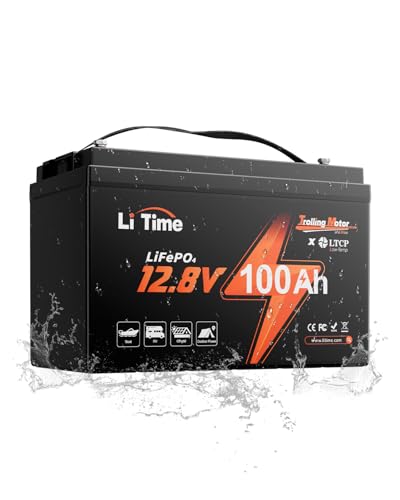
The LiTime 12V 100Ah TM is a lithium iron phosphate battery built specifically for trolling motor duty — TM is the maker’s trolling motor designation — in a Group 31 footprint. Its listing describes a 12-volt, 100 amp-hour LiFePO4 battery with a built-in 100-amp battery management system (BMS) and low-temperature charging protection, designed for marine, boat and RV use. The BMS is not a footnote: it is the electronic guard that protects the cells against overcharge, over-discharge, over-current and short circuit, and the low-temperature protection blocks charging below freezing, which is when lithium cells can be damaged.
For a bass boat, the case for a battery like this rests on two numbers that have nothing to do with its headline capacity. The first is usable capacity: a LiFePO4 battery can be discharged through essentially its full rated capacity as a matter of routine, where a lead-acid battery should be kept to about half, so one 100Ah lithium battery delivers roughly the daily usable energy of a much larger lead-acid bank. The second is weight: a Group 31 LiFePO4 battery weighs a fraction of a Group 31 AGM, and removing that weight from the bow or the stern compartment improves hole shot, top speed and shallow-water draft all at once. LiTime also describes very long deep-cycle life for this battery family compared with the few hundred cycles typical of lead-acid, which is why the higher purchase price is often recovered over the battery’s service life.
Two cautions are essential. This is a deep-cycle battery for the trolling motor and electronics; it is not sold as an outboard cranking battery, so keep a proper cranking battery in the starting position unless your outboard maker explicitly approves the specific lithium model for starting. And lithium requires a charger with a LiFePO4 profile — check that your onboard charger offers one, or budget for a charger that does, before the battery arrives.
4. Dakota Lithium 12V 100Ah — Premium Lithium with a Long Warranty
ASIN: B08N57HR2K
Dakota Lithium’s 12-volt 100 amp-hour LiFePO4 battery is the premium version of the same idea as the LiTime above: a full 100 amp-hours of lithium capacity for trolling motors, fish finders and marine electronics, in a battery that weighs roughly half or less of the Group 31 lead-acid battery it replaces. Dakota Lithium describes its batteries as built around LiFePO4 chemistry for long cycle life and backs this battery with an 11-year warranty, the longest commitment in this guide and a large part of what the premium buys, alongside United States-based support.
On the water, the advantages mirror the LiTime’s: nearly all of the rated capacity is usable, voltage stays steadier through the discharge — keeping a trolling motor pulling hard late in the day and sonar images clean — and the weight saving compounds across a bank. Two in series make a 24-volt system and three make a 36-volt system.
The same two cautions apply, and they are worth repeating because they are the mistakes that damage lithium batteries. Use this battery for deep-cycle duty, not as an outboard starter, unless the maker explicitly rates the specific model for cranking your engine. Charge it only with a LiFePO4-compatible profile, and respect the low-temperature charging limits in the maker’s documentation if you fish through winter. Bought for the right seat and charged correctly, this is the fit-and-forget end of the trolling motor market.
Best for: Tournament and frequent anglers building a 12-, 24- or 36-volt lithium trolling bank who want the longest stated warranty in this guide.
5. Dakota Lithium 12V 54Ah — Lightweight Lithium for Smaller Rigs
ASIN: B084WPWXFR
Not every fishing boat needs 100 amp-hours. Dakota Lithium’s 12-volt 54 amp-hour LiFePO4 battery is listed by the maker for trolling motors, fish finders, ice fishing and marine use, with the same 11-year warranty commitment as its larger sibling and a cycle-life rating the maker describes in the thousands. At 54Ah it carries a little over half the energy of the 100Ah batteries above, in a substantially smaller and lighter package that one person can carry to the launch in one hand.
On a small bass boat, jon boat or kayak with a modest 12-volt trolling motor, 54 amp-hours of usable lithium capacity covers a full day of stop-and-go fishing without the stern-heavy penalty of lead-acid. It is also a sensible dedicated electronics battery, isolating sonar from the voltage dips of engine starting that reboot screens.
What it is not is a tournament bass boat’s main trolling bank. Anglers running high-thrust 24- or 36-volt motors all day in wind and current should size up to the 100Ah batteries, in series sets as needed, rather than asking a 54Ah battery to do a job beyond its capacity. Match the battery to the motor and the day you actually fish, and this smaller lithium makes a clean, light solution.
Best for: Smaller bass boats, jon boats and kayaks with 12-volt trolling motors, and dedicated electronics banks.
How to Choose the Best Battery for a Bass Boat
Assign batteries by job before you compare brands. Every bass boat needs a cranking battery rated for starting its outboard, and most need a separate deep-cycle bank for the trolling motor. Dual-purpose AGM batteries such as the OPTIMA D31M BlueTop and the Interstate 31M-AGM belong in the cranking seat when electronics share that bank. LiFePO4 batteries such as the LiTime TM and the Dakota Lithium models belong in the trolling and electronics seats. Putting a deep-cycle-only battery in the cranking seat, or a starting battery on the trolling motor, shortens both the day and the battery’s life.
Match the bank voltage to the trolling motor. A 12-volt motor needs one 12-volt battery. A 24-volt motor needs two 12-volt batteries wired in series, or a dedicated 24-volt battery. A 36-volt motor needs three in series, or a dedicated 36-volt battery. Series batteries should be the same model, the same age and the same state of charge; replace a series bank as a matched set rather than dropping one new battery in beside tired ones, because the weakest battery limits and is overworked by the whole string.
Compare usable capacity, not just amp-hours. A 100Ah lead-acid battery should routinely give up only about half its capacity if it is to last, while a 100Ah LiFePO4 battery can use essentially all of it. That is why a single lithium battery so often replaces a pair of lead-acid batteries in practice. For planning, a trolling motor draws roughly one amp per pound of thrust at full speed, less at the lower settings anglers use most; work out your hours at your typical settings against usable capacity, not the number on the case.
Confirm the group size and the compartment. Group 31 is the common large bass boat size, and Group 27 and Group 24 appear on smaller rigs. Measure the tray, check the hold-down, note the terminal positions, and on lithium batteries confirm the case size matches the group footprint claimed, because lithium cases sometimes borrow a group size approximately rather than exactly.
Check the charger before the batteries arrive. AGM batteries need an AGM charge profile. LiFePO4 batteries need a lithium profile with the correct voltage and no equalisation stage, and they must not be charged below freezing unless the battery has low-temperature protection or heating. Many modern onboard chargers offer selectable profiles per bank, which lets one charger serve an AGM cranking battery and a lithium trolling bank correctly at the same time.
Caring for Bass Boat Batteries
Charge after every trip, whatever the chemistry. Lead-acid batteries left sitting partly discharged lose capacity permanently, and lithium batteries store best partly charged rather than full or empty, following the maker’s storage guidance. Keep terminals clean and tight, inspect cables and connections at the start of the season, and make sure every battery is held down properly — a bass boat’s ride across chop is a vibration test no battery passes while bouncing loose in its compartment.
During the off-season, disconnect parasitic loads, top up lead-acid batteries with a smart maintainer on the correct profile, and store lithium batteries at the maker’s recommended state of charge. Test before the first tournament rather than at the ramp.
Frequently Asked Questions
Can I use a lithium battery to start my outboard?
Only if the battery’s maker explicitly rates that specific model for engine cranking and your outboard maker approves it. The lithium batteries in this guide are deep-cycle batteries for trolling motors and electronics, so keep a cranking or dual-purpose AGM such as the OPTIMA D31M BlueTop in the starting position.
How many batteries does a bass boat need?
At minimum two systems: one cranking battery for the outboard, and a trolling bank of one, two or three batteries depending on whether the trolling motor is 12, 24 or 36 volts. Many bass boats therefore carry two to four batteries in total, plus the electronics load sharing one of those banks.
Is lithium worth it for a trolling motor?
For anglers who fish often, usually yes. A LiFePO4 battery offers roughly double the usable capacity of a same-rated lead-acid battery, a fraction of the weight, steadier voltage through the day and a far longer cycle life. For an occasional angler with a small 12-volt motor, an AGM deep-cycle battery can still be the more economical answer.
What size battery do I need for a 24-volt trolling motor?
Two 12-volt deep-cycle batteries of the same model wired in series — two of the 100Ah lithium batteries in this guide are a common tournament choice — or a single dedicated 24-volt battery. Size the amp-hours to your longest day, using usable capacity rather than the headline rating.
Verdict
Build a bass boat’s battery system by seats, not by shopping for a single winner. In the cranking seat, the OPTIMA D31M BlueTop (B00099DW6G) is the dual-purpose AGM benchmark, with 900 CCA and 155 minutes of reserve for the electronics that share its bank, and the Interstate 31M-AGM (B0BHTT7K4J) is the Group 31 alternative for owners who value a broad local service network. In the trolling and electronics seats, lithium has earned its place: the LiTime 12V 100Ah TM (B0CS6FC3PG) brings trolling-specific lithium runtime in a Group 31 case, the Dakota Lithium 12V 100Ah (B08N57HR2K) adds the longest stated warranty in this guide, and the Dakota Lithium 12V 54Ah (B084WPWXFR) covers smaller rigs and dedicated electronics banks. Match the bank voltage to your motor, size by usable capacity, charge each chemistry on its correct profile, and the system will start the outboard, pull the trolling motor and run the screens from the first cast to the weigh-in.