Key takeaways
- Choose the best hydrometer for battery testing, comparing EZRED and OTC flooded-cell testers for specific gravity range, temperature compensation, safety and ease of reading.
As an Amazon Associate we earn from qualifying purchases.
Affiliate Disclosure: This article contains affiliate links. If you buy through a link on this page, we may earn a commission at no extra cost to you. Product details are taken from manufacturer and seller listings, not from detailed research by the author, and should be confirmed on the product page before you order.
A battery hydrometer is one of the oldest tools in the workshop, and for flooded lead-acid batteries it is still one of the most honest. A voltmeter tells you what the whole battery is doing at its terminals. A conductance tester estimates health from an electrical model. A hydrometer does something neither of those can do: it samples the actual electrolyte inside each individual cell and measures its density, which rises and falls directly with that cell’s state of charge. When one cell is quietly failing while the others are healthy — the classic pattern in an ageing golf cart pack, a marine house bank or a farm tractor battery — the hydrometer is the tool that shows you which cell it is.
That clarity comes with strict limits, and this guide will be plain about them. A hydrometer only works on batteries whose cells you can open: flooded lead-acid batteries with removable vent caps. It cannot test a sealed AGM, gel or lithium battery, because there is no accessible liquid electrolyte to sample. It also involves handling dilute sulphuric acid, so it demands basic safety discipline. Within those limits, though, choosing well matters. Hydrometers differ in how they display the reading, whether they compensate for temperature, how rugged the barrel and bulb are, and how easy the scale is to read in poor light under a bonnet or inside a battery compartment.
This guide explains what specific gravity means, how to take a reading correctly and safely, what separates a good hydrometer from a frustrating one, and then looks at two widely sold models from established tool brands, with the evidence level for each stated openly. It closes with the mistakes that produce false readings, because most bad hydrometer results are technique problems rather than tool problems.
What a hydrometer actually measures
Electrolyte in a flooded lead-acid battery is a mixture of sulphuric acid and water. As the battery discharges, sulphuric acid is absorbed into the plates and the mixture becomes more water-like, so its density falls. As the battery charges, the acid returns to the electrolyte and density rises again. Specific gravity is the ratio of the electrolyte’s density to the density of pure water, so a fully charged cell reads high and a discharged cell reads low.
The working range for battery work is narrow and well established. Most battery hydrometers are scaled from about 1.100 to 1.300. A fully charged flooded cell typically reads somewhere around 1.265 to 1.300 depending on the battery’s design and the manufacturer’s specification, a partly discharged cell reads lower, and a cell down near 1.100 is effectively discharged. The exact full-charge figure varies by battery type and maker, so treat the manufacturer’s published figure for your battery as the reference and use the hydrometer to compare cells against each other and against that reference over time.
That cell-to-cell comparison is the hydrometer’s real diagnostic power. After a full charge, the cells of a healthy battery should read closely together. A single cell that sits clearly below its neighbours — a spread of roughly fifty points, meaning 0.050, or more is the commonly used warning threshold in battery service guidance — points to a cell that is sulphated, shorted or otherwise failing, and no amount of charging will usually bring it back into line. A battery can show a respectable terminal voltage and still hide one bad cell; the hydrometer finds it.
Temperature, and why it changes the reading
Specific gravity readings are temperature-sensitive because liquids expand as they warm. Warm electrolyte is less dense, so the same state of charge gives a slightly lower reading on a hot day and a slightly higher one in a cold workshop. Readings are conventionally corrected to a standard reference temperature, around 80 degrees Fahrenheit in North American battery practice.
Hydrometers handle this in three ways. Some have a built-in thermometer and a correction scale printed on the instrument, so you read the electrolyte temperature and adjust. Some use a compensated scale or pointer design that the maker states needs no separate temperature table. And the simplest float types leave the correction entirely to you, which is fine if you know the rule of thumb used in service work — roughly, add or subtract a few points of specific gravity for each ten degrees the electrolyte sits above or below the reference temperature — and misleading if you compare a cold morning reading directly against a warm afternoon one without thinking about it.
For a home user testing one car battery a few times a year, temperature compensation is a convenience. For anyone maintaining a bank of deep-cycle batteries in an unheated building, where electrolyte temperature swings widely across the seasons, it is close to essential for consistent records. Decide which you are before you choose the tool.
The main hydrometer designs
The classic design is the float hydrometer: a glass or plastic barrel with a rubber bulb on top and a flexible intake tube below. You squeeze the bulb, dip the tube into the cell, and release to draw electrolyte up until a calibrated float inside rises freely. You read the scale on the float where it meets the surface of the liquid. Float hydrometers are simple, cheap to make well, and easy to understand, but the float can stick to the barrel wall, bubbles can lift it, and reading a fine scale at the liquid line takes a steady hand and decent light.
A second design replaces the free float with a pointer, dial or disc mechanism. As the sample fills the chamber, a sensing element moves a pointer across a printed scale, or floating discs rise according to density. These are often marketed as easier to read, because you look at a pointer position or count discs rather than judging a meniscus on a narrow float, and some incorporate temperature compensation into the mechanism. The trade-off is more moving parts in contact with acid, so rinsing after use matters even more.
Refractometers are the modern alternative: a drop of electrolyte on a prism, a look through an eyepiece, and a digital or optical scale reading. They use far less electrolyte and are very repeatable, but they are a different instrument at a different price point, and this guide stays with true hydrometers, which is what the search asks for. Whichever design you pick, acid resistance is non-negotiable: barrels, bulbs and seals live in sulphuric acid, and materials not made for it swell, crack or cloud until the scale is unreadable.
How to take a correct and safe reading
Safety first, every time. Wear eye protection and gloves, work in ventilation, keep baking soda and clean water nearby for spills, and never lean your face over an open cell. Batteries that have just been charged can release hydrogen gas, so keep sparks and flames away and do not test immediately after fast charging if the electrolyte is gassing heavily. Remove the vent caps carefully, and if the electrolyte level is below the top of the plates, top up with distilled water only, then charge the battery before testing — adding water and testing straight away dilutes the sample and gives a falsely low reading.
Charge state matters for the same reason. A hydrometer reading is only meaningful on a battery that has been charged and then rested, because surface charge and recent gassing distort the sample. Draw electrolyte into the barrel and expel it back into the same cell once or twice before taking the reading; this mixes the sample and wets the float so it moves freely. Draw enough liquid that the float or sensing element floats clear of the top and bottom stops, hold the instrument vertical, tap it lightly to dislodge bubbles, and read at eye level. Record the figure for that cell, return the electrolyte to the same cell — never transfer electrolyte between cells — and move to the next. When you finish, rinse the hydrometer thoroughly with clean water, because dried acid residue is the main cause of sticky floats and false readings next time.
The two hydrometers in this guide
EZRED SP101 Battery Hydrometer — the simple, rugged workshop standard
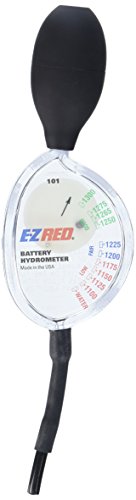
The EZRED SP101 is the hydrometer most likely to be hanging in a service station, and its listing describes it exactly that way: a battery hydrometer made to stand up to tough treatment in service stations and garages, designed so that both customer and technician can see the state of the battery acid. Its stated specific gravity range is 1.100 to 1.300, which covers the full working span from discharged to fully charged for flooded cells. The maker emphasises two usability points: there is no difficult float reading to interpret, and no temperature tables are required, which places it in the easy-reading category rather than the fine-scale laboratory category. The listing describes the construction as rugged and the tool as economical in the sense that the first cost is the only cost, with no replacement parts in normal use.
For a home mechanic or a golf cart owner, that combination is the appeal. You are not buying precision instrumentation; you are buying a tool that survives a toolbox, reads clearly enough to compare cells and judge state of charge, and asks little technique of you beyond the basics above. Its limits follow from the same simplicity: if you keep formal charge records for a large off-grid bank and need the finest repeatable figures, a temperature-compensating professional instrument is the better class of tool. One caution from the indexed listing data: the product information carried a note that the model was listed as discontinued by the manufacturer, so check the current listing and seller carefully before ordering, and make sure the item offered is the genuine SP101.
- Evidence level: candidate — the ASIN, range and product description come from the indexed Amazon US listing for this exact model, but a live product page read could not be completed in this batch because Amazon returned an access-denied response. Confirm current availability, seller and specification on the product page before ordering.
OTC 4619 Professional Battery Hydrometer — the temperature-aware professional option
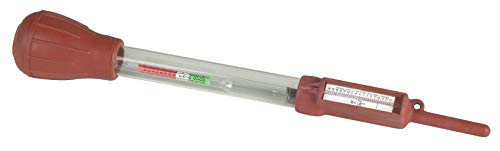
The OTC 4619 is positioned a step up, as a professional battery hydrometer. Seller and manufacturer descriptions state that it displays the battery’s specific gravity on an easy-to-read float with a scale ranging from 1.100 to 1.300, the same working span as the EZRED. What lifts it into the professional category in the descriptions is temperature: the instrument is described as temperature-compensating in design summaries and as fitted with a thermometer with a direct correction approach in others, which reflects the reality that temperature handling is its headline feature compared with basic float testers. Descriptions also emphasise a professional build intended for repeated workshop use, with a glass barrel and a heavy-duty rubber bulb and intake arrangement suited to drawing samples from deep cells.
Choose the OTC if your research is regular, recorded and done across seasons — a marine or RV house bank you monitor monthly, a fleet of flooded batteries, solar storage in an outbuilding — because consistent, temperature-aware readings make your records comparable from visit to visit. Choose it, too, if you simply prefer reading a float scale on a professional instrument and are willing to rinse and store it carefully, since glass rewards care and punishes drops. For occasional checks on a single car, it is more tool than the job requires, and the simpler EZRED pattern will serve you just as honestly.
- Evidence level: candidate — the ASIN comes from Amazon US product links for this exact model found in research, and the range and features from manufacturer and seller descriptions, but a live product page read could not be completed in this batch because Amazon returned an access-denied response. Confirm current availability and the exact specification on the product page before ordering.
No other hydrometer models are given codes in this guide, deliberately. Several other well-known testers — deluxe float testers from general tool brands and deep-cycle testers from battery brands — are sold on Amazon US, but a code that could not be tied to an indexed listing for the exact model was not attached to them here. Buy those by exact brand and model number from the listing, and check the scale range and temperature arrangement against the guidance above.
Mistakes that produce false readings
The commonest error is testing the wrong battery type. If the battery has no removable caps, stop: it is sealed, and forcing access damages it and tells you nothing. The second error is testing straight after adding water or straight off the charger, both covered above. The third is a dirty instrument. A float that sticks because of dried acid or contaminated residue reads late and low; rinse after every session and store the hydrometer clean. The fourth is reading carelessly — barrel tilted, float touching the wall or the stops, bubbles clinging to the float, scale read from above instead of at eye level. The fifth is chasing tiny differences. A hydrometer is a comparison and state-of-charge tool, not a laboratory density meter; treat differences of a few points as noise, and differences of fifty points between cells as the signal.
Frequently asked questions
Can I use a hydrometer on an AGM or sealed battery? No. AGM, gel and sealed maintenance-free batteries have no accessible liquid electrolyte to sample, and opening them is not a service procedure. Use voltage and conductance testing for those batteries, and reserve the hydrometer for flooded batteries with removable caps.
What specific gravity means fully charged? It depends on the battery maker’s specification, but fully charged flooded cells commonly read around 1.265 to 1.300, and a cell near 1.100 is discharged. Always compare against the specification for your battery and, just as importantly, compare the cells against each other.
One cell reads much lower than the rest. What does that mean? After a full charge and rest, one cell sitting roughly fifty points or more below its neighbours usually indicates a failing cell — sulphation, a short or lost active material. Charging rarely restores it, and the battery is normally approaching replacement.
How often should I test? For a car in daily use, testing when starting feels sluggish or before winter is enough. For golf cart, marine, RV and off-grid deep-cycle banks, a monthly or seasonal routine with written records per cell is the practice that catches decline early.
Do I need temperature compensation? If you test in a climate-controlled space and only need state of charge, you can manage without it. If you test the same bank across hot and cold seasons and compare readings over time, compensation or a built-in thermometer makes those comparisons trustworthy.
Bottom line
The best hydrometer for battery testing is the one whose reading style and temperature handling match how you actually maintain batteries. For straightforward, rugged, occasional use on flooded car, golf cart and marine batteries, the EZRED SP101 pattern — full 1.100 to 1.300 range, easy reading, no temperature tables — is the sensible standard. For regular, recorded testing across seasons, the OTC 4619’s professional, temperature-aware approach earns its place. Whichever you choose, charge and rest the battery first, protect your eyes, rinse the tool afterwards, and read the cells against each other: that comparison, more than any single number, is what a hydrometer is for.