Key takeaways
- Compare the best chainsaw chain sharpeners for home workshops, from bench grinders to bar-mounted file guides, with pitch fit, file sizes, and setup tips.
A dull saw chain does not just slow you down. It makes the saw work harder, cuts crooked, throws fine dust instead of chips, and tempts you to push down on the bar, which is where control starts to slip away. Sharpening your own chains at home fixes all of that, and it costs far less over a few seasons than paying a shop or swapping in a new chain every time the edge fades.
The five sharpeners below cover the main ways home users keep a chain sharp: a bench grinder for repeatable workshop results, guided file holders that sharpen cutters and depth gauges together, a bar-mounted filing guide for precision hand work, and a rotary-tool attachment for owners who already have the tool it mounts on. Each one fits a different budget, chain pitch, and sharpening style.
As an Amazon Associate, we earn from qualifying purchases.
Quick answer
For most home workshops, the Oregon 410-120 bench grinder gives the most repeatable results across every common chain pitch. If you prefer hand filing, the STIHL 2 in 1 Easy File sharpens cutters and depth gauges in one guided pass, while the Granberg File-N-Joint adds bar-mounted precision. Dremel owners can start with the A679-02 attachment kit instead.
Oregon Professional Compact 120-Volt Bench Chain Grinder (410-120)

The Oregon 410-120 is the pick for anyone who sharpens several chains a season and wants every cutter ground to the same angle and length. It bolts to a bench or mounts on a wall, and the chain sits in a self-centering vise that you index from tooth to tooth. A built-in work light shines right on the cutter, which matters more than it sounds when you are checking whether the grinding wheel is kissing the edge or digging in.
Oregon ships the grinder with two grinding wheels for cutter work and a flat profile disc for depth gauges, plus a dressing brick and a quick-check template so you can keep the wheel profile honest. It handles the full spread of homeowner chain pitches, from small quarter-inch chain up to .404-inch pitch, which covers everything from pole saws to large firewood saws.
The trade-offs are setup time and a fixed home in the workshop. Dialing in the vise angles for a new chain takes a few minutes, and a grinder removes metal faster than a file, so a heavy hand shortens chain life. Work through one side, reset the vise, then do the other, with a light touch on each tooth.
STIHL 2 in 1 Easy File Chain Sharpener, .325-Inch (56057504304)
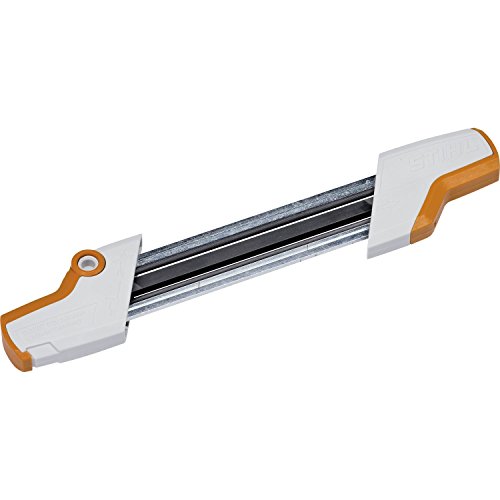
The STIHL 2 in 1 Easy File solves the most common hand-filing mistake: sharpening the cutters while ignoring the depth gauges, the small rakers in front of each tooth that decide how big a bite the cutter takes. The guided holder carries two round files for the cutters and a flat file for the depth gauges, so a single pass along each tooth handles both jobs at the angle the guide sets.
This version is sized for .325-inch pitch chain, the pitch found on many mid-size homeowner and farm saws, and the file diameter matches that chain. STIHL sells sibling versions for other pitches, so match the holder to your chain before ordering. The guide markings line up with the witness marks stamped on STIHL cutters, which makes it easy to keep your stroke angle consistent from the first tooth to the last.
Because the tool rides on the chain itself, it works anywhere: tailgate, stump, or workshop bench. It removes metal slowly, which forgives beginner technique but means a badly rocked chain takes patience. Keep spare round files on hand, since a worn file burnishes instead of cutting. For occasional users who sharpen a few times a year, this is the simplest route to a chain that pulls itself into the wood again.
Granberg File-N-Joint Bar-Mounted Chain Saw Sharpener (G-106B)

The Granberg File-N-Joint takes hand filing a step further by clamping directly to the guide bar and carrying the file on a rigid, adjustable carriage. Once you set the filing angle, cutter height, and depth-gauge stop, every tooth gets filed to the same geometry, left side and right side alike. That repeatability is what freehand filing struggles to match, and it is why this design has stayed in production for decades.
The body is cast aluminum with zinc-plated steel hardware, and the swivel guide carries calibrated markings so you can return to a recorded setting when you switch chains. It accepts standard round and flat files in the sizes common chain pitches need, and it adjusts for pitch, angle, and tooth height rather than being locked to one chain family.
Two honest caveats: files are not included, so budget for a set in your chain’s size, and the first setup takes a careful read of the instructions. After that, sharpening becomes a rhythm of clamping, filing a tooth, and advancing the chain. Woodcutters who file often and care about even cutter length, the detail that keeps a saw tracking straight, will get the most from it.
Dremel A679-02 Sharpening Attachment Kit (A679-02)
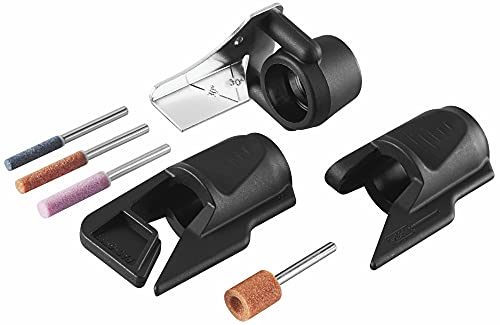
If a Dremel rotary tool already lives in your workshop, the A679-02 kit is the lowest-cost way into powered sharpening. The chainsaw attachment is a guide that holds a small grinding stone at a fixed angle against the cutter while the rotary tool spins it, and the kit includes four sharpening stones in the sizes common chains use. You move along the bar tooth by tooth, touching each cutter for a couple of seconds.
The same box also carries a lawn mower blade sharpening attachment and a garden tool attachment for shears, hoes, and shovels, which makes the kit useful well beyond the saw. Dremel lists compatibility across most of its rotary tool lines, old and current, so the odds are good your existing tool fits.
The limits are real, though. There is no depth-gauge provision, so rakers still need a flat file and a gauge tool from time to time. The guide sets one angle, which will not match every chain maker’s specification exactly, and a spinning stone removes metal quickly if you linger. Treat it as a fast touch-up system between proper sharpenings, and it earns its drawer space. Without a Dremel tool to mount it on, skip to the other picks.
PFERD Chain Sharp CS-X Chain Saw Sharpener, 13/64-Inch File (17303)

The PFERD Chain Sharp CS-X is the other guided 2-in-1 design worth knowing about. PFERD is a German file maker, and its holder positions a round file for the cutter and a flat file for the depth gauge in one ergonomic frame, set at the standard sharpening angle used by most chain makers. Each pass restores the edge and trims the raker to match, the same one-step logic as the STIHL holder.
This 17303 version carries a 13/64-inch file sized for 3/8-inch low-profile chain, the pitch fitted to a huge share of homeowner saws from the major brands. PFERD makes the CS-X in several file sizes for other pitches, so confirm your chain pitch and required file diameter on the chain box or the bar stamp before choosing.
Ergonomics are the quiet strength here: the handle shape keeps your wrist neutral and the file position is visible, which helps new filers see what the file is doing. Replacement files are standard PFERD parts. Shoppers cross-shopping the STIHL holder will notice the family resemblance between the two tools; pick based on the file size your chain needs and which listing fits it exactly, and buy one rather than both.
How to choose
Start with your chain, not the sharpener. Every chain has a pitch, the spacing that decides file diameter and grinder wheel thickness, and it is stamped on the bar or printed on the chain box. Common homeowner pitches are 3/8-inch low profile, .325-inch, and full-size 3/8-inch, and each takes a different file size. A sharpener that cannot match your pitch and file diameter is the wrong sharpener, however good its reviews.
Next, decide how you like to work. A bench grinder is fastest and most consistent for a workshop with several saws, but it stays home and needs setup for each chain. Guided file holders travel anywhere, remove metal gently, and handle depth gauges as part of the pass, at the cost of more strokes per tooth. A bar-mounted guide like the Granberg sits between the two: still hand-powered, but with settings you dial in once. Rotary attachments are quick for touch-ups if you already own the tool.
Finally, think about depth gauges. Cutters get the attention, but a chain with fresh edges and tall rakers still will not bite. If your system does not address depth gauges, add a flat file and a depth-gauge tool to the kit. And plan on brief, frequent touch-ups: a few strokes per tooth after a tank or two of cutting beats a long rescue session later.
Who should skip
Skip this roundup if your saw runs a specialty chain, such as a carbide-tipped chain or a ripping chain for a chainsaw mill. Carbide cutters need diamond abrasives, and ripping chain uses different top-plate angles than the guides here are built around. A milling or rescue-saw dealer is the right source for those.
Also skip the hand-filing picks if your chain has struck rock, soil, or embedded metal and the cutters are chipped unevenly. Rebuilding badly damaged teeth takes a grinder’s controlled metal removal, or a shop’s, and filing one tooth at a time will test your patience. And if you cut only once a year, paying a shop to sharpen while you wait may cost less than any tool on this page.
FAQ
How often should I sharpen my chainsaw chain?
Touch up the chain as soon as it starts throwing fine dust instead of coarse chips, or when you notice yourself pushing the saw into the cut. For most firewood work that means a few file strokes per tooth every one or two tanks of fuel, plus a fuller sharpening whenever the saw has cut dirty wood.
What file size does my chain need?
File diameter follows chain pitch. As a rule, 3/8-inch low-profile chain uses a 5/32-inch or 13/64-inch file, .325-inch chain uses a 3/16-inch file, and full-size 3/8-inch and .404-inch chains use a 7/32-inch file. Confirm against the chain maker’s specification, since a file that is too large or small changes the cutter shape.
Can a bench grinder damage my chain?
Yes, if you press too hard or dwell on one tooth. Grinding builds heat fast, and an overheated cutter loses hardness and dulls quickly afterward. Use a light, tapping contact, keep the wheel dressed to its proper profile, and take the same small amount off each tooth so cutter lengths stay even.
Do I really need to lower the depth gauges?
Yes. Every sharpening shortens the cutters slightly, while the depth gauges stay the same height, so over time the rakers limit how much wood each cutter can take. The saw then cuts slowly even with sharp edges. Guided 2-in-1 holders trim the gauges as you file, which is their main advantage over a bare round file.
Final verdict
For a workshop that sharpens regularly, the Oregon 410-120 bench grinder is the most complete answer: one machine, every common pitch, and cutters ground evenly enough to make a saw track straight again. Hand filers are well served too. The STIHL 2 in 1 Easy File and the PFERD Chain Sharp CS-X both fold depth-gauge work into every pass, the Granberg File-N-Joint adds dialed-in precision on the bar, and the Dremel A679-02 turns a rotary tool you may already own into a quick touch-up station. Match the tool to your chain pitch first, and any of the five will keep you cutting with chips flying.
Product and ASIN Reference
| Product | ASIN |
|---|---|
| Oregon Professional Compact 120-Volt Bench Chain Grinder (410-120) | B00Y0S88Y8 |
| STIHL 2 in 1 Easy File Chain Sharpener, .325-Inch (56057504304) | B00HY96EW8 |
| Granberg File-N-Joint Bar-Mounted Chain Saw Sharpener (G-106B) | B0002ZY1WG |
| Dremel A679-02 Sharpening Attachment Kit (A679-02) | B003BIFMK6 |
| PFERD Chain Sharp CS-X Chain Saw Sharpener, 13/64-Inch File (17303) | B003M4JLE2 |