Key takeaways
- Compare the best cordless hammer drills for brick, block and concrete, checking torque, BPM, chuck type and battery platform before you buy.
A hammer drill/driver is the tool that lets one cordless drill handle the whole job list: driving screws and boring wood like a normal drill, then switching to hammer mode so a carbide masonry bit can chew into brick, block, mortar and light concrete for anchors, tapcons and ledgers. The difference between models is not whether they have a hammer setting — nearly all mid-range drills do — but how much torque sits behind it, how many blows per minute the hammer mechanism delivers, and whether the chuck and gearbox survive regular masonry work. The five drills below are the current flagships and compacts from the major battery platforms, all sold as bare tools, so the deciding factor for most buyers is which battery system already lives in the shop.
As an Amazon Associate, we earn from qualifying purchases.
Quick answer
For most people, the Milwaukee M18 FUEL 2904-20 is the strongest all-round pick, pairing class-leading torque with a compact body. DEWALT owners should look at the three-speed DCD996B for heavy work or the smaller DCD805B for everyday jobs, while Makita users get the punchy XPH14Z or the lighter XPH16Z. All five drill, drive and hammer-drill in one tool.
Milwaukee M18 FUEL 1/2-Inch Hammer Drill/Driver (2904-20)

The 2904-20 is the current M18 FUEL flagship, and it leads this group on outright twisting power: Milwaukee’s brushless motor is rated at 1,400 in-lbs of torque, the highest figure here, with a hammer rate of 33,000 BPM for anchor holes in block and brick. Despite that output, the tool-only body weighs just 3.3 pounds and stays short enough to work between studs, which matters when the same drill spends most of its life driving screws and boring wood rather than drilling masonry.
The half-inch metal ratcheting chuck grips round-shank and hex bits securely under hammer vibration, and the two-speed gearbox lets you drop into low gear for large auger bits or stay in high for fast pilot holes. Milwaukee also builds in an anti-rotation control mode that reacts when the bit binds, reducing the wrist-twisting kick that big hammer drills can deliver when a bit snags in concrete. A side handle is included for two-handed masonry work.
Choose this one if you already own M18 batteries and want a single drill that covers framing, deck ledgers and regular anchor setting without feeling underpowered. It is the benchmark the other four are measured against.
DEWALT 20V MAX XR Hammer Drill/Driver (DCD996B)
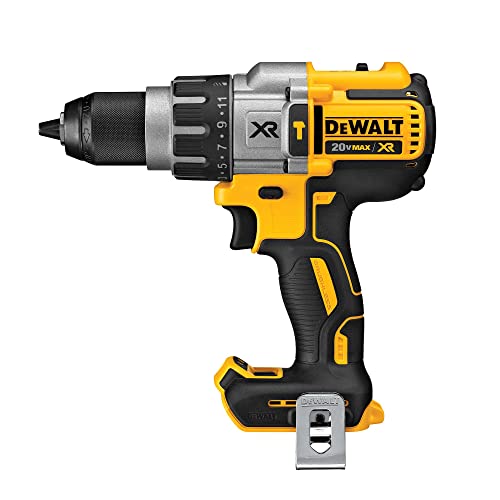
The DCD996B is DEWALT’s long-running premium hammer drill, built around a brushless motor and a three-speed all-metal transmission. That third gear is its signature advantage: a genuine low range for turning large hole saws and self-feed bits, a mid range for general drilling, and a high range for fast work in wood and steel, with hammer mode available for masonry. DEWALT rates the tool at 820 unit watts out, which places it firmly in the heavy-duty class.
An adjustable, removable side handle ships in the box for controlling the torque in hammer mode, and the half-inch metal ratcheting chuck uses carbide inserts to hold bits under impact. The LED foot light offers three modes, including a spotlight setting that stays on for extended work in dark cavities — a small detail that proves useful when drilling inside cabinets or between joists.
Pick the DCD996B if your work mixes heavy driving, big-diameter boring and frequent masonry anchors, and you value gearing range over the last word in compactness. It is a larger, heavier tool than the DCD805B below, and that size is the honest trade for its broader gear spread.
Makita 18V LXT Brushless Hammer Driver-Drill (XPH14Z)

Makita positions the XPH14Z at the top of its LXT drill line, and the spec sheet backs that up: 1,250 in-lbs of maximum torque, two speeds topping out at 2,100 RPM, and a hammer rate of 31,500 BPM. That blow rate is what makes it quick in brick and mortar — for the anchor sizes most home and light commercial work involves, BPM matters as much as torque, and this drill pairs a high figure with a head length of roughly seven inches that fits where bigger flagships cannot.
The all-metal half-inch ratcheting chuck is built for the vibration of hammer work, and the kit-style extras carry over to the bare tool: a side handle, depth stop rod and belt clip are included, so it arrives ready for two-handed masonry drilling. The brushless motor also lets the tool run cooler and longer per charge than the brushed generation it replaced.
The XPH14Z suits Makita 18V owners who drill into masonry often enough to want flagship numbers but still reach for the same drill for daily driving. One buying note: some marketplace listings for this model show limited featured-offer availability, so check the seller details on the listing before ordering.
DEWALT 20V MAX XR Compact Hammer Drill/Driver (DCD805B)

The DCD805B takes the XR formula and shrinks it. Its head is a half-inch shorter than the previous-generation compact it replaced, which makes a real difference inside cabinets, between joists and on ladder work, yet the brushless motor still delivers 620 in-lbs of torque and a hammer rate of 34,000 BPM — the highest blow count in this roundup. Maximum speed is 2,000 RPM across two gears, enough for everything short of production masonry drilling.
That combination makes it the most balanced everyday drill here: light and short for the ninety percent of work that is wood, drywall and hardware, with a genuine hammer function for the occasional brick anchor, doorbell mount or concrete tapcon. The LED foot light and belt hook carry over from the bigger XR models, and it runs on the same 20V MAX batteries as the rest of the platform, including the compact POWERSTACK packs.
Choose the DCD805B if you are on the DEWALT platform and your masonry work is occasional rather than daily. Renovators, electricians and serious DIYers who drill a handful of anchor holes per project will rarely miss the flagship’s extra muscle.
Makita 18V LXT Compact Brushless Hammer Driver-Drill (XPH16Z)

The XPH16Z is Makita’s compact answer to the same problem the DCD805B solves: how much hammer drill can be packed into a body sized for all-day driving. It delivers 970 in-lbs of torque — a strong figure for a compact — with two speeds up to 1,800 RPM and a hammer rate of 27,000 BPM. Those numbers trail the XPH14Z, but they cover the realistic compact workload: anchors in brick and block, pilot holes in mortar, and endless flat-pack, cabinetry and framing fasteners in between.
Because it shares the 18V LXT platform with its bigger sibling, it drops straight into an existing Makita kit with no new batteries or chargers. The shorter, lighter body reduces fatigue on overhead work and repetitive driving, and the brushless motor keeps runtime competitive despite the smaller frame.
Pick the XPH16Z if you want one Makita drill that lives in the tool belt rather than the gang box. Users who regularly set larger anchors in poured concrete should step up to the XPH14Z instead; everyone else gets a more manageable tool for the work they actually do most.
How to choose
Start with the battery platform, because it decides the real cost. Every drill here is a bare tool, so the cheapest good option is almost always the strong model that matches batteries already on your shelf. Switching platforms means new batteries and a charger, which can outweigh any spec advantage.
Next, separate torque from hammer rate, because they do different jobs. Torque, measured in inch-pounds, is what drives lag screws, turns auger and self-feed bits, and keeps large hole saws moving. Hammer rate, measured in blows per minute, is what pulverizes masonry ahead of a carbide bit — for anchor holes in brick and block, a high BPM figure usually means faster drilling than a small torque advantage. Flagships such as the Milwaukee and the XPH14Z offer both; compacts trade some of each for size.
Then be honest about how much masonry you drill. A hammer drill/driver uses a cam-action hammer mechanism that is ideal for brick, block, mortar and light concrete up to moderate anchor sizes. It is not a rotary hammer: if your work is mostly holes in poured concrete, structural anchors or any chiseling, an SDS-Plus rotary hammer is the right tool and no drill/driver substitutes for it. Occasional tapcons and brick anchors, on the other hand, are exactly what these five are built for.
Finally, check the supporting details. A metal ratcheting chuck holds up to hammer vibration better than a plastic one. A side handle is close to mandatory for controlled masonry work with a high-torque drill. Two speeds are standard; DEWALT’s three-speed DCD996B adds a true low gear for the largest bits. And consider anti-rotation protection, like the system on the Milwaukee, if you regularly bore big holes where bit binding is a real risk.
Who should skip
Skip this entire category if your drilling is mostly in poured concrete or you need to set large structural anchors — buy or rent an SDS-Plus rotary hammer instead, because a cam-action hammer drill will be slow and will wear bits quickly. Also skip these bare tools if you own no batteries on any of these platforms and only drill a few holes a year; a corded hammer drill or a drill/driver kit on sale will cost less to get started. And if you never touch masonry at all, a plain drill/driver is lighter and cheaper than its hammer-equipped twin, so there is no reason to carry the extra mechanism.
FAQ
Can a cordless hammer drill replace a rotary hammer?
No. A hammer drill/driver vibrates a carbide bit forward with a cam mechanism, which works well in brick, block and mortar. A rotary hammer uses a piston to deliver far more impact energy per blow and accepts SDS bits, making it much faster in poured concrete. For a few anchor holes, the hammer drill is fine; for daily concrete work, it is the wrong tool.
What bits do I need for the hammer mode on these drills?
Use carbide-tipped masonry bits with round or hex shanks that fit a standard three-jaw chuck — all five drills here use a conventional half-inch keyless chuck, not SDS. Standard twist bits and spade bits handle the wood and metal side. Never use a masonry bit in hammer mode on wood or steel, and never use a standard twist bit in hammer mode on masonry.
Is a bare tool a good buy if I am starting from zero?
Usually not as a first purchase. These five are sold without batteries or chargers, aimed at users already invested in the platform. If you are starting fresh, a kit version of the same drill with two batteries and a charger almost always works out cheaper than buying the parts separately, and it gets you working immediately.
How big a hole can these drills handle in concrete?
With a sharp carbide bit, expect comfortable drilling for the common anchor range — roughly quarter-inch to half-inch holes in brick, block and light concrete. Larger diameters, deep holes and poured or reinforced concrete slow these tools down sharply and are rotary-hammer territory. Working in low gear with the side handle fitted gives the best control at the top of that range.
Final verdict
There is no weak tool in this group, only platform decisions. Milwaukee’s 2904-20 is the strongest single pick for anyone on M18 batteries. DEWALT users split by workload: the DCD996B for gearing range and heavy boring, the DCD805B for a compact everyday drill with a real hammer mode. Makita owners get the same split with the flagship XPH14Z and the handier XPH16Z. Match the drill to your batteries first, your masonry workload second, and any of the five will serve for years.
Product and ASIN Reference
| Product | ASIN |
|---|---|
| Milwaukee M18 FUEL 1/2-Inch Hammer Drill/Driver (2904-20) | B0BB854SJ8 |
| DEWALT 20V MAX XR Hammer Drill/Driver (DCD996B) | B01DR90MM6 |
| Makita 18V LXT Brushless Hammer Driver-Drill (XPH14Z) | B08VN5TKVR |
| DEWALT 20V MAX XR Compact Hammer Drill/Driver (DCD805B) | B09YXQHR8M |
| Makita 18V LXT Compact Brushless Hammer Driver-Drill (XPH16Z) | B0CB9P53DS |