Key takeaways
- Compare the best drill bit sharpeners for home workshops, from Drill Doctor electric models to grinder jigs, with bit sizes, angles and split-point picks.
A dull twist bit does not just drill slowly. It wanders off the mark, overheats, work-hardens the surface of metal, and can snap inside a workpiece at the worst possible moment. Most home workshops have a coffee can or a battered index case full of bits in exactly that condition, kept out of habit rather than usefulness. A dedicated drill bit sharpener turns that drawer of scrap back into a working set, restoring factory geometry in about a minute per bit instead of relying on freehand grinding skill that takes years to build.
The five sharpeners below cover the realistic options for a home shop: three self-contained electric machines from Drill Doctor at different feature levels, a bench-grinder jig for people who already own the grinder, and a precision water-cooled jig for Tormek owners. Each one was checked against manufacturer specifications for bit capacity, point angles, and the materials it can grind.
As an Amazon Associate, we earn from qualifying purchases.
Quick answer
For most home workshops, the Drill Doctor 750X is the sharpener to buy: it handles bits from 3/32 to 3/4 inch, adjusts from 115 to 140 degrees, and creates split points. The DD500X covers smaller bits with two fixed angles for less money, and the DD350X is the fixed-angle budget pick. Already own a bench grinder? The General Tools 825 jig costs little. Tormek owners should look at the DBS-22.
Drill Doctor 750X Drill Bit Sharpener

The 750X is the flagship of the Drill Doctor line and the most capable sharpener on this list. It sharpens bits from 3/32 inch up to 3/4 inch, which covers everything in a standard home index plus the larger bits used for lag bolts and dowel work. The point angle adjusts anywhere from 115 to 140 degrees, so the same machine handles general-purpose 118-degree bits and the flatter 135-degree points preferred for harder metals.
A push-to-stop port creates and restores split points, the self-centering feature that keeps a bit from wandering when it starts a hole. An adjustable material-removal control lets you take a light pass on a bit that only needs a touch-up, or grind harder on one with a chipped edge. The E-Z Align chuck system holds the bit at the correct orientation, and the long port design works with longer bits, including masonry bits.
It sharpens high-speed steel, cobalt, carbide, black oxide, and titanium-nitride coated bits on a replaceable diamond wheel. If a workshop drills metal regularly, restores broken bits, or owns bits larger than 1/2 inch, this is the model that fits. The trade-offs are size and complexity: it is the largest unit here, and the extra adjustments reward owners who read the manual and practice on a few sacrificial bits first.
Drill Doctor DD500X Drill Bit Sharpener

The DD500X sits in the middle of the range and suits workshops whose bits top out at 1/2 inch, which describes the majority of home drilling. It sharpens bits from 3/32 to 1/2 inch and offers two point angle settings, 118 and 135 degrees, selected with a simple switch rather than a continuous dial. That covers the two point geometries found on nearly every consumer bit set.
Like the 750X, it can create split points, which is a feature many buyers do not expect at this level. The diamond sharpening wheel handles steel, masonry, carbide, and titanium-coated bits, and the wheel is replaceable when it eventually wears. A one-piece alignment clamp keeps setup consistent from bit to bit, so results stay repeatable once the first couple of bits are done.
What you give up versus the 750X is the adjustable material take-off, the continuous angle range, and capacity above 1/2 inch. For a garage workshop that mostly drills wood, mild steel, and the occasional masonry anchor hole, those omissions rarely matter. Owners who sharpen a full index case once or twice a year will find the simpler controls faster to relearn after months on the shelf.
Drill Doctor DD350X Drill Bit Sharpener

The DD350X is the entry point: a compact electric sharpener that does one job, putting a standard 118-degree point back on bits from 3/32 to 1/2 inch. There is no angle selection and no split-point port. That simplicity is the appeal. Load the bit in the chuck, rotate it against the diamond wheel, and the geometry comes out the same every time, which is exactly what a beginner or an occasional user needs.
It sharpens steel, masonry, carbide, and titanium-nitride coated bits, and the compact body stores on a shelf without claiming bench space. A six-foot power cord gives some flexibility about where it sits during a sharpening session. The fixed angle means bits ground for harder metals at 135 degrees will be converted to 118, which is fine for wood and general work but not ideal for a dedicated metal-drilling set.
This is the right buy for someone whose alternative is throwing dull bits away. A single rescued index case of name-brand bits justifies the machine, and every sharpening after that is effectively free. Anyone who already knows they want split points or larger capacity should step up to the DD500X or 750X instead of buying twice.
General Tools 825 Drill Grinding Attachment

The General Tools 825 is not a sharpener by itself. It is an all-metal jig that bolts down next to a bench or surface grinder and holds the bit at a controlled angle against the side of the wheel, replacing the freehand guesswork that ruins bits. For workshops that already own a bench grinder, it is by far the cheapest route to consistent points, and it has been in production for decades.
The attachment handles bits from 1/8 to 3/4 inch. A pivoting head lets you grind both cutting edges without removing the bit, and the angle gauge offers settings that cover the common point angles, including the standard 118-degree geometry. The manufacturer specifies it for use with ANSI, OSHA, and UL approved grinders, and the wheel must be rated for side grinding, a detail the manual covers and buyers should respect.
The learning curve is real. Setup involves positioning the jig at the correct distance from the wheel and working through the included angle chart, and the first few bits are practice. It also cannot sharpen bits smaller than 1/8 inch, and there is no split-point capability. As a skill-building tool that leverages equipment already on the bench, though, it earns its place, and its all-metal construction should outlast several sets of bits.
Tormek DBS-22 Drill Bit Sharpening Attachment
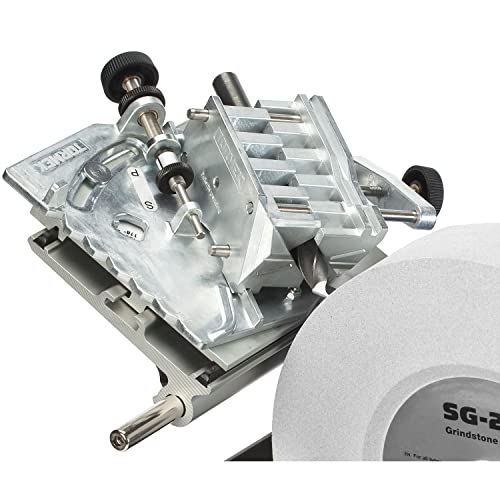
The DBS-22 is a precision jig for Tormek water-cooled sharpening systems, and it exists for owners who want drill points ground to tighter tolerances than a dry electric sharpener produces. It mounts on the Tormek universal support and sharpens bits from 3 mm to 22 mm, roughly 1/8 to 7/8 inch, the widest capacity on this list.
Its signature feature is the four-facet point. Instead of the flat chisel edge a conventional grind leaves, the DBS-22 grinds a pointed four-facet geometry that starts holes without walking and cuts rounder, straighter holes. Point angles adjust continuously between 90 and 150 degrees, and the clearance angle can be set to 7, 9, 11, or 14 degrees to suit the material being drilled. Both cutting edges are ground symmetrically in the same setup, which is what makes the accuracy repeatable.
Water cooling keeps the bit from overheating and losing its temper during grinding, a genuine advantage on small bits and high-speed steel. The obvious limitation is that the jig does nothing without a Tormek machine underneath it, so it only makes sense for existing Tormek owners. For them, it turns a sharpening station they already trust for chisels and knives into the most precise drill sharpener here.
How to choose
Start with bit size. Measure the largest bit you actually use. If everything in your index is 1/2 inch or under, the DD350X and DD500X cover you. Bits up to 3/4 inch require the 750X, the General Tools 825, or the DBS-22. Very small bits under 1/8 inch rule out the 825 jig entirely.
Next, think about point angles. A fixed 118-degree point handles wood, plastic, and soft metal well. If you drill steel regularly, a 135-degree option, found on the DD500X and 750X, reduces wandering and heat. Split points matter for the same reason: they self-center on contact. Only the two larger Drill Doctor models create them.
Consider what you already own. A bench grinder on the bench makes the General Tools 825 the value pick, accepting a steeper learning curve. A Tormek station makes the DBS-22 the precision pick. Everyone else is better served by a self-contained electric unit with an alignment chuck, because repeatability, not raw grinding power, is what a sharpener is really selling.
Finally, check the wheel. Diamond wheels handle carbide and coated bits; they are replaceable on the Drill Doctor models, which keeps long-term costs predictable. Whatever you choose, plan to practice on two or three worn bits before touching the good set.
Who should skip
Skip sharpeners altogether if your bits are cheap bulk sets bought by the pound. When a replacement set costs less than the time spent grinding, replacement wins. Also skip if you only drill a handful of holes a year; a fresh bit now and then is simpler.
Skip the jigs if you do not own the host machine. The General Tools 825 needs a bench grinder with a side-rated wheel, and the DBS-22 needs a Tormek system; buying either machine just to run the jig erases the value. Skip the DD350X if your set includes split-point bits you want to keep as split points, and skip every model here for brad-point, spade, Forstner, or step bits, which need different sharpening methods.
FAQ
Can these sharpeners handle carbide and masonry bits?
The three Drill Doctor models sharpen carbide and masonry bits on their diamond wheels, within their size ranges. The General Tools 825 and Tormek DBS-22 depend on the wheel fitted to the host machine, so check the wheel specification before grinding carbide.
What is the difference between 118-degree and 135-degree points?
The 118-degree point is the general-purpose standard for wood, plastic, and soft metals. The 135-degree point is flatter, usually paired with a split point, and suits harder metals because it reduces walking at the start of the hole and spreads cutting forces over a wider edge.
How long does a diamond sharpening wheel last?
Wheel life depends on how many bits are sharpened and how much material is removed. Touching up lightly dulled bits wears a wheel slowly, while restoring chipped or broken bits shortens its life. Drill Doctor wheels are replaceable, and the swap takes only a few minutes.
Can a sharpener fix a broken or chipped bit?
Usually, yes, within limits. A sharpener with adjustable material removal, like the 750X, can grind past a chipped edge and form a fresh point, though the bit ends up slightly shorter. Bits with bent shanks, damaged flutes, or cracks running down the body should be discarded instead.
Final verdict
For a typical home workshop, the Drill Doctor 750X is the complete answer: the widest capacity, adjustable angles, split points, and a replaceable diamond wheel. The DD500X delivers most of that for bits up to 1/2 inch, and the DD350X is the honest budget choice for standard points. Bench grinder owners should add the General Tools 825, and Tormek owners will get the finest points from the DBS-22. Any of the five beats a drawer full of dull bits.
Product and ASIN Reference
| Product | ASIN |
|---|---|
| Drill Doctor 750X Drill Bit Sharpener | B000BKTA00 |
| Drill Doctor DD500X Drill Bit Sharpener | B000BKUY1O |
| Drill Doctor DD350X Drill Bit Sharpener | B000BKX9CU |
| General Tools 825 Drill Grinding Attachment | B0002YOQ8Q |
| Tormek DBS-22 Drill Bit Sharpening Attachment | B004AYCXVG |