Key takeaways
- Compare the best hacksaws and mini hacksaws for home workshops, from high-tension frames to a compact mini, with blade, tension and throat-depth guidance.
A hacksaw is the hand tool that handles the cuts a wood saw should never touch: threaded rod, bolts, conduit, copper and PVC pipe, angle iron, and the hardened fastener that refuses to let go. A full-size 12-inch frame does most of that work, while a mini hacksaw reaches the spots a full frame cannot enter. This guide compares five frames worth owning, from a high-tension flagship to a pocket-size mini, and explains the blade and tension details that decide how cleanly each one cuts.
As an Amazon Associate, we earn from qualifying purchases.
Quick answer
For most home workshops, the LENOX HT50 is the hacksaw to buy first: its I-beam frame tensions a blade hard enough to track straight through steel, and it stores spare blades inside the frame. The Stanley STHT20138 and CRAFTSMAN CMHT20138 cover the same 12-inch jobs for less fuss, the Stanley FatMax 5-in-1 adds flush-cut and jab-saw tricks, and the Capri Tools 20105 mini handles tight spaces.
LENOX HT50 High-Tension Hacksaw (12132HT50)

The HT50 is built around an I-beam frame, the same structural idea that keeps floor joists from flexing, and that stiffness is the whole point. LENOX rates the frame for blade tension up to 50,000 psi, far beyond what a basic tubular frame can hold, and a blade held that taut resists the twisting and bowing that make cuts wander off the line in steel rod and pipe.
Two practical touches separate it from ordinary frames. The I-beam doubles as storage for up to five spare 12-inch blades, so a fresh blade is always in the tool rather than in a drawer across the shop. The front of the frame also accepts a standard reciprocating saw blade, which converts the saw into a jab saw for starting cuts in sheet material and working in confined corners.
It ships with one 12-inch, 24 TPI high-speed steel blade, weighs about a pound and a half, and carries a rubberized grip that stays put with gloves on. Blade changes are the one chore owners mention: the tensioning hardware that makes the frame so rigid also makes swapping blades slower than on a quick-release frame. For a workshop that cuts metal every week, that trade favors the HT50.
Stanley STHT20138 Solid Frame High-Tension Hacksaw

The STHT20138 is the straightforward full-size option: a solid metal frame, a 12-inch blade, and no parts that feel experimental. Stanley rates the frame for blade tension up to 225 pounds, which is plenty to keep a blade tracking straight through conduit, threaded rod, and PVC without the frame flexing under a firm push stroke.
Its throat depth of 4-3/8 inches is the working number that matters day to day. That depth lets the frame pass over pipe and stock that a shallow frame would collide with halfway through the cut. The blade mounts at 90 degrees for normal cutting or turns to 180 degrees, which lines the blade up with the frame for flush cuts against a wall or floor.
A full-grip handle protects the knuckles and gives the pushing hand a large, comfortable surface, and the tension knob is oversized enough to adjust with work gloves on. It arrives with a 12-inch, 24 TPI carbon steel blade fitted. At just over a pound, it is light enough for overhead cuts in a garage or basement, and the fixed frame accepts only 12-inch blades, which keeps the buying decision simple: every standard replacement blade on the shelf fits it.
CRAFTSMAN CMHT20138 12-Inch Hacksaw
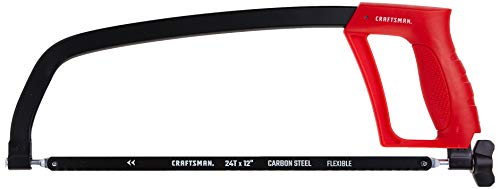
The CMHT20138 is the value pick in this group, and it earns that place by keeping the fundamentals right instead of trimming them away. The solid frame holds a standard 12-inch blade, and the cutting depth of 4.375 inches matches the deeper frames in this guide, so it swallows the same pipe and stock sizes as the pricier saws.
Craftsman fits a full-grip handle that shields the hand during the push stroke, and the frame design keeps the blade under steady tension for straight cuts in metal rod, bolts, and plastic pipe. At roughly 1.3 pounds it is an easy saw to control one-handed while the other hand steadies the workpiece in a vise or against a bench stop.
What you give up versus the high-tension flagships is refinement: tension tops out below the LENOX and Klein class frames, so the blade is a little more willing to drift on long cuts through thick steel, and there is no onboard blade storage. For the occasional metal cut in a home workshop — trimming bolts, shortening a shelf bracket, cutting pipe for a plumbing repair — those are compromises most owners will never notice, and the saw leaves room in the budget for a pack of quality bi-metal blades.
Stanley FatMax 5-in-1 Hacksaw (0-20-108)

The FatMax 5-in-1 is one frame that rearranges itself into five tools. In its standard position it is a normal 90-degree hacksaw with a large throat depth. Reposition the blade to 45 degrees and it makes flush cuts along a surface. Remove the front section of the frame and the blade works as a jab saw for tight spaces. The blade can also mount at the front of the frame for inside cuts, and spare blades store inside the frame itself.
That versatility suits workshops where the odd cut matters more than the fast cut: trimming a pipe stub inside a cabinet, cutting a bolt flush with a bracket, or reaching a fastener behind an appliance. Blade tension is fully adjustable and holds up to about 220 pounds, set with a quick-release mechanism that speeds up the changeovers this saw invites.
The frame is 430 millimeters long and the saw weighs about 2.2 pounds, noticeably more than a basic frame, which is the honest cost of the extra hardware. It ships with a 12-inch, 24 TPI bi-material blade. Owners who only ever make straight cuts in open space will not use half of what it does, but for remodel work full of awkward angles, it replaces a small handful of single-purpose tools.
Capri Tools 20105 Mini Hacksaw

A mini hacksaw solves a different problem: the full frame simply does not fit. The Capri Tools 20105 is a compact handle-and-frame design in which most of the blade extends ahead of the grip, so the cutting edge reaches into sink cabinets, engine bays, and electrical boxes where a 12-inch frame would jam against the surroundings.
It accepts both 10-inch and 12-inch blades, an unusual flexibility in this class, and comes with a 12-inch, 24 TPI blade fitted. The blade base is flexible carbon steel with hardened teeth, a combination that tolerates the bending a mini inevitably sees when it works at odd angles. At 0.43 pounds — under seven ounces — it disappears into a tool bag or apron pocket, and the soft ergonomic grip gives more control than the bare stamped handles on cheaper minis.
There is no tension adjustment, because the design holds the blade by its extended layout rather than by frame tension, so cuts in thick steel are slower going than with a full-size saw. Treat it as the second saw in the shop: the one that finishes the cut the big frame started, trims the bolt nothing else can reach, and handles PVC and thin-wall tubing in place.
How to choose
Start with blade tension, because it decides cut quality more than any other specification. High-tension frames, rated in the tens of thousands of psi or several hundred pounds of pull, keep the blade from bowing and wandering, which matters most in steel. A basic solid frame is fine for PVC, copper, and the occasional bolt, but regular metal work rewards the stiffer frame every time.
Match the blade to the material, not the other way around. Teeth per inch is the key number: 18 TPI blades cut faster in thicker stock, 24 TPI is the all-purpose choice most frames ship with, and 32 TPI leaves the cleanest edge in thin sheet and tubing while cutting more slowly. Bi-metal blades are the sensible default for a home workshop because the flexible body survives bending that snaps a rigid carbon steel blade.
Check throat depth before buying. The depth, measured from the blade to the frame spine, limits the size of pipe or stock the frame can pass over; around 4 inches or more covers typical home plumbing and rod sizes. Deep-throat and low-profile frames exist for larger work.
Finally, decide whether a mini belongs in the kit. If cuts regularly happen inside cabinets, under sinks, or between studs, a mini hacksaw earns its drawer space immediately. If every cut happens at a bench vise, one good full-size frame is the better spend, paired with spare blades in at least two tooth counts.
Who should skip
Skip the mini hacksaw if your cutting happens at a bench and involves thick steel bar or hardened bolts; a mini has no tension adjustment and will make slow, tiring work of jobs a full frame finishes quickly. Skip the premium high-tension frames if you cut metal a few times a year, because a solid basic frame and good bi-metal blades deliver the same finished cut for occasional use. Skip the multi-configuration FatMax if you value the fastest blade changes, since every rearrangement takes a moment a fixed frame does not. And skip hacksaws entirely for wood: the fine teeth clog and tear in timber, where a dedicated hand saw or pull saw is the right tool.
FAQ
What blade should a home workshop keep on hand?
A 24 TPI bi-metal blade is the best single choice because it handles steel rod, bolts, copper, and PVC without drama. Add an 18 TPI blade for faster cuts in thicker stock and a 32 TPI blade for thin tubing and sheet, and the three cover nearly every household cut.
Can a hacksaw cut wood in a pinch?
It can, slowly, and the result is rarely worth it. Hacksaw teeth are designed for metal, so they clog with wood fibers and leave a rough edge. For a one-off cut in a dowel or trim piece where no wood saw exists, a coarse 18 TPI blade is the least bad option.
Why does the blade keep wandering off the line?
Wandering usually means low blade tension or a dull blade. Tighten the tensioning knob until the blade feels taut and resists twisting, start the cut with light strokes to establish a groove, and replace blades that have lost teeth. A high-tension frame reduces the problem but cannot fix a worn blade.
How long does a hacksaw blade last?
A bi-metal blade cutting mild steel and household metals typically lasts through dozens of cuts before the teeth dull enough to slow the work. Cutting hardened steel, stainless, or abrasive materials shortens that life sharply. When a blade stops biting at the start of a stroke and begins to skate, it is done.
Final verdict
Buy the LENOX HT50 if metal cutting is a regular part of your workshop life; its tension and blade storage make it the frame the others are measured against. Choose the Stanley STHT20138 for a lighter, simpler full-size saw, the CRAFTSMAN CMHT20138 when value leads the decision, and the FatMax 5-in-1 when remodel work throws awkward angles at you. Add the Capri Tools 20105 mini when tight spaces are a recurring problem. Any of the five, fitted with fresh bi-metal blades, covers the metal cutting a home workshop actually sees.
Product and ASIN Reference
| Product | ASIN |
|---|---|
| LENOX HT50 High-Tension Hacksaw (12132HT50) | B000LGBZDE |
| Stanley STHT20138 Solid Frame High-Tension Hacksaw | B009CMV9D4 |
| CRAFTSMAN CMHT20138 12-Inch Hacksaw | B07R92S9YZ |
| Stanley FatMax 5-in-1 Hacksaw (0-20-108) | B004AEVIJE |
| Capri Tools 20105 Mini Hacksaw | B0791WKFQ9 |