Key takeaways
- Five electric pressure washers compared for driveways, decks, siding and cars, with pressure, flow, hose length and nozzle sets explained for home use.
A pressure washer turns a weekend of scrubbing into an afternoon of rinsing. Green algae on a shaded deck, tire marks and oil spots on concrete, mildew streaking the siding, and the grit that builds up on fences all surrender to a focused jet of water far faster than they do to a brush and bucket. Electric models suit most homes because they start with a trigger pull, run quietly enough for a suburban street, need no fuel or oil changes, and store in a garage corner. The catch is that headline pressure numbers are maximums, not working figures, and flow rate matters just as much when you are rinsing a wide slab. This guide compares five corded electric washers that cover the range from light patio duty to heavy driveway work, and explains how to match one to your surfaces.
As an Amazon Associate, we earn from qualifying purchases.
Quick answer
For most homes, the Westinghouse ePX3100 is the balanced pick, pairing strong pressure with a steel wand and a full nozzle set. The Sun Joe SPX3000 remains the value staple with dual soap tanks, the Craftsman CMEPW2100 adds big wheels and a kink-resistant hose, the AR Blue Clean AR383 brings a metal pump head, and the Kärcher K1700 covers lighter jobs.
Westinghouse ePX3100 Electric Pressure Washer

The ePX3100 is the strongest all-rounder in this group. Westinghouse rates it at 2,300 max PSI with up to 1.76 max GPM, which puts it at the top end of what a household circuit can feed, and that output shows on concrete: a 15-degree tip walks across a driveway slab at a sensible pace instead of creeping. The pro-style steel wand feels a step above the plastic lances bundled with many electrics, and the five-nozzle set covers the full spread from a 0-degree pinpoint jet for spot work to a 40-degree fan for rinsing siding and a soap tip for detergent.
An onboard soap tank means you are not dragging a separate foam bottle around, and the anti-tipping design keeps the compact body planted when the hose tugs at it, which is the moment lesser units topple. The four quick-lock wheels roll it over expansion joints and gravel edges without a fight. If your cleaning list mixes an oil-stained garage apron, a mildewed fence line, and a pair of cars, this is the machine that handles all three without feeling stretched, and its working pressure is honest enough that decks can still be washed safely with the wider fan tips from a sensible distance.
Sun Joe SPX3000 Electric Pressure Washer

The SPX3000 has been the default starter pressure washer for years, and its layout explains why. A 14.5-amp motor delivers 2,030 PSI certified under the PWMA rating system, with flow up to 1.76 GPM, and the headline feature is a pair of removable detergent tanks. Two tanks let you keep car shampoo in one and a siding or deck cleaner in the other, then swap between them with a dial instead of rinsing and refilling a single reservoir mid-job.
Five quick-connect nozzles ride in onboard storage, the 20-foot high-pressure hose pairs with a 35-foot power cord protected by a GFCI plug, and the Total Stop System shuts the pump off whenever you release the trigger, which saves wear and keeps the machine quiet between passes. The rated working flow is lower than the maximum figure suggests, so big driveways take a little longer than with the strongest picks here, and the tall body rewards a flat parking spot. For patios, walkways, outdoor furniture, and regular car washing, though, it covers the brief completely, and its long production run means hoses, seals, and accessories are easy to find.
Craftsman CMEPW2100 Electric Pressure Washer
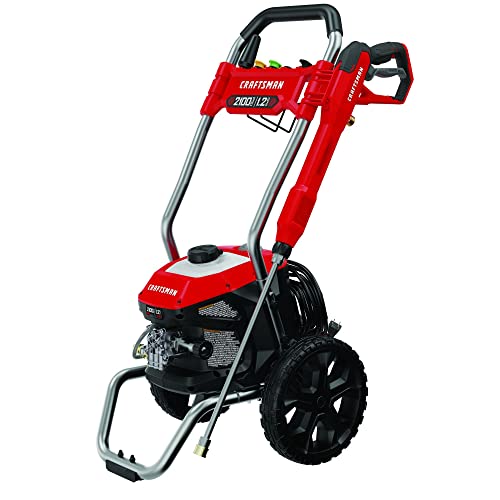
The CMEPW2100 is built for people whose cleaning route is long. It stands on 10-inch wheels that roll over lawn edges, gravel, and hose piles without snagging, and its 25-foot kink-resistant hose resists the tight loops that strangle cheaper hoses when you pull the machine around a corner. Output is 2,100 max PSI at 1.2 GPM from a 13-amp motor, which is squarely in driveway and deck territory, and the unit is CETA certified, so the pressure figure has been verified by an outside body rather than simply printed on the box.
The nozzle set covers the jobs that matter: 15-degree and 25-degree fan tips for concrete and wood, a turbo nozzle that spins a pinpoint jet into a scouring cone for stubborn stains, and a soap tip feeding the integrated detergent tank. A 35-foot power cord extends the working radius, so most homes can clean front and back without hunting for a second outlet. At just under thirty pounds it is not the lightest washer here, but the wheels do the carrying. Choose it if your property has long runs of concrete, a big deck, or both, and you value reach and rolling ease over the last increment of pressure.
AR Blue Clean AR383 Electric Pressure Washer

AR Blue Clean comes from Annovi Reverberi, an Italian pump maker, and the AR383 shows that heritage in its pump head and fittings, which use more metal than the all-plastic pumps common at this level. It delivers 1,900 PSI at up to 1.5 GPM from a 14-amp motor. That pressure sits a notch below the leaders here, but the flow rate is generous, and flow is what carries loosened dirt off a slab, so real-world cleaning speed on patios and siding is closer than the numbers suggest.
The kit includes two wands, a variable fan lance for everyday washing and a turbo lance for ground-in grime, plus a 20-foot hose and a snap-on detergent bottle for soap work. A Total Stop System idles the pump when the trigger is released, onboard holders keep the wands and cord corralled, and the whole unit is light enough to carry up porch steps one-handed. The detergent bottle is smaller than the tanks on the Sun Joe and Westinghouse, so plan a refill on whole-house siding days. Pick the AR383 if you wash often, care about pump construction, and mostly clean decks, fences, vehicles, and walkways rather than expansive stained concrete.
Kärcher K1700 Electric Pressure Washer

The K1700 is the compact option for lighter cleaning lists. Kärcher rates it with its TruPressure figure of 1,700 PSI at 1.2 GPM, which is honest, modest output aimed at cars, patio furniture, fences, bicycles, and small decks rather than neglected driveways. In exchange you get the smallest footprint in this guide, a folding handle, and a machine that hangs or shelves neatly in a crowded garage or shed.
Three nozzles cover the essentials: a 15-degree tip for general work, a turbo nozzle that concentrates the jet for spot stains and mossy joints, and a soap nozzle that draws from the removable detergent tank. The 20-foot hose is adequate for a patio or a car on a short driveway, and an on-off foot switch lets you start and stop the pump without bending to the body. The universal motor is louder than an induction unit and the pressure will not strip heavy staining from old concrete in one pass, but for renters, townhouse owners, and anyone whose heaviest job is spring deck washing, the K1700 does the work without dominating storage space or the budget category it sits in.
How to choose
Start with the pressure and flow pair, and read both as rated figures where the maker gives them. Pressure loosens dirt; flow rinses it away. Around 1,700 to 2,100 PSI with at least 1.2 GPM handles cars, decks, fences, and siding, while stained concrete goes faster at 2,300 PSI and above. Multiply the two numbers for a rough cleaning-units comparison, but treat maximum ratings with suspicion and give extra weight to PWMA or CETA certified figures, which are checked by outside organizations.
Nozzle choice matters more than raw power on delicate surfaces. A 0-degree tip can gouge wood and lift paint, so decks and cars belong under 25-degree and 40-degree fans, with distance used as the fine adjustment. Turbo nozzles speed up concrete work but should stay off softwood. Next, measure your working radius: hose length plus cord length decides whether you can clean both sides of the house from one outlet, and a kink-resistant hose saves real frustration.
Finally, check safety and storage. A GFCI plug and a total stop system should be non-negotiable, and before buying any used or older electric washer, check the model against the CPSC recall database: Ryobi recalled its RY142300 and RY142711VNM washers in August 2025 because a capacitor could overheat and burst, and none of the five models in this guide is under a recall. Wheeled units suit big properties; compact cube and upright designs suit small garages.
Who should skip
Skip electric entirely if your jobs are commercial scale, your surfaces are far from any outlet, or you need to run a surface cleaner over a very large driveway every week; a gas washer still wins that brief. Skip the compact models if your concrete is heavily oil-stained, since low flow stretches the job out. Renters in apartments with no outdoor tap or exterior outlet have nothing to plug a washer into, and owners of delicate cedar shake, old soft brick, or failing paint should skip pressure washing altogether and wash by hand, because even a fan tip can raise grain, drive water behind siding, or strip a weak finish in seconds.
FAQ
How much PSI do I need to clean a concrete driveway?
For typical residential concrete, 2,000 to 2,300 PSI with a 15-degree or turbo nozzle clears tire marks, algae, and ground-in dirt. Heavier oil staining responds better to detergent and hot water than to more pressure, and going far beyond that range risks etching the surface, so technique and a pre-soak matter more than chasing the biggest number on the box.
Can an electric pressure washer damage a wood deck?
Yes, if the jet is too concentrated or held too close. Use a 25-degree or 40-degree fan tip, keep the nozzle moving, hold it at a consistent distance, and work along the grain. Never use a 0-degree tip on wood, and be careful with turbo nozzles on softwood such as cedar, where the spinning jet can furrow the surface in a single pass.
What does a total stop system do?
A total stop system switches the pump motor off automatically whenever you release the spray trigger, and restarts it when you squeeze again. That cuts noise between passes, reduces heat and wear inside the pump, and saves electricity. Every washer in this guide includes one, and it is worth treating as a required feature on any electric model you consider.
How should I store an electric pressure washer for winter?
Drain the pump and hose completely, because trapped water that freezes can crack the pump housing. Run pump-saver antifreeze through the unit if it will sit in an unheated garage, disconnect and coil the hose without tight kinks, empty the detergent tank, and store the machine upright indoors where temperatures stay above freezing whenever possible.
Final verdict
Most households should start with the Westinghouse ePX3100: it has the strongest verified output here, a steel wand, and the nozzle range to move between cars and concrete. The Sun Joe SPX3000 is the proven value pick with its dual detergent tanks, the Craftsman CMEPW2100 suits long driveways and big decks, the AR Blue Clean AR383 rewards frequent users with its pump build, and the Kärcher K1700 keeps things small and simple for light duty. Match the machine to your largest regular job, respect the nozzle chart, and any of the five will keep a home exterior looking washed rather than weathered.
Product and ASIN Reference
| Product | ASIN |
|---|---|
| Westinghouse ePX3100 Electric Pressure Washer | B083B2M9NT |
| Sun Joe SPX3000 Electric Pressure Washer | B00CPGMUXW |
| Craftsman CMEPW2100 Electric Pressure Washer | B085284YHK |
| AR Blue Clean AR383 Electric Pressure Washer | B002Z8E52Y |
| Kärcher K1700 Electric Pressure Washer | B01N20PROC |