Key takeaways
- Learn how to choose a garage door opener for your home garage, from belt and chain drives to smart controls, battery backup, and safety features.
A garage door opener stays out of mind until it fails on a cold morning or starts grinding loud enough to wake the house. Choosing a replacement is not only about lifting power. Drive type, noise level, smart controls, battery backup, and safety features all shape daily use for years. This guide explains the main decisions in plain terms and then looks at five openers sold on Amazon that cover the most common home garage setups. Measure your door before ordering anything, because height, width, weight, and headroom decide which models fit.
As an Amazon Associate, we earn from qualifying purchases.
Quick answer
For most home garages, a belt drive opener with built-in Wi-Fi and battery backup is the safest all-round choice. Belt drives run quietly, Wi-Fi control adds remote checks and alerts, and battery backup keeps the door working during a power cut. Match lifting power to your door weight, confirm the rail fits your door height, and check that safety sensors are included before you buy.
1. Chamberlain B6753T Smart Garage Door Opener with Camera

The Chamberlain B6753T sits at the top of the Chamberlain home range and suits owners who want a full smart garage in one box. It uses a belt drive with a 1.25 HP motor, which gives it strong lifting power for heavier double doors while staying quiet enough for garages under bedrooms. The headline feature is a built-in camera with a wide view of the garage interior, so you can see deliveries and check whether the door closed from the myQ app.
Battery backup is included, so the door still opens during a power cut. The opener works with myQ smartphone control and Amazon Key in-garage delivery, and it pairs with voice assistants. Two remotes and a wireless keypad come in the box, along with safety reversing sensors.
Key details: 1.25 HP belt drive motor; built-in camera with wide-angle view; myQ Wi-Fi control; LED corner to corner lighting; battery backup included; wireless keypad and two remotes included.
Choose this model when the garage doubles as a workspace or entry point and you want camera monitoring without adding a separate device. It fits standard sectional doors and handles heavier insulated or double doors with ease.
2. Chamberlain B2405 Quiet Wi-Fi Garage Door Opener
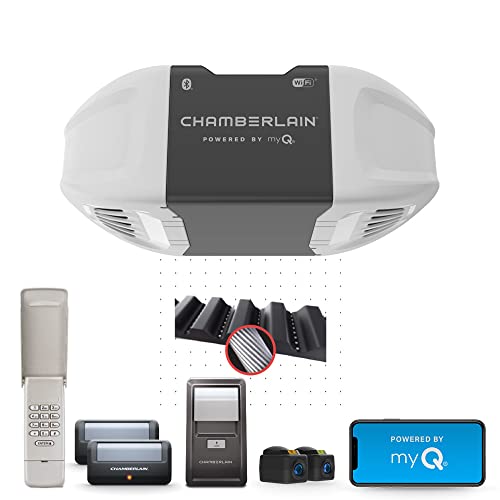
The Chamberlain B2405 is the sensible middle of the range: a quiet belt drive opener with smart control, without the camera and extra lighting of the flagship model. Its 0.5 HP motor suits standard single doors and lighter double doors, and the steel-reinforced belt keeps noise low in attached garages. Built-in Wi-Fi connects to the myQ app, so you can open, close, and check the door from a phone, set schedules, and receive alerts when the door opens.
A wireless keypad is included, which is handy for family members, dog walkers, or anyone who needs access without a remote or phone. Safety reversing sensors are included, with a timer-to-close option for owners who forget to shut the door.
Key details: 0.5 HP belt drive motor; built-in Wi-Fi with myQ app control; wireless keypad included; ultra-quiet belt drive; Amazon Key in-garage delivery support; safety reversing sensors included.
Pick the B2405 for a standard single or light double door when you want quiet smart operation at a lower cost than the camera models. Confirm your door weight first, because a heavy insulated double door may need a stronger motor.
3. Genie StealthDrive 7155-TKV Connect Garage Door Opener

The Genie StealthDrive 7155-TKV is built for heavier doors and owners who want strong smart-home integration. Its 1.25 HPc DC motor drives a steel-reinforced belt, and Genie rates it for sectional doors up to 7 feet high and 500 pounds, which covers most insulated double doors. Battery backup is built in, so the door keeps working through a power cut, and the opener includes a wireless keypad, two pre-programmed remotes, and a multi-function wall console.
Aladdin Connect Wi-Fi links the opener to a phone app and to Alexa, Google Assistant, SmartThings, and Amazon Key in-garage delivery. The Safe-T-Beam safety system stops and reverses the door when the beam is broken.
Key details: 1.25 HPc DC motor with steel-reinforced belt drive; rated for doors up to 7 feet high and 500 pounds; Aladdin Connect Wi-Fi with Alexa and Google support; integrated battery backup; wireless keypad and two remotes included; Safe-T-Beam safety system.
Choose this opener for a heavy or oversized door, or when your household already uses Alexa or SmartThings. Check the door height and weight on the door label, and budget for an 8-foot extension kit when the door is taller than 7 feet.
4. Genie SilentMax 1200 Model 4042-TKH Garage Door Opener

The Genie SilentMax 1200, model 4042-TKH, is the value pick in this guide and a good match for owners who want quiet belt drive operation without paying for Wi-Fi and a camera. Its 0.75 HPc DC motor opens standard single and double doors at a brisk pace, and the steel-reinforced belt drive keeps vibration and noise down. Motion detection lighting switches the opener lights on when you enter the garage.
The package includes a wireless keypad and a three-button remote, plus the Safe-T-Beam safety system. There is no built-in Wi-Fi on this model, so remote phone control needs a separate add-on controller when that matters.
Key details: 0.75 HPc DC motor with steel-reinforced belt drive; motion detection lighting; wireless keypad and remote included; Safe-T-Beam safety system; ultra-quiet belt drive operation; no built-in Wi-Fi.
Pick the SilentMax 1200 when your priority is a quiet, reliable opener for a standard door and you do not need phone control. It suits rental properties and detached garages, and test the safety sensors after installation so the door reverses correctly.
5. Chamberlain RJO70 Wall Mount Garage Door Opener

The Chamberlain RJO70 takes a different approach: instead of hanging a motor head from the ceiling, it mounts on the wall beside the door and drives the torsion bar directly. That frees the whole ceiling, which is ideal for garages with high ceilings, overhead storage racks, or a car lift. It is also the answer when headroom is too low for a standard rail opener.
Despite the compact form, the RJO70 is a full-featured smart opener. It includes battery backup, bright LED lighting, myQ Wi-Fi control, and a deadbolt lock that secures the door when closed. The direct drive design runs very quietly. It works with sectional doors and needs a torsion spring system, so check your door hardware before ordering.
Key details: Wall mount jackshaft design with direct drive; frees ceiling space completely; battery backup included; myQ Wi-Fi smartphone control; automatic deadbolt lock; bright LED lighting; works with sectional doors on torsion springs.
Choose the RJO70 when ceiling space matters more than anything else, or when a standard rail opener will not fit. Because it mounts to the torsion bar, installation is more involved than a rail opener, and many owners hire a professional. Never adjust torsion springs yourself, because they store enough energy to cause serious injury.
How to choose
Start with the door itself. Measure height and width, then find the weight, which is often printed on a label on the door or in the original paperwork. Standard sectional doors run 7 feet high, and taller doors need a rail extension kit. Heavy insulated or wooden double doors need a stronger motor, roughly 0.75 HP and above, while a standard single steel door runs fine on a 0.5 HP unit. Note that Genie lists HPc, a horsepower comparison figure, rather than raw horsepower.
Drive type comes next. Belt drives are the quietest and suit attached garages and bedrooms above the garage. Chain drives cost less and handle heavy doors well, but they are louder. Wall mount jackshaft openers suit low headroom and high ceilings. For most homes, a belt drive is the easy default.
Built-in Wi-Fi adds remote control, alerts, schedules, and delivery access, and it avoids buying a separate hub later. Check that the opener works with your voice assistant and smart home system before committing. Battery backup is worth having in areas with frequent outages, because a dead opener turns the garage into a locked box.
Safety is not optional. Every opener sold in the United States must include safety reversing sensors and an auto-reverse system under federal rules. Test the auto-reverse monthly with a block of wood on the floor, and test the sensors by breaking the beam while the door closes. Keep the wall control out of reach of small children. When the door itself is damaged, unbalanced, or has broken springs, fix the door before replacing the opener, because a struggling door will wear out even a strong motor.
Who should skip
Skip a full opener replacement when the door itself is the problem. A door that sticks, sags, or will not stay half open needs spring, track, or panel work first, and a new opener will not fix it. Call a professional for spring and cable work, because those parts are under high tension.
Skip smart camera models when you do not want another camera in the home or another app to manage, and choose a simpler belt drive instead. Skip wall mount openers when your door uses extension springs rather than torsion springs, because jackshaft models need a torsion bar. Skip the strongest motors for a light single panel, because extra lifting power adds cost without benefit. Finally, skip any opener that lacks safety sensors, and skip DIY installation when the job involves wiring or springs.
FAQ
How do I know what size garage door opener I need?
Match the motor to the door weight and size. A 0.5 HP opener handles a standard single steel door, while heavier insulated or double doors need 0.75 HP or more. Most rails fit 7-foot doors, and taller doors need an extension kit.
Are belt drive openers better than chain drive openers?
Belt drives are quieter and need less maintenance, which makes them the better pick for attached garages and homes with bedrooms nearby. Chain drives cost less and are very durable, so they suit detached garages where noise matters less.
Do I need Wi-Fi on a garage door opener?
Wi-Fi is useful when you want to check the door from work, let someone in while you are away, or receive alerts when the door opens. It is not essential when a remote and keypad cover your routine.
Can I install a garage door opener myself?
Many homeowners install rail openers with basic tools, a ladder, and a free afternoon, following the manual step by step. Wall mount openers and any work involving torsion springs should go to a professional. Never adjust springs yourself, and test the safety reverse and sensors before regular use.
Final verdict
The right garage door opener starts with the door, not the feature list. Measure height, width, and weight, then choose a drive type that fits your noise tolerance and ceiling. For most home garages, the Chamberlain B2405 covers the common case: quiet belt drive, Wi-Fi control, and a keypad for a standard door. Owners with heavier double doors should look at the Chamberlain B6753T or the Genie StealthDrive 7155-TKV for stronger motors and battery backup. The Genie SilentMax 1200 is the pick for quiet simplicity, and the Chamberlain RJO70 is the answer when ceiling space is precious. Whichever model you choose, test the safety sensors after installation and keep the door itself in good repair.