Key takeaways
- Compare the best cordless framing nailers for walls, decks and remodels, with guidance on nail angle, battery platforms, depth control and jam clearing.
A cordless framing nailer removes the compressor, the hose and the setup time from framing work, which matters whether you are building a deck over two weekends or framing walls all week. Modern battery nailers drive full-size framing nails with flywheel, gas-free air spring or nitrogen spring designs, and the best ones sink nails flush in engineered lumber without stalling. The real differences sit in nail angle, magazine capacity, weight, firing modes and which battery platform the tool belongs to. This guide compares five well-regarded cordless framing nailers across the major platforms, explains what separates a 21-degree nailer from a 30-degree one, and flags the buyers who are still better served by a pneumatic gun and a small compressor.
As an Amazon Associate, we earn from qualifying purchases.
Quick answer
The best cordless framing nailer for most people is a 30-degree or 21-degree model on a battery platform they already own. DEWALT and Milwaukee suit heavy framing, Metabo HPT offers a strong kit value, and CRAFTSMAN covers lighter DIY work. Match the nail angle to local code and nail availability before buying.
DEWALT DCN692B 20V MAX XR Dual Speed Framing Nailer
The DEWALT DCN692B is a brushless 20V MAX XR framing nailer built around a flywheel drive, and it accepts 30 to 34 degree paper tape collated nails from 2 to 3.5 inches long. Two selectable speeds let you match driving power to nail length, which helps when you move between shorter nails in sheathing work and full-length nails in doubled top plates. It offers both sequential and bump firing modes, a tool-free depth adjustment wheel, and a dry fire lockout that stops the tool cycling once the magazine runs low, protecting the driver blade and the workpiece.
Because it is sold as a bare tool, it makes the most sense for carpenters and serious DIY builders who already run DEWALT 20V MAX batteries on their saws and drills. The flywheel design needs a brief spin-up compared with air spring tools, but in bump mode it keeps pace well on wall framing. A stall release lever clears most jams without tools, and the rafter hook rotates for storage on joists or ladders.
Milwaukee M18 FUEL 30 Degree Framing Nailer 2745-20
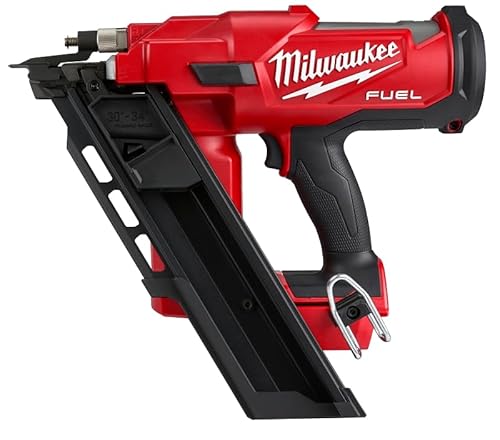
Milwaukee’s 2745-20 uses a sealed nitrogen air spring that fires instantly with zero ramp-up time, so the nail is driven the moment you pull the trigger in sequential mode or set the nose down in bump mode. It takes 30 to 34 degree clipped head and full round offset head paper collated nails, and Milwaukee rates it to fire up to 750 nails per charge on a 5.0Ah REDLITHIUM battery in the extended capacity magazine configuration. Tool-free depth adjustment, a dry fire lockout and an onboard hex wrench for clearing the occasional jam round out the working features.
This is the heavier-duty choice of the group, aimed at framers who shoot nails all day and want pneumatic-like consistency without a hose. It accepts the extended capacity magazine that holds additional strips, reducing reloads on long runs of studs. If your cordless kit already runs on M18 batteries, the 2745-20 is the natural flagship pick; if you need round head nails for code reasons, its 21-degree sibling below covers that ground instead.
Milwaukee M18 FUEL 21 Degree Framing Nailer 2744-20
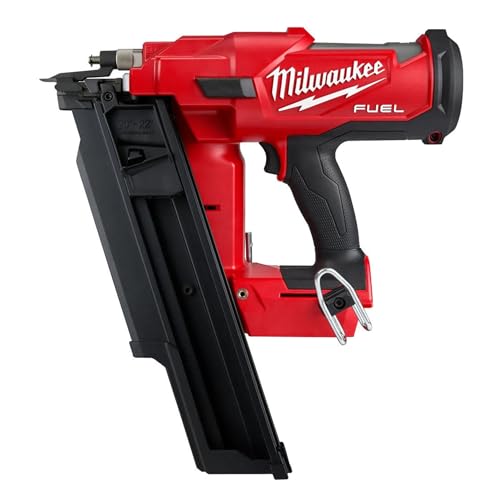
The 2744-20 is Milwaukee’s 21-degree counterpart, built for full round head plastic collated nails, the style many building codes and inspectors prefer because the round head keeps full holding power in structural connections. It shares the same nitrogen air spring mechanism as the 30-degree model, delivering consistent drives in LVL and treated lumber with no ramp-up delay, plus sequential and contact actuation modes, power depth adjustment without tools, and dry fire lockout.
Choose this version when your work is inspected structural framing, when local suppliers stock 21-degree nails more reliably, or when you simply prefer plastic collation that sheds small collation fragments rather than paper tape. Weight and balance are close to the 30-degree model, and it runs on the same M18 battery lineup, so crews can standardize on one charger. For deck builders and remodelers outside strict code work, the 30-degree model is usually easier to feed; for new residential framing, the 21-degree gun is the safer long-term buy.
Metabo HPT NR1890DRST 18V MultiVolt 21 Degree Nailer Kit
The Metabo HPT NR1890DRST is a 21-degree plastic collated framing nailer sold as a kit with a battery and charger, which makes it attractive to buyers starting a new platform from zero. Its air spring drive system is mechanically sealed and needs no refills or fuel cells, and the brushless motor drives 2 to 3.5 inch nails into engineered lumber. Selective actuation switches between sequential and bump firing from a panel on the tool, and depth adjustment is tool-less.
A standout detail is the MultiVolt battery compatibility: the included 18V battery also fits the wider MultiVolt lineup, and the tool accepts the MultiVolt AC adapter for corded backup on long shop days. The NR1890DRST carries the brand’s reputation from the Hitachi pneumatic era, and its kit pricing structure means you are not forced into a bare-tool purchase plus separate batteries. For a one-nailer household or a small crew adding a first cordless framer, this is the most complete package in the group.
CRAFTSMAN V20 Cordless Framing Nailer CMCN621PLB
The CRAFTSMAN CMCN621PLB brings cordless framing to the V20 platform at an entry point aimed at homeowners and occasional builders. It drives 30 to 34 degree paper tape collated nails, offers tool-free jam release and tool-free depth settings, and includes a belt hook for ladder work. The flywheel-style drive is tuned for projects like fence repairs, shed framing, deck blocking and basement finishing rather than production framing volume.
For a homeowner who already owns V20 drills and saws from the same kit, this nailer removes the rental question from weekend projects entirely. It will not match the cycle speed or magazine capacity of the professional models above, and it is sold as a bare tool, so budget for a battery if you are new to the platform. Within its intended lane, though, it delivers consistent drives in dimensional lumber and handles the framing tasks most houses actually demand, from partition walls to playset builds.
How to choose
Start with nail angle, because it decides which nails you can buy locally and whether the gun suits inspected work. The 21-degree plastic collated format uses full round head nails and is the conservative choice for structural framing; 30 to 34 degree paper tape nails are clipped or offset head, feed smoothly, and dominate remodel and deck work. Second, weigh the battery platform you already own: batteries and chargers are a large share of total cost, and every nailer here is most economical inside its own ecosystem. Third, consider drive type. Nitrogen and air spring tools fire instantly and feel closest to pneumatic guns, while flywheel tools spin up briefly but are mechanically simple. Fourth, check magazine capacity and whether an extended magazine exists if you frame long runs. Finally, confirm the tool offers tool-free depth adjustment, dry fire lockout and both firing modes, since those three features shape daily usability more than headline power figures.
Who should skip
Skip cordless framing nailers if you frame production housing all day beside a compressor anyway; a pneumatic gun is lighter per shift and never waits on a charger. Skip them if you only hang pictures or assemble small furniture, where a brad nailer is the right tool and a framer is wasted money. Also skip buying into a new battery platform for a single tool if your existing platform already sells a competent framer, because the second charger ecosystem rarely pays for itself. Finally, renters and one-project users should compare rental costs first: a weekend rental of a pneumatic setup can undercut ownership when the project list ends there.
FAQ
Can a cordless framing nailer replace a pneumatic one?
For most remodeling, deck and residential framing work, yes. Current brushless models drive 3.5 inch nails into engineered lumber reliably. Production crews who fire thousands of nails daily may still prefer pneumatic guns for their lighter weight and unlimited runtime on a compressor.
What is the difference between 21-degree and 30-degree nailers?
The angle describes how nails sit in the magazine. Twenty-one-degree nailers use plastic collated full round head nails, often preferred for code framing. Thirty to 34 degree nailers use paper tape collated clipped or offset head nails, which feed compactly and suit remodel work. The nails are not interchangeable.
Do cordless framing nailers need fuel cells?
No. Every model in this guide is battery-only, using a flywheel, nitrogen spring or air spring to drive nails. That removes the per-nail fuel cost of older gas-actuated cordless framers and avoids combustion fumes indoors.
How many nails can one battery drive?
It depends on nail length, lumber density and battery size. Manufacturers rate flagship models at several hundred nails per charge on mid-size batteries, with the largest packs extending that further. Carrying one spare battery keeps a full day of framing moving without pauses.
Final verdict
For most buyers, the Milwaukee 2745-20 is the strongest all-round cordless framing nailer thanks to its instant-fire nitrogen spring and deep M18 ecosystem, while the 2744-20 covers round head code work. The DEWALT DCN692B remains an excellent pick inside the 20V MAX system, the Metabo HPT kit is the smartest starting package, and the CRAFTSMAN serves V20 owners with lighter project lists. Pick by platform first, nail angle second, and the tool will earn its place.