Key takeaways
- Compare the best dust collectors for home workshops, from rolling single-tool units to canister-filter machines, with guidance on airflow and filtration.
A dust collector is the machine that decides whether your workshop air stays breathable while the table saw, planer and jointer run. Unlike a shop vacuum, a true collector moves a large volume of air at low pressure, pulling chips and fine dust through four-inch hoses before they escape into the room. The five collectors in this guide span the realistic home workshop range: compact rolling units that serve one tool at a time, a wall-mountable portable, and full-size canister machines that can anchor a small ducted layout. Each entry explains what the airflow rating means in practice, how the filtration level affects the finest and most harmful dust, and which shop layout the machine actually fits.
As an Amazon Associate, we earn from qualifying purchases.
Quick answer
For a one-car garage shop, the WEN DC3401 rolling collector is the sensible start, while the JET DC-1100VX-CK is the best long-term anchor machine with its canister filter. The WEN DC3474 adds capacity, the POWERTEC DC5372 is the portable pick with fine filtration bags, and the Shop Fox W1727 remains a proven compact floor model.
WEN DC3401 5.7-Amp Rolling Dust Collector
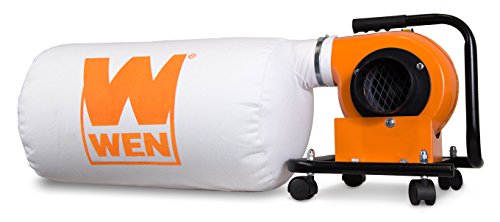
The DC3401 is WEN’s compact entry point: a 5.7 amp motor rated at up to 660 CFM, a 12 gallon collection bag, and a rolling base with an optional wall mount, so it can follow the tool in use or park out of the way. Its six-inch nylon impeller and four-inch inlet suit the classic one-tool-at-a-time workflow: roll it to the table saw, connect the hose, make your cuts, then wheel it to the planer. The filtration bag captures the bulk of chips and dust while keeping the unit light enough to move with one hand.
This is the right scale for a single-car garage or basement shop where a full-size collector would consume floor space the workbench needs. It will not keep up with two machines running at once or a long fixed duct run, and no collector in this size class will. Judged on its intended job, it is a well-judged machine: enough airflow for any single home workshop tool, honest filtration, and a footprint that disappears into a corner when the car needs to come back inside.
WEN DC3474 7.4-Amp Rolling Dust Collector
The DC3474 steps up within the same rolling format: a 7.4 amp motor, a larger 15 gallon collection bag, a mobile base and the same optional wall mount flexibility as its smaller sibling. The extra capacity matters most at the planer and jointer, the two machines that fill bags fastest; fewer bag changes means fewer interruptions and less dust spilled on the floor during swaps. Its higher airflow also tolerates a short run of hose to a second tool with a blast gate, the first step toward a semi-permanent layout.
Choose the DC3474 over the DC3401 when your shop centers on a planer or a wide jointer, or when you know a two-tool setup is coming. It remains a single-stage bag collector, so the finest dust fraction is handled by the bag’s filtration rating rather than a pleated canister, and it still wants to live near the tools rather than at the end of a long duct network. For the growing one- or two-car shop, it is the balanced middle of this guide.
JET DC-1100VX-CK Vortex Cone Dust Collector

The JET DC-1100VX-CK is the anchor machine of the group: a 1.5 horsepower collector rated at 1,100 CFM, fitted with a two-micron canister filter instead of a bag. The canister’s pleated media offers far more filter surface area, which keeps airflow strong as dust loads and captures the fine particles that matter most for your lungs. JET’s Vortex Cone technology keeps heavier chips swirling down into the collection bag rather than packing against the filter, reducing how often the filter needs cleaning, and the filter’s cleaning handle knocks accumulated dust loose without opening the machine.
It runs on standard household power or can be wired for the higher voltage, and its steel impeller and four casters suit permanent placement at the center of a small ducted system serving three or four tools through blast gates. This is the collector to buy when you are done upgrading: it costs and weighs more than the rolling units, and it rewards a shop that gives it a fixed home. For serious hobbyists, it is the performance benchmark here.
Shop Fox W1727 1 HP Dust Collector

The Shop Fox W1727 has been a small-shop staple for years: a 1 horsepower motor, rated at 800 CFM, prewired for standard household voltage with the option to rewire for higher voltage, and a 2.5 micron filter bag over a 2.1 cubic foot collection capacity. Its footprint is compact for a floor-standing collector, and the design is deliberately simple: a steel impeller, a heavy bag, and a switch, with parts support through the Grizzly and Shop Fox dealer network.
The W1727 fits the shop that wants a stationary collector for one or two main tools without stepping up to canister pricing. Its bag filtration is coarser than the JET’s canister, so pairing it with an ambient air filter or wearing a respirator during long sessions remains wise. What it offers instead is a long production history, straightforward maintenance and airflow comfortably above the rolling compact class. For a dedicated woodworking corner of a garage, it remains an entirely rational choice that owners tend to keep for a decade.
POWERTEC DC5372 1 HP Portable Dust Collector
The POWERTEC DC5372 takes the portable route seriously: a 1 horsepower motor rated at 560 CFM, one-micron filter bags, and a carry-friendly format designed to move between machines or between the shop and a job site. The one-micron bag rating is the headline, finer than most bag collectors in this class, which makes the DC5372 interesting for smaller shops where the collector shares air with the person working and there is no room for a separate ambient filter.
Portability shapes its limits as well: collection capacity is modest, so planer work fills it quickly, and its airflow is tuned for a short hose to a single tool. Within that brief it performs well, and the included bags and fittings make it a complete starter system. Contractors who thickness-plane trim on site and hobbyists in spare-room shops both fit its profile. If your dust collection problem is really about fine dust in a small shared space, this is the most filtration you can get in a machine you can carry with one hand.
How to choose
Start with airflow matched to your hungriest tool: table saws and bandsaws are content with the output of the compact class, while planers and jointers reward the strongest collector you can place nearby, because chip volume, not just dust, must be carried. Second, decide between rolling and stationary. Rolling collectors moved to each tool outperform a stationary machine starved by long ducts in small shops; stationary machines win once you run fixed ducting with blast gates. Third, weigh filtration seriously: canister filters and one-micron bags capture the fine fraction that settles in lungs, while standard bags mainly control chips and visible dust. Fourth, check your power: the larger machines here still run on household circuits, but confirm the circuit can share load with the tool running beside it. Finally, measure your space honestly, including the height of a canister machine and the swing of its cleaning handle.
Who should skip
Skip a dust collector if your only dust makers are sanders and routers; a good shop vacuum with a separator and a fine filter serves those tools better, since they need high suction at small ports rather than high airflow. Skip the full-size canister class if your shop is a balcony or a shared spare room, where the portable units exist precisely for you. Skip buying any collector as a substitute for respiratory protection during heavy MDF work; collection at the source reduces exposure but does not eliminate it. And skip the largest machine if your duct plan is imaginary: a mid-size collector placed close to the tools collects more dust than a big one at the end of an undersized, leaky run.
FAQ
What CFM does a home workshop actually need?
For one tool at a time through a short hose, collectors in the 560 to 800 CFM range handle table saws, jointers and planers in home shops. Larger ratings matter when you add duct length, elbows or a second tool. Ratings are measured under ideal conditions, so real installations always deliver less at the tool.
Is a canister filter worth it over a bag?
For most home shops, yes. A pleated canister provides far more filter area, so airflow stays higher as dust accumulates, and its finer rating captures more of the smallest particles. Bags cost less and are simpler to empty, but their coarser ratings and smaller area make them the weaker choice for air quality.
Can one collector serve several machines?
Yes, with fixed ducting, blast gates at each tool and only one gate open at a time. Keep runs short, avoid sharp elbows, and size the collector for the longest run. Rolling the collector to the active tool achieves the same result in small shops without any ductwork at all.
How often do bags and filters need attention?
Collection bags should be emptied before they fill past roughly two-thirds, since an overfilled bag chokes airflow and stresses seams. Canister filters need their cleaning handle worked regularly and a deeper cleaning when airflow drops. A collector that suddenly seems weak is almost always asking for one of these two services.
Final verdict
The JET DC-1100VX-CK is the best dust collector here for a shop ready to commit, pairing strong airflow with canister filtration that protects both lungs and performance. The WEN DC3401 and DC3474 cover the rolling, one-tool workflow at two sensible sizes, the POWERTEC DC5372 maximizes fine filtration in a portable body, and the Shop Fox W1727 remains the steady stationary value. Match the machine to your layout rather than the largest rating, and your shop air will improve immediately.