Key takeaways
- Thermal imaging cameras vs infrared thermometers compared for home inspections, HVAC checks and electrical work, with five verified tools for each job.
An infrared thermometer tells you the temperature of one small spot. A thermal imaging camera shows you the temperature of everything in view at once, as a picture. That single difference decides which tool belongs in your bag for finding insulation gaps, tracing radiant floor heat, spotting an overloaded breaker or checking whether a duct is leaking into the attic. This comparison lays out three thermal imagers and two spot thermometers worth owning, explains where each technology genuinely wins, and helps you avoid the two common buying mistakes: paying for an imager when a spot reading would do, and trusting a spot gun to find a problem it cannot see.
As an Amazon Associate, we earn from qualifying purchases.
Quick answer
Pick a thermal imaging camera when you need to find a problem whose location you do not know, like a leak, a cold draft path or a hot connection. Pick an infrared thermometer when you already know where to point and need a fast number. The FLIR ONE Pro and HIKMICRO B10 lead the imagers; the Etekcity Lasergrip 1080 and Klein IR1 cover spot checks.
FLIR ONE Pro Thermal Imaging Camera for iOS

The FLIR ONE Pro plugs into an iPhone with a Lightning connector and turns it into a thermal imager with a 160 by 120 native infrared sensor, enhanced by FLIR’s VividIR processing and MSX image blending, which embosses visible-light detail onto the thermal image so labels, edges and wiring stay readable. It measures across a wide range suited to building and electrical work, offers spot meters and region readouts in the FLIR ONE app, and records stills and video for documentation.
As a phone accessory it is always with you, which makes it the imager most likely to be present when a problem appears. The trade-offs are phone dependence and battery sharing: long inspections draw on the phone, and owners of USB-C iPhones need the corresponding version instead. For home inspectors, HVAC technicians and serious DIY troubleshooters who carry iPhones, the Pro’s image quality and mature app make it the default recommendation in this comparison.
HIKMICRO B10 Handheld Thermal Imaging Camera
The HIKMICRO B10 is a dedicated handheld imager with a 256 by 192 infrared sensor, SuperIR enhancement to 320 by 240, a 2 megapixel visible camera for fusion images, and a 3.2 inch LCD screen, so nothing depends on a phone. Its 25 Hz refresh rate keeps the image smooth while you pan across a wall or ceiling, the temperature range runs from below freezing to over a thousand degrees Fahrenheit, and the IP54 housing with a pistol grip suits attic, crawlspace and plant room conditions.
Dedicated hardware brings practical advantages: instant startup, physical controls with gloves, onboard storage and no app permissions or phone compatibility questions. It costs more than phone-based imagers with similar sensors, which is the honest trade. For electricians, maintenance staff and inspectors who use thermal imaging weekly, the B10’s standalone design and strong sensor make it the most capable tool in this guide, and the one most likely to survive years of site work.
FLIR ONE Gen 3 Thermal Imaging Camera for Android

The FLIR ONE Gen 3 for Android with USB-C is the entry point into real thermal imaging: an 80 by 60 native sensor with VividIR enhancement, the same MSX blending as its Pro sibling, and the FLIR ONE app’s spot meters, timers and image capture. Resolution is modest, which limits how far away you can stand and still read a scene, but for the classic home tasks, finding the cold stripe where insulation is missing, confirming a radiator is heating evenly, or locating a pet behind furniture, it resolves more than enough.
Its value is diagnostic reach at the lowest cost in this guide: problems that are invisible to a spot thermometer because you would never think to point at that exact joist bay become obvious in one sweep. Android users should confirm their phone supports USB-C on-the-go connections, and everyone should expect shorter inspection range than the Pro. As a first thermal imager for a homeowner or a backup for a pro, it earns its place.
Etekcity Lasergrip 1080 Infrared Thermometer

The Lasergrip 1080 is the classic spot thermometer: a pistol-grip gun measuring from minus 58 to 1130 degrees Fahrenheit with a 12 to 1 distance-to-spot ratio, a laser pointer to show the measurement area, a backlit display with a maximum reading hold, and adjustable emissivity from 0.1 to 1.0. That emissivity adjustment is its standout feature at this level, because shiny metal, painted surfaces and food all radiate differently, and correcting for the surface makes readings meaningfully more accurate.
It answers the questions spot guns are for: is the grill grate ready, is the pizza steel hot enough, is one brake rotor hotter than the other, is the vent air actually cold. What it cannot do is search: point it at the wrong square inch and the problem stays hidden. Kept in the kitchen or the toolbox for known targets, it is fast, tough and accurate enough for household and light trade work.
Klein Tools IR1 Infrared Thermometer
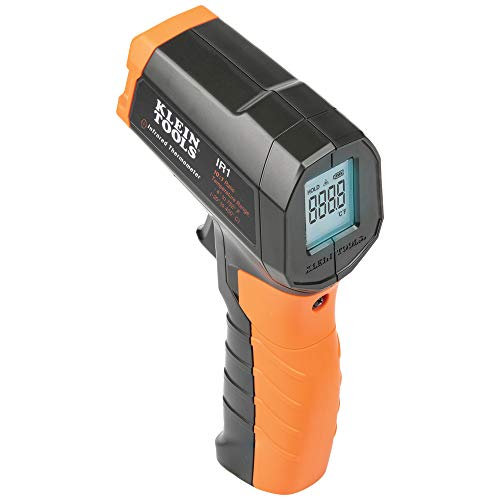
The Klein IR1 is the trade-focused spot gun: a range from minus 4 to 752 degrees Fahrenheit, a 10 to 1 distance-to-spot ratio, a targeting laser, auto-hold after the trigger releases, and a fixed emissivity of 0.95 that matches most non-metallic building and mechanical surfaces. The housing is built for tool bags and belt carry, with the simple two-button operation electricians and HVAC techs prefer when they are on a ladder.
Fixed emissivity is both its convenience and its limit: readings on bare shiny metal will read low, and there is no adjustment to correct them. For its intended work, checking motor housings, duct surfaces, breakers, vents and bearings, 0.95 is the right default and the IR1’s speed and durability carry the day. Between the two spot guns here, choose the Etekcity for adjustable emissivity and kitchen range, and the Klein for jobsite toughness and trade habits.
How to choose
Decide by the shape of your problem. If you are hunting, not knowing where the leak, draft, blockage or hot spot is, you need an imager: a camera shows gradients and patterns across a whole surface, which is how hidden problems announce themselves. If you are verifying, confirming a temperature at a known point, a spot thermometer is faster, cheaper and often more accurate at that single point. Next, weigh resolution against working distance: higher sensor resolution lets you stand back and still resolve small targets like individual breakers. Then check temperature range against your tasks; building diagnostics live in a narrow band, while engine and brake work needs the high end of a spot gun’s range. Consider emissivity handling if you measure metals, and finally decide between phone-based convenience and dedicated hardware that starts instantly and survives the site.
Who should skip
Skip thermal imagers if your temperature questions are all known-point checks, like cooking surfaces and vent output; a spot gun answers them for a fraction of the cost. Skip spot thermometers as your only tool if you do energy audits, water damage hunting or electrical panel surveys, where the fault location is the whole question. Skip both if you need certified measurement for compliance reporting, which calls for calibrated instruments with documentation. And skip the entry-level imager if your work is paid inspection: clients and reports deserve the resolution and range of the stronger models, and the upgrade pays for itself in credibility.
FAQ
Can an infrared thermometer find a water leak?
Only indirectly and unreliably. A leak changes surface temperature where evaporation cools the material, but you must point the gun at exactly the affected spot. A thermal imager shows the whole cool patch at once, including its shape and source path, which is why leak hunting belongs to cameras.
What does distance-to-spot ratio mean?
It describes how large an area the thermometer averages from a given distance. A 12 to 1 ratio reads a one-inch circle from twelve inches away, or a ten-inch circle from ten feet. Standing too far back mixes the target with its surroundings and produces misleading numbers.
Why do shiny metal surfaces read wrong?
Infrared tools measure radiated heat, and polished metal radiates poorly while reflecting heat from other objects. Adjustable emissivity settings, a piece of matte tape on the surface, or a flat painted spot gives a trustworthy reading. This affects spot guns and imagers alike.
Is a phone-based thermal camera good enough for home use?
For the common home tasks, yes. Missing insulation, drafts, overheating outlets, radiant heat tracing and plumbing leaks all show clearly on current phone-based imagers. Professional inspectors benefit from dedicated cameras with higher resolution, onboard storage and no dependence on a phone battery.
Final verdict
Thermal imaging cameras and infrared thermometers are complements, not rivals. Buy the imager when finding the problem is the job: the HIKMICRO B10 for dedicated professional hardware, the FLIR ONE Pro for the strongest phone-based images, and the FLIR ONE Gen 3 for an affordable start. Buy the spot gun when measuring is the job: the Etekcity Lasergrip 1080 for adjustable emissivity at home, the Klein IR1 for the trade toolbox. Many well-equipped shops end up owning one of each.