Key takeaways
- Compare the best workshop air filtration systems and ceiling-mounted air cleaners, with CFM sizing help, filter ratings, timers and remote picks.
A dust collector catches chips and coarse dust at the tool, but the finest particles escape into the room air, hang there for hours, and settle on every surface. A workshop air filtration system is the second half of the defense: a ceiling box with a fan and two filters that scrubs the whole room while you work and after you leave. This guide compares five ceiling-mounted air cleaners, from a compact unit for a one-car garage to high-output machines for a two-car shop, and explains how to size one by air changes per hour instead of guesswork.
As an Amazon Associate, we earn from qualifying purchases.
Quick answer
For most one-car garage shops, the WEN 3410 is the sensible start: three speeds, a remote and a timer in a small cabinet. Shops needing more air changes should step up to the WEN 3417 or the JET AFS-1000B, both rated just over 1,000 CFM. The JET AFS-1000C adds a sensor that adjusts speed on its own, while the POWERTEC AF1045 matches the big units on airflow.
WEN 3410 3-Speed Remote-Controlled Air Filtration System
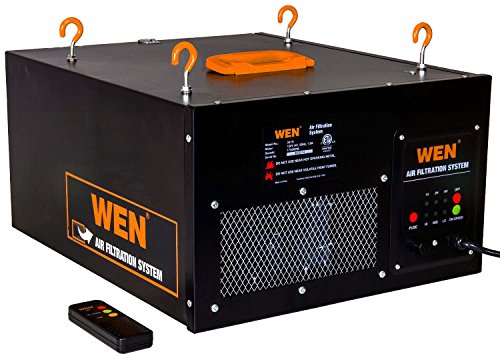
The WEN 3410 is the entry point to ceiling-mounted filtration, built for smaller shops where a full-size unit would be oversized. Its three speeds deliver 300, 350 or 400 CFM, which is enough to turn over the air in a one-car garage or a basement shop several times an hour. Air passes through a 5-micron outer filter that catches the larger airborne particles first, then a 1-micron inner filter that traps the fine dust a collector misses.
An RF remote controls power, speed and the programmable timer from across the room, and because it uses radio frequency rather than infrared, it does not need a clear line of sight to the unit overhead. The timer is the feature owners lean on most: set it before you leave and the machine keeps scrubbing while the dust you raised settles out, then shuts itself off. At roughly 31 pounds, it is also one of the easier units in this category to lift into place on a ladder with a helper.
The trade-off is capacity: in a two-car garage, 400 CFM on high cycles the room air slowly, and the filters load faster relative to the room volume. For a compact shop, though, the 3410 covers the job at the lowest complexity in this guide.
WEN 3417 3-Speed Remote-Controlled Industrial-Strength Air Filtration System
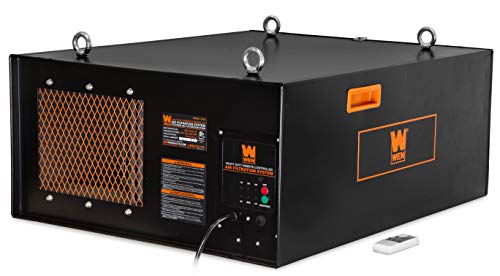
The WEN 3417 is the 3410’s bigger sibling, aimed at shops that outgrow the compact class. Its three speeds run 556, 702 and 1,044 CFM, so on high it moves roughly two and a half times the air of the smaller unit. That output suits a two-car garage or a dedicated shop room where a table saw, planer and sander all contribute dust during a session.
It uses the same two-stage layout: a 5-micron outer filter in front of a 1-micron inner filter, and the replacement filters are shared with the wider WEN 3415 filter family, which keeps spares easy to source. The remote control and timer carry over as well, so the working pattern is identical to the 3410, just scaled up. A 3-amp motor drives the higher airflow, and the unit weighs about 55 pounds, so plan the ceiling mount with joist-rated hardware and a second pair of hands.
The WEN counters the JET AFS-1000B below with filter commonality across the brand’s lineup and a straightforward control scheme; the JET counters with a heavier steel cabinet and a longer track record in pro shops. Either is a defensible anchor for a mid-size shop.
JET AFS-1000B Air Filtration System
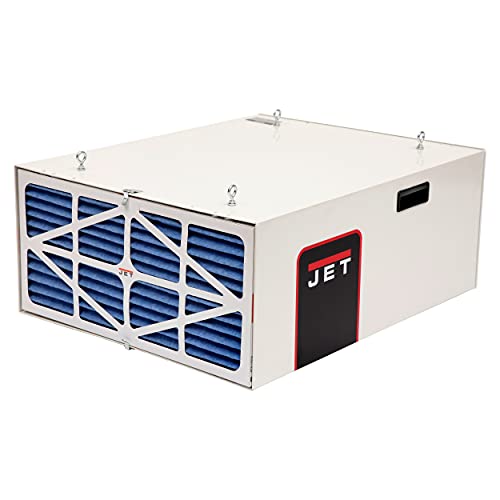
The JET AFS-1000B is the long-running benchmark in this category, a steel-box unit that has been a fixture in home and small professional shops for years. It is rated up to 1,044 CFM across three speeds and filters in two stages: an electrostatic outer filter that attracts fine particles as air enters, and a 1-micron inner filter behind it. The remote control handles power, speed and the built-in timer, so you can leave it running after the last cut of the day.
Two practical points separate the AFS-1000B from the budget end. First, the all-metal housing shrugs off the knocks and vibration of a working shop and can also sit on a bench or shelf if ceiling mounting is not an option. Second, its filter sizes are a de facto standard, so replacement outer and inner filters are stocked by a long list of woodworking suppliers, not just the original maker.
The design is older than the AFS-1000C below, and it shows in the controls: no air quality sensor, no automatic mode, and a simpler display. What you get instead is a proven, repairable machine whose airflow matches the newest models in this guide.
JET AFS-1000C Air Filtration System

The AFS-1000C is JET’s ground-up redesign of the formula, and its headline feature is a built-in air quality sensor. In automatic mode the unit reads the dust level in the room and adjusts its own fan speed across six settings, from 450 to 1,000 CFM, spinning up when you start milling and easing back as the air clears. A radio frequency remote overrides or confirms settings from anywhere in the shop, and the timer runs far longer than most, from 1 to 16 hours.
The housing is molded ABS rather than steel, which cuts the net weight to about 33 pounds and helps damp vibration and noise; JET rates the sound level at 51 to 67 decibels measured at one meter, depending on speed. A brushless motor draws 3.8 amps, and the angled LED display on the underside shows speed, timer and a filter status indicator, so a glance upward tells you when the filters need attention. Filtration stays two-stage, with an electrostatic outer filter and a 1-micron inner filter.
This is the pick for buyers who want the machine to manage itself between sessions. If you would rather set a speed and forget the electronics, the AFS-1000B above does the same core job with fewer features to pay for.
POWERTEC AF1045 3-Speed Remote Controlled Air Filtration System

The POWERTEC AF1045 posts the highest airflow figures in this guide: 655, 875 or 1,060 CFM from a 1/5-horsepower, 3-amp motor with three speeds. Its two-stage filtration pairs a 5-micron outer filter with a 1-micron inner filter, and the listing bundle for the AF1045C package includes a spare set of inner and outer filters in the box, which removes the first replacement purchase from your list.
An infrared remote controls power and speed and sets the auto-off timer at 1, 2 or 4 hours. Infrared means the remote needs line of sight to the unit, a small but real difference from the RF remotes on the WEN and JET C models when the machine hangs behind ducting or a lumber rack. POWERTEC rates the sound at 63 to 68 decibels at three feet across its speed range.
At roughly 62 pounds net, this is the heaviest unit here, and the case is sized for larger rooms, so it makes the most sense in a two-car garage or a shop that regularly runs dusty operations. Mounting hardware is included, and the manual specifies keeping the bottom of the unit at least seven feet above the floor.
How to choose
Start with air changes per hour, not the CFM headline. Multiply your shop’s length, width and ceiling height to get its volume in cubic feet, then multiply the unit’s CFM by 60 and divide by that volume. The result is how many times per hour the machine cycles the room’s air; six to eight changes per hour is a good target for a woodworking shop. A 20 by 20 foot shop with an 8-foot ceiling holds 3,200 cubic feet, so a 400 CFM unit delivers about seven and a half changes per hour, while the same room with a 10-foot ceiling drops that figure and argues for a 1,000 CFM class machine.
Second, look at the two filter stages. Every unit here pairs a coarse outer filter, usually rated at 5 microns, with a 1-micron inner filter, and that pairing matters more than any single-stage claim: the outer filter protects the expensive inner filter from loading up with coarse dust. Check the replacement filter size before you buy, because common sizes are cheaper and easier to find than proprietary ones.
Third, decide how you will control a box hanging over your head. A timer is close to mandatory, since the biggest benefit comes from running the unit for an hour after you stop cutting. RF remotes work from anywhere; infrared remotes need a clear view of the control panel. Sensor-driven automatic mode, as on the AFS-1000C, removes the decision entirely.
Finally, plan the mount. These units hang from eye bolts and chains or brackets screwed into ceiling joists, never into drywall alone, and the heavier models need two people to install safely. Keep the intake unobstructed and leave room to slide the filters out for cleaning.
Who should skip
Skip a ceiling-mounted filtration system if you do not yet own a dust collector or a good shop vacuum setup. Ambient filtration only handles the fine dust that escapes capture at the tool; it does nothing for the chips and heavy dust a collector removes at the source, and buying the ceiling unit first leaves the biggest part of the problem untouched.
Skip it, too, if your shop time is mostly hand-tool work, assembly and finishing, which produce little airborne dust, or if your space is a shared garage where the car returns every night and ceiling clearance is already tight. And if your main dust source is a single machine used in short bursts, a respirator plus source capture will serve you better than a room-sized appliance. These units also do not replace respiratory protection during heavy milling; they reduce the background dust load between and after sessions.
FAQ
Does an air filtration system replace a dust collector?
No. The two machines do different jobs. A dust collector pulls chips and dust out of a tool through a hose before they escape, while a ceiling-mounted filtration system cleans the fine particles that are already floating in the room air. Shops that care about dust control generally run both, with the filtration unit continuing to work after the collector shuts off.
How often do the filters need cleaning or replacement?
The outer filter loads first and can usually be vacuumed or blown out several times before replacement; the inner filter lasts longer because the outer stage protects it. In a shop used every weekend, expect to clean the outer filter monthly and replace filters on a cycle measured in months rather than weeks. A filter status indicator, where fitted, takes the guesswork out of the timing.
Can these units sit on a bench instead of hanging?
Most can. The JET models are designed to hang from the ceiling but can also rest on a sturdy bench or shelf, and some owners prefer that for filter access. Ceiling mounting keeps the unit out of the work zone and places it where warm, dust-laden air collects, so it remains the better default when the joists allow it.
How loud are workshop air filtration systems?
Expect conversation-level noise on low speed and something closer to a loud fan on high. Published figures for the units in this guide run from the low 50s to the high 60s in decibels depending on speed and measurement distance. Running the unit on its timer after you leave the shop is the simplest way to get the high-speed cleaning without working alongside the noise.
Final verdict
For a compact shop, the WEN 3410 delivers the essential pattern of two-stage filtration, remote control and a timer at the smallest size and weight here. Step up to the WEN 3417 or the JET AFS-1000B when your room volume demands roughly 1,000 CFM, choosing between them on filter availability and cabinet construction. The JET AFS-1000C earns its place for the sensor-driven automatic mode and long timer, and the POWERTEC AF1045 is the value play at the top of the airflow chart, with spare filters in the box. Size by air changes per hour, mount it into joists, and let it run after every session.
Product and ASIN Reference
| Product | ASIN |
|---|---|
| WEN 3410 3-Speed Remote-Controlled Air Filtration System | B00LPD9BDI |
| WEN 3417 3-Speed Remote-Controlled Industrial-Strength Air Filtration System | B07KKXNY26 |
| JET AFS-1000B Air Filtration System | B00004R9LO |
| JET AFS-1000C Air Filtration System | B09WVCQQ7S |
| POWERTEC AF1045 3-Speed Remote Controlled Air Filtration System | B0CQL2WBKW |