Key takeaways
- Compare the best contour gauges for woodworking and flooring, from locking 10-inch duplicators to a fine stainless-pin gauge, with pin and lock advice.
Fitting a floor plank around a door casing, scribing a shelf to a wavy wall, or matching one half of a molding profile to the other all come down to the same problem: the shape you need to copy is not a straight line, and a tape measure cannot describe it. A contour gauge solves that problem in seconds. Its row of thin sliding pins presses against the object, takes the outline, and holds it long enough for you to trace the shape onto tile, laminate, hardwood, or sheet goods. The five gauges below cover the main designs worth buying, from locking 10-inch plastic-pin duplicators for flooring work to a fine stainless-pin gauge for precision woodworking. Each one earns its place for a different reason, and the differences in pin material, pin depth, and locking hardware matter more than the brand name on the box.
As an Amazon Associate, we earn from qualifying purchases.
Quick answer
For most flooring and trim work, the Saker 10-inch gauge is the safest buy, with fine pins and a positive lock. The VARSK 10-inch runs it close with an aluminum core, while the JOREST connectable set covers longer profiles. The General Tools 837 suits precision woodworking, and the Acari two-gauge set covers mixed jobs.
Saker Contour Gauge, 10 Inch

The Saker is the gauge most buyers picture when they search for this tool, and it holds that position because the design gets the basics right. The 10-inch body carries a dense row of ABS pins, each roughly six hundredths of an inch wide, which is fine enough to follow the steps in stacked trim and the curve of a pipe without leaving a chunky, stair-stepped trace. An adjustable locking lever clamps the pins once the profile is captured, so the outline survives the trip from the workpiece to the saw bench without drifting.
In use, the workflow is the standard one for this tool class: press the pin row squarely into the profile, slide the lock closed, carry the gauge to the material, and trace along the pin ends with a sharp pencil. The body carries inch and metric scales, which helps when the captured shape also needs a quick length check. Saker also sells a 5-inch version of the same design for tight spots, and the 10-inch model is the better default for flooring, where door jambs and heating pipes tend to be wider than a short gauge can span in one press.
Choose the Saker if you want one gauge that handles the common jobs without fuss. Its pins are plastic, so it will not match the trace fidelity of a steel-pin gauge on very fine molding detail, but for laminate, vinyl plank, and trim work it is the balanced pick.
VARSK Contour Gauge Tool, 10 Inch (VAR-350)

The VARSK VAR-350 takes the same 10-inch locking format and builds it around a heavy-duty aluminum alloy core, which gives the body a rigidity that all-plastic gauges lack. That stiffness matters when you press the gauge hard into a profile: a flexing body lets the end pins wander, and the trace comes out slightly wider than the original. The VARSK pins are ABS, sized at five hundredths of an inch, and they travel up to two and a half inches deep, enough for baseboards, crown molding returns, and most pipe diameters found in residential flooring work.
A lock holds the captured shape, and the maker pitches the tool at molding reproduction, spindle duplication on the lathe, and fitting flooring around moldings, which is a fair description of where a 10-inch gauge earns its keep. The pin depth is the specification to weigh here. Many budget gauges stop at roughly an inch and a quarter of travel, which is too shallow for deeper trim profiles; the VARSK’s deeper travel covers more of the shapes a renovator actually meets.
Pick the VARSK if your work leans toward woodworking and molding rather than flat flooring alone, or if you simply prefer a metal core in a tool that will live in a jobsite box. It is a straightforward, well-built version of the standard design.
JOREST Connectable Contour Gauge, 10 and 5 Inch Set

The JOREST set answers the one question a single 10-inch gauge cannot: what happens when the profile is longer than the tool. The set pairs a 10-inch gauge with a 5-inch gauge, and the two connect end to end to form a 15-inch gauge. Used apart, the small gauge handles pipe cutouts and short trim returns while the larger one covers jambs and longer curves. Joined together, the pair spans wide baseboard runs and the long, shallow arcs that show up in older houses where nothing is quite straight.
Both pieces carry locks, and the pin tension can be adjusted with a screwdriver, a useful detail because pin friction is a compromise on every gauge of this type: too loose and the pins slip before you trace, too tight and they refuse to follow delicate profiles. Being able to tune that friction extends the useful life of the set as the pins wear.
The trade-off is that a joined gauge is only as accurate as the joint. For a single continuous trace across the splice, press the profile in one motion and check the seam before tracing. For most users, though, the flexibility of three working lengths in one purchase makes this the most versatile option in the roundup, and the natural choice for flooring installers who meet a different profile on every job.
General Tools 837 6-Inch Contour Gauge

The General Tools 837 is the traditionalist’s gauge, and it has been in workshops for decades. Instead of plastic pins, it uses stainless steel leaves packed at thirty-five pins per inch, the finest resolution in this roundup, with a pin travel of up to three and a half inches. That combination produces the cleanest traces on fine molding, turned work, and the small profiles found in furniture repair and architectural restoration, where a plastic pin’s width can swallow the detail you are trying to copy.
There is no locking lever. The pins hold their position by friction alone, which experienced users manage by handling the gauge carefully and tracing promptly, but it does mean the 837 asks for a gentler touch than the locking gauges above. The steel pins are also delicate compared with ABS: drop the tool or force it against a hard edge and individual leaves can bend, and the maker and reviewers alike treat careful storage as part of owning one.
At six inches, it is the shortest gauge here, and that limits it to smaller work. Buy the 837 when the accuracy of the trace matters more than span or speed, for example when reproducing a section of damaged molding or fitting parts in repair work. For rough flooring cuts, its finesse is wasted and its fragility is a liability.
Acari Designs Contour Gauge with Lock Set, 10 and 5 Inch
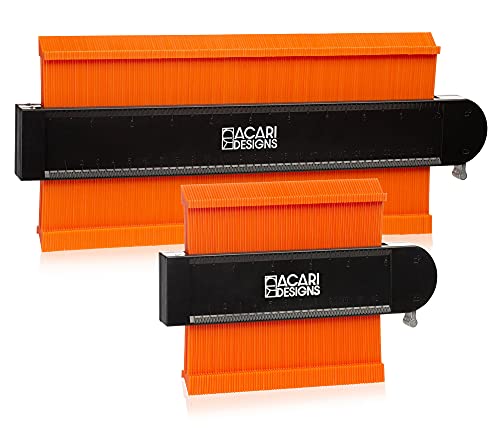
The Acari Designs set (part CG1) bundles a 10-inch and a 5-inch gauge, each built on a reinforced aluminum alloy core with its own lock. Unlike the JOREST set, the two gauges do not join together; they are two independent tools, which suits a different way of working. One gauge can hold a captured profile at the bench while the other is in use at the workpiece, and two installers on the same job are not left sharing a single tool.
The alloy core gives both gauges a solid feel, and the locks hold the pin rows firmly once a shape is captured, which is what you want when the gauge has to travel from a bathroom pipe cluster to the tile saw without the outline shifting. The pin rows follow the usual pattern for this class, fine enough for flooring, tile, and trim outlines, and the two sizes cover the standard range of residential obstacles, from narrow radiator pipes to full door casings.
Choose the Acari set if you want the two most useful sizes as separate, locking tools rather than a connectable system. It is a practical, construction-grade bundle for renovators who would rather have a spare gauge than a longer one, and the metal cores should outlast the all-plastic bodies of cheaper sets.
How to choose
Start with the work. Flooring and tile installers need span and a lock: a 10-inch locking gauge handles door jambs, pipes, and casings in a single press, and the lock keeps the outline intact on the walk to the saw. Woodworkers copying fine molding should look at pin fineness first, because pin width sets the smallest detail the gauge can reproduce, and consider a steel-pin gauge despite its shorter span.
Pin depth is the second specification. Shallow pins bottom out on deep trim and leave the top of the profile unrecorded, so match the travel to the deepest molding you expect to copy. Pin material comes next: ABS pins are durable, gentle on finished surfaces, and cheap to replace, while stainless pins trace finer detail but bend if mishandled. A lock is worth having on any gauge that will be carried around a jobsite; friction-only gauges belong at the bench.
Finally, think about length strategy. A connectable set gives the longest reach, a two-gauge set gives a working spare, and a single mid-size gauge is enough for occasional jobs. Whichever design you pick, test it on a scrap profile first and check the trace against the original before cutting good material.
Who should skip
Skip a contour gauge entirely if your work is all straight cuts and square corners, because a tape and a combination square already cover it. Skip the fine steel-pin design if the tool will be tossed into a shared jobsite box, since bent leaves ruin its one advantage. Skip the longest connectable setups if you only copy short profiles, and skip every gauge here if you need a permanent record of a profile: the pins hold a shape for minutes, not days, so trace and cut in the same session. Anyone fitting flooring once, for a single room, may also find that careful cardboard templating does the job without another purchase.
FAQ
What is a contour gauge used for?
It copies the outline of an irregular object, such as a pipe, door casing, or molding profile, so the shape can be traced onto flooring, tile, or wood and cut to fit. Press the pins against the object, lock them if the gauge has a lock, then trace along the pin ends onto the material.
Are plastic or metal pins better?
Plastic pins are tougher, cheaper, and safe on finished surfaces, and they are fine enough for flooring and trim. Metal pins are thinner and packed more densely, so they reproduce fine molding detail more accurately, but they bend if the gauge is dropped or forced, and they need careful storage.
What size contour gauge should I buy?
A 10-inch gauge covers most residential work, including door jambs and common pipe sizes. Choose a 5-inch model for tight corners and short profiles, and a connectable or two-gauge set if you regularly meet profiles longer than ten inches or want a second gauge holding a shape at the bench.
How do I get an accurate trace from a contour gauge?
Press the gauge straight into the profile with even pressure, keep it perpendicular to the surface, and set the lock before moving it. Trace with a sharp pencil held flat against the pin ends, then test the cut on scrap. Re-press and re-trace rather than trying to adjust a shifted pin row.
Final verdict
The Saker 10-inch is the right default for most readers: fine pins, a real lock, and a size that covers everyday flooring and trim work. The VARSK matches it closely with a stiffer aluminum core and deeper pin travel. The JOREST set is the pick for long profiles, the General Tools 837 for fine woodworking detail, and the Acari set for buyers who want two independent locking gauges. Match the gauge to the profiles you actually copy, and any of the five will do its one job well.
Product and ASIN Reference
| Product | ASIN |
|---|---|
| Saker Contour Gauge, 10 Inch | B083FBRJPM |
| VARSK Contour Gauge Tool, 10 Inch (VAR-350) | B0895JCFMX |
| JOREST Connectable Contour Gauge, 10 and 5 Inch Set | B0969G39FL |
| General Tools 837 6-Inch Contour Gauge | B00004T7RA |
| Acari Designs Contour Gauge with Lock Set, 10 and 5 Inch | B08HXJ351J |