Key takeaways
- How much does a battery pack cost? We explain what sets what you pay — capacity, charging speed and cables — and which power banks to keep in your bag.
Disclosure: As an Amazon Associate, this site may earn from qualifying purchases made through links on this page.
Intro
How much does a battery pack cost? The short answer is that it depends on what the pack can do. A small pocket bank that tops up a phone once asks for far less than a large bank that can charge a tablet and a laptop. Three things set what you pay more than anything else: capacity, output wattage, and extras such as built-in cables, a wall plug, or a display. Brand support matters too, since a bank from a maker with a real warranty and a support channel you can reach is worth more over the years than a no-name pack with the same numbers on the box.
This article answers the question in plain terms and then shows five portable power banks you can buy on Amazon US, all rechargeable lithium-ion packs for phones, and several that also handle tablets. Every figure in the picks comes from the listings themselves. This article gives no dollar figures, because the amount you pay for any bank shifts often and differs between sellers; the listing shows the current amount when you look. The guidance here is general knowledge about how these packs work, not the result of laboratory work.
A battery pack, in the sense most people mean it, is a portable charger: a sealed lithium-ion pack with USB ports that refills a phone, tablet, earbuds, or watch away from a wall outlet. Capacity is measured in milliamp-hours, written mAh. A 5,000mAh bank holds roughly one phone top-up. A 10,000mAh bank holds roughly one full phone charge plus a second top-up. A 20,000mAh bank holds several phone charges, or one or two tablet charges. Output wattage decides how quickly the bank refills your device: a 15W bank fills a phone slowly, a 20W bank moves noticeably quicker, and a 45W or higher bank can run a tablet while it charges.
At a Glance
- What you pay for a battery pack depends mainly on capacity, output wattage, and extras such as built-in cables or a wall plug.
- A 5,000mAh pocket bank asks for the least; a 10,000mAh bank sits in the middle; a 20,000mAh or larger laptop-class bank asks for the most.
- Rated capacity is a ceiling, not a promise: expect roughly 60 to 85 out of every 100 mAh to reach your phone, because voltage conversion and cable losses take a share.
- Output wattage matters as much as capacity. A 20W bank fills a phone far quicker than a 10W or 12W bank of the same size.
- Built-in cables and a wall plug add convenience and a little bulk. A detachable cable can be replaced if it wears out; a built-in cable cannot.
- Weight grows with capacity. A 5,000mAh bank can weigh just over 3 ounces; a 10,000mAh bank usually weighs 6 to 9 ounces.
- All five picks in this article are portable power banks for phones, and several also charge tablets. Check the listing for the current amount before you buy.
How to Choose
Capacity: 5,000, 10,000, or 20,000mAh
Capacity is the first fork in the road. A 5,000mAh bank suits a light day: one solid top-up for a phone, in the smallest and lowest-weight body. A 10,000mAh bank is the sweet spot for most people, with a full phone charge plus a second top-up in a body that still fits a jacket pocket. A 20,000mAh bank suits travel, long days away from outlets, and households that charge several devices. Remember that rated capacity is not the same as usable output. A 10,000mAh bank delivers roughly 6,000 to 8,500mAh to your phone after conversion losses, which is still a full charge for most phones and a good part of a second one.
Output wattage: how quickly it fills your device
Wattage decides charging speed. A bank with a 3A USB-C output moves at up to 15W, which fills a modern phone in about two hours from empty. A 20W bank takes a phone to about half charge in roughly half an hour, per the listings. A 45W bank does the same job quicker still and can keep a tablet running while it charges. Check the wattage of the port you plan to use, not just the headline number: some banks put their highest wattage on one USB-C port only, while the other ports run slower. If you charge a tablet, look for at least 20W on a USB-C port, and 30W or more if the tablet is large.
Built-in cables or bring your own
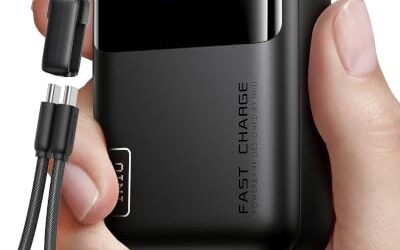
Built-in cables are the most practical convenience on a power bank. A bank with a built-in USB-C cable means you never hunt for a cord, and a bank with a built-in wall plug recharges itself straight from an outlet with no adapter at all. The trade-off is that a built-in cable cannot be replaced if it frays, and it adds a little thickness. A bank with no built-in cable stays slimmer and lets you use a cable of the length you like, but you must remember to carry one. The INIU pick in this article uses a detachable cable, while the charmast pick builds the cables and the plug into the body.
Size and weight
A bank lives in a pocket or a bag, so size and weight matter every day. The Nitecore NB Air in this article weighs about 3.14 ounces and is smaller than most phones. The 10,000mAh banks here weigh roughly 6 to 9 ounces each. A two-pack, like the Miady, gives you a spare bank for a second bag or a second person, at the weight of two banks. If you carry the bank in a front pocket, favor the slimmest body you can find. If it rides in a backpack, a slightly heavier bank with more capacity is the better trade.
Safety and support
A power bank is a dense lithium-ion pack, so safety belongs on the checklist. Look for overcharge, overheat, overcurrent, and short-circuit protection on the listing, and favor makers that publish a warranty and a support channel you can reach. INIU backs its banks with a 3-year care plan plus lifetime technical support. Keep the bank away from heat, do not puncture it, and recycle it at a battery drop-off when it reaches the end of its life instead of putting it in household waste.
The Picks
1. INIU 10000mAh Slim Portable Charger
INIU 10000mAh Slim Portable Charger, Triple 3A USB-C
The INIU 10000mAh Slim is the top pick for most people, because it pairs a thin body with genuinely quick 3A charging. It holds 10,000mAh and has a USB-C port that works for input and output plus two USB-A ports, so it can charge three devices at once. The listing names it the slimmest and lowest-weight USB-C 10,000mAh bank in its line, and it ships with a travel pouch and a cable. INIU backs it with a 3-year care plan plus lifetime technical support. If you want one bank for daily carry that covers a full phone charge plus a second top-up, this is the one to buy first.
2. Nitecore NB Air 5000mAh
Nitecore NB Air 5000mAh Ultra Lightweight Power Bank, USB-C
The Nitecore NB Air is the lowest-weight pick in this article, at about 3.14 ounces, with a carbon fiber frame and an IPX7 waterproof build. It holds 5,000mAh and charges through a single USB-C port, so you bring your own cable. Its job is a single solid phone top-up from a body smaller than most phones, and it suits a front pocket, a running belt, or a small purse. The listing calls it airline-approved, and its rugged build suits outdoor use. If you want the bank you actually carry every day because you forget it is there, this is the one.
3. iWALK 4500mAh 20W Mini Power Bank
iWALK Portable Charger 4500mAh 20W USB-C Mini Power Bank
The iWALK mini is the pocket-rescue pick: a lipstick-sized bank with a built-in USB-C connector, so there is no cable to lose or forget. It holds 4,500mAh and delivers 20W output, and the listing says it takes an iPhone 15 Pro from empty to about half charge in roughly 30 minutes. It measures about 3.1 by 1.5 inches and weighs about 6.1 ounces, and it supports pass-through charging, so the phone and the bank can share one outlet. Treat it as a rescue top-up rather than a second battery: 4,500mAh is roughly one phone charge from empty, not a full day of use. If you want a bank for a night out, a festival, or a long commute, this is the one that fits in a pocket you already have.
4. Miady 2-Pack 10000mAh Portable Charger

Miady 2-Pack Portable Charger, Slim 10000mAh Power Bank
The Miady two-pack is the household pick: two slim 10,000mAh banks in one box, each with a USB-C bidirectional port plus two USB-A ports, so each bank can charge three devices at once. Each bank measures about 5.5 by 2.6 by 0.6 inches and weighs about 7.68 ounces. One bank can live in your bag and the other in a second bag, a car, or a partner’s pocket, and the pair covers a household with several phones. If you want a spare bank always within reach without buying twice, this is the practical choice.
5. charmast 10000mAh with Built-in Cables and Plug
charmast Portable Charger with Built-in Cables and Plug, 10000mAh
The charmast is the all-in-one pick: 10,000mAh in a slim housing with built-in charging cables and an integrated wall plug, so the bank recharges straight from an outlet with no adapter at all. It measures about 5.95 by 2.76 by 0.72 inches, weighs about half a pound, and supports up to 5V and 3A output through its USB-C and USB-A outputs. A rubberized cover improves grip and scratch protection. Some buyers note mixed long-term durability, which the listing’s own buyer comments reflect, so treat this as the convenience pick rather than the longest-lived one. If you hate carrying cables and adapters, this is the bank that removes them.
Comparison Table
| Pick | Capacity | Output | Built-in cable or plug | Weight |
|---|---|---|---|---|
| INIU Slim | 10,000mAh | Triple 3A USB-C + USB-A | Detachable cable | Not stated |
| Nitecore NB Air | 5,000mAh | USB-C | None | 3.14 oz |
| iWALK Mini | 4,500mAh | 20W USB-C | Built-in USB-C connector | 6.1 oz |
| Miady 2-Pack | 2 x 10,000mAh | USB-C + 2 x USB-A each | None | 7.68 oz each |
| charmast | 10,000mAh | Up to 5V 3A | Built-in cables + wall plug | 8 oz |
Which One Fits Your Situation
- One bank for daily carry: the INIU Slim, with 10,000mAh, triple 3A outputs, and a 3-year care plan.
- The lowest weight in a pocket: the Nitecore NB Air, at about 3.14 ounces with a waterproof carbon fiber frame.
- A rescue top-up for a night out: the iWALK mini, with a built-in USB-C connector and 20W output in a lipstick-sized body.
- A spare bank always within reach: the Miady two-pack, with two 10,000mAh banks that each charge three devices at once.
- No cables or adapters to carry: the charmast, with built-in cables and a wall plug in one slim body.
FAQ
How much does a battery pack cost?
What you pay for a battery pack depends on capacity, output wattage, and extras. A small 5,000mAh pocket bank asks for the least, a 10,000mAh bank sits in the middle, and a 20,000mAh or larger laptop-class bank asks for the most. Built-in cables, a wall plug, a display, and a longer warranty each add a little. The amount shifts often and differs between sellers, so check the listing for the current amount before you buy. This article gives no dollar figures for that reason.
Why do two 10,000mAh banks ask for different amounts?
Capacity is only one part of what you pay. Output wattage matters as much: a 45W bank with a detachable cable and a 3-year care plan asks for more than a basic 10W bank of the same size. Built-in cables, a wall plug, a display, waterproofing, and brand support each add to the amount. Two banks can share the same mAh number and still differ widely in speed, convenience, and how long the maker stands behind them.
Is a bigger mAh number always better?
No. A bigger number means more stored energy, but it also means more weight and a larger body, and the usable output is always below the rated number. A 10,000mAh bank delivers roughly 6,000 to 8,500mAh to your phone after conversion losses. For daily carry, a slim 10,000mAh bank is usually the better trade than a heavy 20,000mAh bank you leave at home. Match capacity to your day: one top-up, one full charge, or several charges for travel.
Do built-in cables matter?
Yes, for convenience. A built-in cable means you never hunt for a cord, and a built-in wall plug means the bank recharges itself straight from an outlet. The trade-off is that a built-in cable cannot be replaced if it frays, while a detachable cable can. If you carry one bank everywhere, built-in cables remove a daily annoyance. If you already carry a cable you like, a slimmer bank without one is the better buy.
Can I take a power bank on a plane?
Yes, in carry-on luggage, under the general rule that banks under 100Wh travel in the cabin. All five picks in this article sit well under that line: a 10,000mAh bank holds about 37Wh, and a 20,000mAh bank holds about 74Wh. Never put a power bank in checked luggage. Check your airline’s own rules before you fly, since carriers can set their own limits.
How long does a 10,000mAh bank last before it needs a recharge?
A 10,000mAh bank holds roughly one full phone charge plus a second top-up, so for most people it lasts a day or two of heavy use before it needs a recharge of its own. Recharge it with a USB-C charger; a 15W input takes several hours, while a quicker input shortens that time. A bank also loses a little charge while it sits unused, so top it up the night before a trip rather than trusting a bank that sat in a drawer for weeks.
Final Take
How much does a battery pack cost? It depends on what the pack can do, and the honest answer is to match the bank to your day rather than to chase the biggest number on the box. A small pocket bank asks for the least and covers one top-up. A 10,000mAh bank sits in the middle and covers most people most days. A large laptop-class bank asks for the most, and gives it back in wattage and capacity you can feel. Among the picks here, the INIU Slim is the best all-rounder for daily carry, the Nitecore NB Air is the one you forget is in your pocket, the iWALK mini is the rescue top-up for a night out, the Miady two-pack keeps a spare always within reach, and the charmast removes cables and adapters from your bag entirely. Whichever you choose, check the listing for the current amount, confirm the ports and wattage match your devices, and keep the bank charged the night before you need it.