
Key takeaways
- Follow the manual for your meter, and use only listed leads and accessories as the maker states.
- Battery banks can supply very large fault currents. Keep metal tools and jewellery away from terminals, and do not short anything while placing the clamp.
- Solar arrays remain live in daylight, and string voltages can be high. Work on PV wiring, disconnects and combiners belongs to a qualified installer and local code.
- Do not bypass fuses, breakers, battery disconnects or inverter protections to simplify a reading.
- Do not claim a reading proves a circuit is safe or fault-free; it shows the current at that moment only.
- Hardwired building work and anything in a panel is for a licensed electrician.
- Budget: small AC/DC clamps from lesser-known brands are available, but check for a safety listing and a stated DC range before buying.
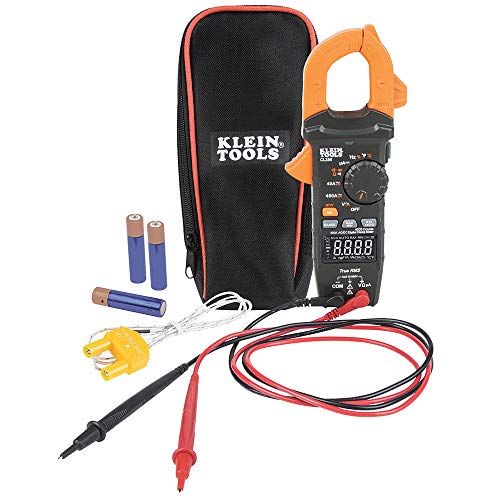
- Mid-range: Fluke 325 and Klein Tools CL390.
- Premium: Klein Tools CL800, Fluke 375 FC and Fluke 376 FC.
Budget, mid-range and premium tiers
A DC amp clamp meter is a clamp that reads direct current in amps, and the most useful picks for a home or small-shop buyer are the Fluke 325 for compact 400 A AC/DC checks, the Klein Tools CL390 for a similar range with non-contact voltage, the Klein Tools CL800 when you want 600 A and a higher voltage category, and the Fluke 375 FC or 376 FC for larger conductors and wireless features. Choose by where the DC current lives: a car or boat battery, a solar string, a charger, or an industrial supply.
Our top picks



As an Amazon Associate we earn from qualifying purchases at no extra cost to you.
Where DC clamp readings are used
Direct current is found in vehicles, boats, RVs, battery banks, solar arrays, electric motors, chargers and telecom or control supplies. A DC clamp lets you see how much current a circuit draws without breaking the wire. Typical questions are “what is my parasitic draw with the ignition off”, “how many amps is this charger delivering”, “is this winch pulling more than its rating”, and “is the battery receiving charge”.
The right meter depends on the size of the conductors and the voltage of the system. Car and boat accessory circuits are low voltage and usually modest in current. Solar strings can carry high voltage, and the wiring and disconnects are covered by local code. For that reason this guide treats solar and building wiring as work for qualified installers.
At a glance
| Model | Best for | Stated DC details | Other points | Limits |
|---|---|---|---|---|
| Fluke 325 | Automotive, marine, small DC systems | DC current up to 400 A; accuracy 2 percent plus 5 digits; DC voltage to 600 V | True-rms; CAT III 600 V and CAT IV 300 V; included K-type thermocouple; 30 mm wire capacity | Mid-sized jaw; no wireless |
| Klein Tools CL390 | Mixed AC/DC work with NCVT | 400 A AC/DC; 600 V AC/DC; DC microamps to 200; accuracy 2.0 percent plus 9 digits on current ranges | 4000 counts; CAT III 600 V; 1.6 inch jaw | Lower category than the CL800 |
| Klein Tools CL800 | Heavier DC loads and higher category | 600 A AC/DC; 1000 V AC/DC | 6000 counts; CAT IV 600 V and CAT III 1000 V; LoZ mode; 1.38 inch jaw | Smaller jaw than the CL390 |
| Fluke 375 FC | Wireless logging up to 600 A | 600 A AC/DC | CAT III 1000 V and CAT IV 600 V; wireless connectivity; optional iFlex for AC current | Premium tier |
| Fluke 376 FC | Large DC conductors | 999.9 A AC/DC through the jaw | iFlex for AC to 2500 A; min, max, average and inrush; 34 mm jaw | The flexible probe covers AC current, not DC |
Extech AC/DC clamps such as the EX830 and EX730 are discontinued, so they are not recommended here.
What to look for
DC zero and stability
DC clamps need to be zeroed with nothing in the jaws, and some drift as they warm or when moved near magnets. A clear zero function, a stable display and a hold button make life easier. If you are chasing a small parasitic draw, remember that the “plus digits” term in the accuracy figure is relatively large on small readings.
Range and resolution
400 A is plenty for most car and boat accessory work. A 600 A or 999.9 A range suits large battery cables and winches. Check the data sheet of any meter for extra low-level DC ranges if you plan to use it with other sensors.
Jaw size and cable fit
Large battery cables are thick. The Fluke 325 lists 30 mm, the Klein CL390 1.6 inches, the CL800 1.38 inches, and the Fluke 376 FC 34 mm. Measure the outer diameter of the cable, including insulation, before buying.
Category and voltage
The category rating describes where the meter may be used. For low-voltage DC in vehicles, voltage is not the limit, but if you go near a building’s service or a solar combiner, the meter’s category and voltage rating must suit the circuit and local rules.
Temperature function
The Fluke 325 includes a thermocouple and the Klein models list temperature. It is handy for checking a hot battery terminal or a warm connection, within the probe’s rated range.
Using a DC clamp correctly
- Select the DC current function and let the meter warm up for the time the manual suggests.
- With the jaws closed around nothing, press the zero button.
- Open the jaws and clamp one conductor only, with the polarity arrow, if shown, pointing along the direction of conventional current flow as the manual states.
- Wait for the reading to settle and use the hold button if the meter is in a tight spot.
- Remove the clamp before changing function or range.
Safety notes
- Follow the manual for your meter, and use only listed leads and accessories as the maker states.
- Battery banks can supply very large fault currents. Keep metal tools and jewellery away from terminals, and do not short anything while placing the clamp.
- Solar arrays remain live in daylight, and string voltages can be high. Work on PV wiring, disconnects and combiners belongs to a qualified installer and local code.
- Do not bypass fuses, breakers, battery disconnects or inverter protections to simplify a reading.
- Do not claim a reading proves a circuit is safe or fault-free; it shows the current at that moment only.
- Hardwired building work and anything in a panel is for a licensed electrician.
- Budget: small AC/DC clamps from lesser-known brands are available, but check for a safety listing and a stated DC range before buying.
- Mid-range: Fluke 325 and Klein Tools CL390.
- Premium: Klein Tools CL800, Fluke 375 FC and Fluke 376 FC.
- Battery monitor with shunt. A permanently installed monitor shows continuous current, state of charge and history. Install it per the maker’s manual, and use a qualified person if you are unsure.
- Multimeter in series. Accurate for small currents, but limited by the meter’s fuse rating, usually around 10 A, and it requires breaking the circuit.
- Clamp accessory for a multimeter. Useful if you already own a good multimeter, provided its output matches the meter’s input as the maker states.
Budget, mid-range and premium tiers
Pick-by-need decision table
| Pick this if you … | Choose |
|---|---|
| Check car, boat or RV circuits and want temperature | Fluke 325 |
| Want a large jaw and NCVT for mixed work | Klein Tools CL390 |
| Need 600 A and a higher category | Klein Tools CL800 |
| Want wireless logging for DC loads | Fluke 375 FC |
| Clamp thick battery cables or busbars | Fluke 376 FC |
Alternatives
A note on reading small DC currents
The accuracy figures on these meters include a fixed digit term. For example, the Fluke 325 lists 2 percent plus 5 digits for DC current, and the Klein CL390 lists 2.0 percent plus 9 digits. On a 400 A range with a display that steps in 0.1 A, five or nine digits is half an amp to nearly an amp. That is fine for a winch or a charger, but it is large when you are hunting a parasitic drain of a fraction of an amp. For small loads, use a finer range if the meter offers one, or place a multimeter in series with its current input following the manual, and stay within the fuse rating.
The Klein CL390 also lists a DC microamp function at 200 microamps through the leads, which is a different measurement from the clamp and suits electronics diagnosis more than battery cables.
Frequently Asked Questions
Why does my DC clamp read a number with nothing clamped?
Offset and stray magnetic fields can cause a small reading. Use the zero function with the jaws closed and empty, away from magnets and large metal objects.
Can I check a car’s parasitic draw with a clamp?
Many people do, using a clamp that reads small DC currents. Because the accuracy statement includes digits, small readings may be imprecise, and a multimeter in series gives better resolution if the draw is small. Follow the vehicle maker’s procedure.
Will an AC clamp read DC?
No. AC-only clamps do not respond to steady current. Make sure the meter lists a DC current range, such as the 400 A on the Fluke 325 and Klein CL390.
Can I use a DC clamp on solar panels?
Some clamps are sold in solar kits, but string voltages can be high and the system is live in daylight. Use only a meter rated for the voltage and category, follow the panel and inverter manuals, and use a qualified installer for any wiring work.
Do I need a flexible probe for DC?
Not for most jobs. Fluke lists its iFlex probe for AC current only, so DC work relies on the rigid jaw. Pick a meter whose jaw fits the cable you need to measure.
Which is better for large cables, a rigid jaw or a flexible probe?
A flexible probe wraps around large or awkward conductors, but Fluke lists its iFlex for AC current. For DC current, choose a meter with a jaw large enough for the cable, such as the 999.9 A Fluke 376 FC.





