Key takeaways
- Supply voltage. Clamp or probe a mains outlet or a control supply and watch the lowest value while a large load starts.
- Battery voltage. Watch the minimum during cranking or heavy load to see whether a battery sags below its working threshold.
- Intermittent faults. A loose connection that opens briefly will show as a minimum that drops towards zero.
- Temperature drift. On meters with a thermocouple function, min and max show the range of a heating or cooling cycle.
- Current inrush. A clamp meter such as the Fluke 376 FC lists min, max, average and inrush, which suits motor startup checks.
A multimeter with a Min/Max function holds the lowest and highest readings it sees over time, so you can catch a voltage sag, a spike or a flickering connection without watching the screen, and the clearest current picks are the Fluke 115 for field service, the Fluke 117 for electricians, the Fluke 179 for general bench and field use, and the Klein Tools MM720 for a trade-focused alternative. For industrial users who need fast peak capture, the Fluke 87V adds a 250 microsecond peak capture mode.
Our top picks

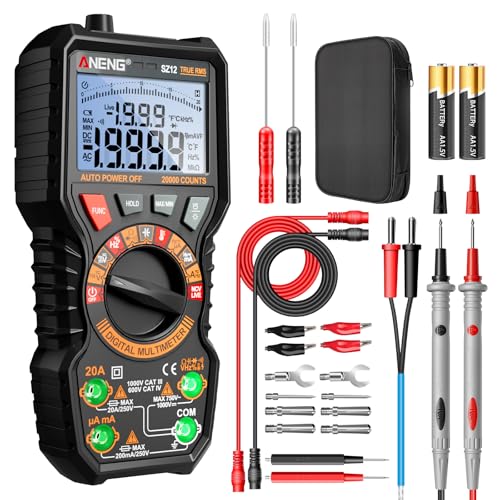
As an Amazon Associate we earn from qualifying purchases at no extra cost to you.
What Min/Max actually records
When you press the Min/Max button, the meter keeps sampling and stores the highest and lowest values reached since you pressed it. Some meters also keep an average and elapsed time, which helps you judge how long a fluctuation lasted. It is not a full data logger with a time stamp for every reading, but it is a simple way to catch events such as a supply that dips when a compressor starts, a thermostat that drifts, or a battery whose voltage sags under load.
Klein’s manuals describe the sequence on the MM720 and MM700: press MAX/MIN, the first press shows the maximum, pressing again shows the minimum, and holding the button for more than one second returns the meter to normal mode. Fluke’s 115 lists Min/Max/Average with elapsed time to record signal fluctuations.
At a glance
| Model | Best for | Stated Min/Max details | Other stated points | Limits |
|---|---|---|---|---|
| Fluke 115 | Field technicians who want a compact true-rms meter | Min/Max/Average with elapsed time | 6000 counts; backlight; AC/DC voltage to 600 V; AC/DC current to 10 A; CAT III 600 V; resistance to 40 megohms; capacitance to 9999 microfarads; 9 V battery | Lower voltage rating than the 179; no temperature function (the related Fluke 116 adds it), so look elsewhere if you need temperature |
| Fluke 117 | Electricians in buildings | Min/Max/Average readings listed by the maker | Electrician’s multimeter with VoltAlert non-contact voltage and low-impedance mode | No temperature function; check the product page for the exact functions of your kit |
| Fluke 179 | General use, temperature included | Min/Max-Average recording | True-rms; 1000 V AC/DC; 10 A AC/DC; resistance to 50 megohms; frequency to 100 kHz; CAT III 1000 V and CAT IV 600 V; temperature to 400 degrees Celsius with included 80BK probe | Higher tier than the 115 |
| Klein Tools MM720 | Trade work with LoZ and temperature | MAX/MIN with sequence button as described in the manual | TRMS, auto-ranging, 1000 V, 6000 counts, 60 megohm resistance, temperature | Included thermocouple rated to 180 degrees Celsius |
| Fluke 87V | Industrial and drive troubleshooting | Min/Max/Average plus 250 microsecond peak capture | 1000 V; CAT III 1000 V and CAT IV 600 V; 10 A; thermocouple temperature function | Premium tier; larger and heavier |
Which readings benefit from Min/Max
- Supply voltage. Clamp or probe a mains outlet or a control supply and watch the lowest value while a large load starts.
- Battery voltage. Watch the minimum during cranking or heavy load to see whether a battery sags below its working threshold.
- Intermittent faults. A loose connection that opens briefly will show as a minimum that drops towards zero.
- Temperature drift. On meters with a thermocouple function, min and max show the range of a heating or cooling cycle.
- Current inrush. A clamp meter such as the Fluke 376 FC lists min, max, average and inrush, which suits motor startup checks.
Understanding peak versus Min/Max
Standard Min/Max uses the meter’s normal sampling, so very short transients can be missed. Peak capture is a separate mode that samples faster. Fluke lists a 250 microsecond peak capture on the 87V. If you suspect short spikes, look for a meter that has a dedicated peak function, not just Min/Max.
Features to compare
True-rms
True-rms matters if you measure AC on variable-speed drives, dimmers, LED drivers or computer equipment. The Fluke 115, 179 and the Klein MM720 list true-rms measurement.
Safety category and voltage limit
The Fluke 115 lists CAT III 600 V, the Fluke 179 lists CAT III 1000 V and CAT IV 600 V, and the Klein MM720 lists a 1000 V rating. Higher categories suit work closer to the electrical supply, and should be matched to the manual for each meter.
Display and backlight
The Fluke 115 lists 6000 counts with a backlight, and the MM720 lists 6000 counts. A readable display is important when you stare at a number that changes.
Battery
The Fluke 115 uses a 9 V alkaline battery, and the maker lists long battery life with the backlight off. Long battery life matters because Min/Max recording can leave a meter on for hours.
Auto power-off
Many meters switch off after a period of inactivity. When using Min/Max for a long observation, check the manual for how to disable auto-off so the meter does not shut down and lose the recorded values.
Budget, mid-range and premium tiers
- Budget: basic meters sometimes include a Min/Max key, but the models in this guide sit above that tier. Look for a listed category and a clear manual.
- Mid-range: Fluke 115, Klein Tools MM720.
- Premium: Fluke 179, Fluke 117 with accessories, and Fluke 87V for peak capture.
Pick-by-need decision table
| If you … | Choose |
|---|---|
| Need a compact field meter and want Min/Max/Average with elapsed time | Fluke 115 |
| Want a higher category, temperature and Min/Max in one meter | Fluke 179 |
| Prefer a trade-oriented meter with LoZ and a clear MAX/MIN procedure | Klein Tools MM720 |
| Need to capture very short peaks | Fluke 87V |
| Work on motors and want inrush records through a clamp | Fluke 376 FC |
Safety and practical notes
- Use the meter within its category and voltage rating, and follow the manual for the leads and fuses.
- When a meter is left connected to a circuit for a long period, secure the leads and keep the meter away from hot or wet surfaces.
- Do not leave test leads connected to mains circuits unattended in a place where people or pets could contact them.
- Any work inside a main panel, or on hardwired circuits, is for a licensed electrician following local code.
- Do not defeat a fuse or breaker to complete a measurement.
Alternatives
- Clamp meters with Min/Max. The Fluke 376 FC lists min, max, average and inrush recording for AC/DC current, which suits large loads.
- Plug-in energy monitor. For a single appliance, a plug-in monitor records usage without exposing wiring.
- Dedicated data logger. If you need time-stamped records over days, use a logger instead of a meter’s Min/Max.
A simple way to use Min/Max for a fault hunt
- Select the function you need, such as DC volts for a battery or AC volts for a supply, and connect the leads to the circuit using the correct inputs.
- Press the Min/Max button to start recording, and note the time.
- Operate the equipment normally: start the motor, switch the load on, or tap the suspected loose connection.
- Press the button to step through the maximum, minimum and, where available, average readings.
- Compare the lowest and highest values with the equipment’s stated operating range in its manual.
This is a diagnostic step for spotting a pattern, not a certification of the supply. Persistent voltage problems at a building’s outlets, flickering lights or repeated tripping are matters for the utility or a licensed electrician.
Also note that a meter which switches itself off will discard the recorded values, and a weak battery can alter readings, so start a long observation with fresh batteries as the manual advises.
Limits worth knowing
- Min/Max values are held only while the meter stays on and in that mode; switching the rotary dial usually clears them, so avoid touching the dial during an observation.
- Fluke lists the current input of its multimeters, including the 115, as 10 A continuous with a short-term overload limit; follow the manual, so do not leave it connected to a larger load for long periods.
- Readings are only as good as the contact. A loose clip or worn probe tip can produce a minimum that is a connection fault in the lead, not in the circuit. Swap leads if a result looks suspicious.
- Meters list their stated accuracy under specific frequency ranges, for example 45 to 500 Hz on the Fluke 115 for AC volts. Outside the band, treat the number as approximate.
Frequently Asked Questions
What is the difference between Min/Max and data logging?
Min/Max stores only the lowest and highest values. A data logger stores readings over time with time stamps, which lets you see when each event occurred.
Will Min/Max catch very short spikes?
It can miss them, because normal sampling is slower than a fast transient. A dedicated peak mode, such as the 250 microsecond peak capture Fluke lists on the 87V, is better for that.
Does the Fluke 87V have Min/Max?
Yes. Fluke lists Min/Max/Average recording on the 87V, along with a 250 microsecond peak capture mode. Check the manual for your exact variant before relying on a particular function.
How do I reset the recorded values?
On the Klein meters, holding the MAX/MIN button for more than a second returns the meter to normal mode. Other meters use their own sequence, so check the manual for your model.
Do I need true-rms for Min/Max?
True-rms is independent of Min/Max, but if you measure AC on electronic loads, true-rms helps ensure that the recorded values are meaningful.
Can I use Min/Max on a clamp meter?
Yes on models that list it. The Fluke 376 FC records min, max, average and inrush. Check the exact function list on the meter’s page.