
Key takeaways
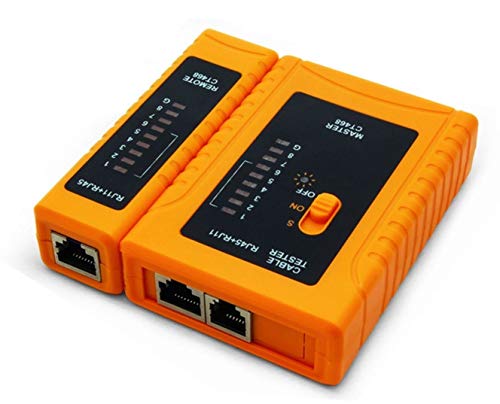
- Continuity or wiremap tester. Shows pin-to-pin connections between a main unit and a remote. Finds opens, shorts and crossed pairs. Budget models are often a pair of boxes with eight lights.
- Cable verifier. Adds length measurement, tone generation and sometimes port detection. Fluke’s MicroScanner line and Klein’s Scout line sit here.
- Certifier. Measures performance against standards for Category 5e, 6 and beyond. These are specialist instruments for professional installers and are rarely a home purchase.
For home and small-office network cabling, the Klein Tools VDV526-200 LAN Scout Jr. 2 is the straightforward wiremap tester, the Klein Tools VDV501-851 Scout Pro 3 kit suits installers who also need length measurement and coax and voice cable, and the Fluke MicroScanner2 suits those who want a trade-grade verifier with tone generation and port detection. An RJ45 cable tester is a handheld tool that checks Ethernet cables terminated with RJ45 plugs for correct wiring: opens, shorts, miswires, split pairs and, on better models, cable length. Most basic units do not certify a cable to a performance standard; they confirm that the wiring is correct, which is what most DIY crimping and patch cable work needs.
Our top picks


As an Amazon Associate we earn from qualifying purchases at no extra cost to you.
Tester, Verifier or Certifier?
- Continuity or wiremap tester. Shows pin-to-pin connections between a main unit and a remote. Finds opens, shorts and crossed pairs. Budget models are often a pair of boxes with eight lights.
- Cable verifier. Adds length measurement, tone generation and sometimes port detection. Fluke’s MicroScanner line and Klein’s Scout line sit here.
- Certifier. Measures performance against standards for Category 5e, 6 and beyond. These are specialist instruments for professional installers and are rarely a home purchase.
Because the keyword says only “tester”, the clearest consumer meaning is a wiremap tester or entry-level verifier for patch cables and in-wall runs, and that is what this guide covers.
Confirmed Models
Klein Tools VDV526-200 LAN Scout Jr. 2
Klein’s manual describes a tester for RJ45-terminated data cable that is designed for use on unenergized cabling. It supports shielded or unshielded Cat 7, Cat 6/6A, Cat 5e and Cat 3 cable, and tests for pass, miswire, open, short, split pair, cross-over and shield faults. A large backlit LCD shows a pin-to-pin wiremap, with the tester end on the top line and the remote end below. It also has a tone generator, though some buyers report that tracing needs a separate probe. The maximum voltage between any two connector pins without damage is listed as 66V DC or 55V AC, which is another reason to test only disconnected cable. It runs on two AAA batteries, with about 80 hours of active use and three years on standby, and the kit includes one self-storing remote. The split-pair check needs a minimum cable length of about 0.5 m.
Klein Tools VDV501-851 Scout Pro 3 Kit
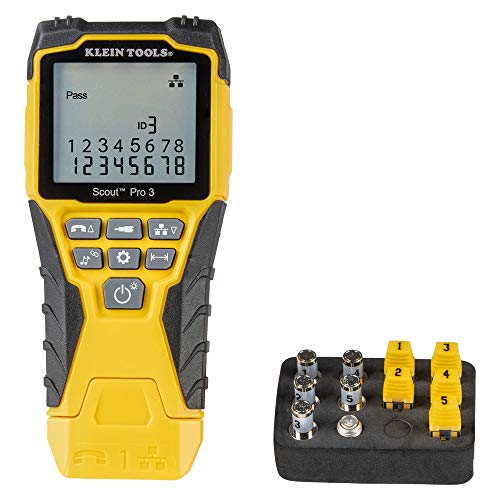
The maker’s kit supports a shielded or unshielded RJ45 port for Cat 5e, 6, 6a, 7 and 7a, an F-connector port for RG6 and RG59 coax and an RJ11/12 port for voice cable. It measures length up to 2000 ft (610 m) by capacitance and tests for open, short, miswire and split pair faults. The kit includes the tester, a self-storing remote, five LanMap RJ45 locator remotes, five CoaxMap F-connector remotes, a coax adapter, a manual and a 9V battery. It has a backlit LCD and a hub blink function. The tone generator needs a tracing probe, the VDV500-123, which is sold separately.
Fluke Networks MicroScanner2 (MS2-100)
Fluke’s datasheet lists a shielded 8-pin jack that accepts RJ45 and RJ11 plugs, an F-connector for coax, support for UTP, FTP and SSTP twisted pair, length measurement up to 460 m (1500 ft), wiremap to TIA-568A/B, remote ID locators, IntelliTone digital tone at 500 kHz plus analog tones, detection of advertised Ethernet port speed at 10 Mbps, 100 Mbps and 1 Gbps, and PoE detection. It runs on two AA batteries for about 20 hours of typical use, weighs 300 g with batteries and the wiremap adapter attached and has a backlit monochrome LCD. NVP can be set by the user or calculated from a cable of known length. An Industrial Ethernet variant, the MS2-100-IE, adds continuity tests on RJ45, M12X, M12D and M8D connectors.
NOYAFA NF-468S
The maker’s page and manual describe a handheld wiremap tester with a separate remote unit for RJ45, RJ11 and RJ12 cables. It reports pass, open, cross and short results and has a PoE test interface that the maker describes as identifying PoE devices and standards. Supported cable types are listed as Cat 5, 5e and 6 in both UTP and STP form, with some listings extending the claim to Cat 6A or Cat 7. Listings differ on length testing: a length figure up to 2000 m appears for telephone lines, while other sources say it has no cable length measurement, so do not buy it for length work. It uses a 9V battery, which some listings state is not included. It is a basic tester without a wiremap display, so it suits occasional use.
At a Glance
| Model | Type | Stated capabilities | Best for | Limits |
|---|---|---|---|---|
| Klein VDV526-200 | Wiremap tester | Open, short, miswire, split pair, cross-over, shield; LCD wiremap; one remote | Homes and small offices | Unenergized cable only; one remote in the kit |
| Klein VDV501-851 | Verifier kit | RJ45, coax and RJ11/12; length to 2000 ft; five locator remotes of each kind | Installers pulling many runs | Tone probe sold separately |
| Fluke MicroScanner2 | Verifier | Length to 460 m, tone, port speed and PoE detection | Trade users and network techs | Larger tool; not a certifier |
| NOYAFA NF-468S | Budget tester | PoE test, RJ45/RJ11/RJ12, pass/open/cross/short | Occasional use | No wiremap display; length testing differs by listing |
Budget, Mid-Range and Premium Tiers
Budget: a simple two-piece LED tester for patch cables, or the NOYAFA unit if you want a PoE check. Mid-range: the Klein VDV526-200, which adds an LCD wiremap and shield testing, with a tone generator for tracing. Premium: the Klein VDV501-851 kit and the Fluke MicroScanner2, which add length measurement, locators and in some cases port detection. A certifier tier sits above these for professionals and is not usually needed at home.
What Testers Can and Cannot Tell You
- They find wiring faults. Opens, shorts, crossed pairs and split pairs are the usual crimping errors.
- They do not guarantee speed. A wiremap pass shows correct connections, not that the cable meets Category 6 performance. Standards-based certification needs a certifier.
- Length measurement is approximate. Capacitance-based length depends on cable type and, in Fluke’s case, the NVP setting.
- Locators help in bundles. Numbered remotes let one person identify which wall port belongs to which cable.
- PoE detection and port speed. The MicroScanner2 detects Ethernet port speed and PoE as listed, which helps when diagnosing a switch port.
Compatibility and Use Notes
- Match the tester to the cable type. Shielded cable needs a shield test, which the VDV526-200 lists.
- Test cables disconnected from live equipment. Connecting a tester to an active switch port or to a line carrying voltage can damage the tester, and Fluke’s tool is designed to detect PoE rather than to tolerate arbitrary voltages, so follow the manual.
- Check both ends. A remote at the far end is needed for a full wiremap on installed cable.
- Test your punch-down and keystone terminations as well as patch cables.
- Replace batteries with the type the maker lists, such as the 9V in the Klein VDV501-851 kit and two AA cells in the MicroScanner2.
Safety Notes
Network cabling is low voltage, but the work around it often is not. Turn off power and follow the manual before working near mains wiring, and never run low-voltage cable in the same conduit as mains conductors unless local code allows it. Do not connect a tester to a telephone line with ringing voltage unless the maker says it is safe. Hardwired mains work stays with a licensed electrician.
Pick X If…
| If you… | Pick | Reason |
|---|---|---|
| Crimp a few patch cables at home | Klein VDV526-200 or a simple LED tester | Finds common wiring faults |
| Pull many runs through a building | Klein VDV501-851 | Locator remotes and length measurement |
| Troubleshoot live networks as a technician | Fluke MicroScanner2 | Port speed and PoE detection listed |
| Want a PoE check on a budget | NOYAFA NF-468S | PoE test interface listed by the maker |
| Need performance certification | A certifier from a professional vendor | Verifiers do not certify |
Alternatives
- Pre-made certified patch cables. Avoid crimping errors altogether for short runs.
- Network link testers built into switches. Some managed switches report cable faults on a port.
- Multimeter continuity test. Possible for one wire at a time, but slow and not suited to eight-wire cables.
- Hiring a cabler. For in-wall runs where certification paperwork is needed.
Frequently Asked Questions
Does a wiremap pass mean my cable will run gigabit?
A pass means the wires are correctly connected, which is necessary for gigabit. It does not certify performance. Poor terminations, damaged cable or interference can still limit speed.
What is a split pair?
It is a miswire where the right pins are connected end to end but the twisted pairs are paired incorrectly. Continuity testers can miss it, which is why models such as the Klein units list split-pair detection.
Can I test a cable that is already connected?
Disconnect it from equipment first. Testing a live link can give wrong results or harm the tester, so follow the manual.
Do I need locator remotes?
Only for multi-cable installs where you must identify which wall port connects to which patch panel position. The VDV501-851 kit includes five RJ45 remotes for this.
What does PoE detection do?
The Fluke MicroScanner2 detects PoE on a port, which helps identify whether a camera or access point is being powered. It does not make a tester safe to plug into arbitrary equipment.
Is a Cat 6 cable tester different from a Cat 5e tester?
For wiremap tests, the same tool usually works on both. Certification to a category needs a certifier with the right test limits.





