
Key takeaways
- AC/DC current. Some clamps read AC current only; models that read DC current can also check automotive and solar circuits.
- True RMS. Gives accurate readings on non-sinusoidal waveforms produced by modern electronics.
- Safety category. CAT III and CAT IV ratings describe where on an electrical system the meter is meant to be used. A higher rating and voltage suits panel work, but is not a reason to work on live equipment without training.
- Jaw size. Needs to be large enough for the cable you will measure.
- Auto-ranging versus manual. Auto-ranging is simpler; manual ranging can be faster for experienced users.
- Extras. Non-contact voltage detection, capacitance, frequency, temperature probe, backlight, data hold and low-impedance mode that reduces the chance of misleading ghost voltages.
For most homeowners and hobbyists, a true-RMS clamp meter that also has test leads for voltage, resistance and continuity, such as the Klein Tools CL390 or Fluke 325, is the best “multimeter with clamp meter”, because it measures current without opening a circuit and still behaves as a full digital multimeter. A multimeter with a clamp meter, often called a clamp multimeter, combines a jaw that senses current around a single conductor with the standard multimeter functions through probes. The jaw is for current; the leads are for voltage, resistance, continuity, capacitance and more. Choosing between models comes down to current range, AC-only versus AC/DC current, safety category, jaw size and the extras you will actually use.
Our top picks


As an Amazon Associate we earn from qualifying purchases at no extra cost to you.
Key Features to Weigh
- AC/DC current. Some clamps read AC current only; models that read DC current can also check automotive and solar circuits.
- True RMS. Gives accurate readings on non-sinusoidal waveforms produced by modern electronics.
- Safety category. CAT III and CAT IV ratings describe where on an electrical system the meter is meant to be used. A higher rating and voltage suits panel work, but is not a reason to work on live equipment without training.
- Jaw size. Needs to be large enough for the cable you will measure.
- Auto-ranging versus manual. Auto-ranging is simpler; manual ranging can be faster for experienced users.
- Extras. Non-contact voltage detection, capacitance, frequency, temperature probe, backlight, data hold and low-impedance mode that reduces the chance of misleading ghost voltages.
Models Checked Against Maker Pages
Klein Tools CL390 (400A)
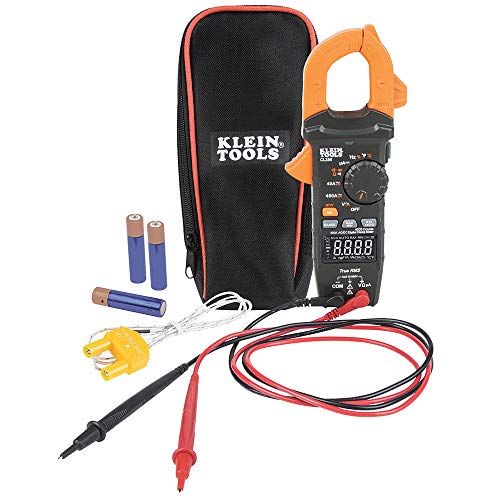
The maker lists an auto-ranging true-RMS clamp meter that measures 400A AC and DC current through the jaw, with non-contact voltage detection in the clamp. Through the test leads it measures AC and DC voltage to 600V, DC microamps (200 microamp range), resistance, continuity, frequency, capacitance and diodes, plus temperature through a thermocouple. The display is a 4000-count LCD, the jaw is listed at 1.6 inches, and the safety rating in the manual is CAT III 600V with double insulation. It is the only one of the three Klein models here that reads DC current through the clamp.
Klein Tools CL800 (600A)
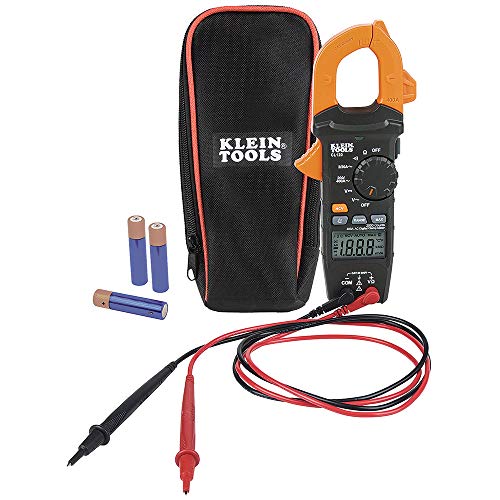
The CL800 is the higher-rated Klein model. It is sold as an AC auto-ranging true-RMS clamp meter with a 600A AC current range, a low-impedance (LoZ) mode that helps identify ghost voltages, a 6000-count LCD and a 1.38 inch jaw. The listed voltage range goes to 1000V AC and DC. The maker’s rating is CAT IV 600V and CAT III 1000V. Some listings show a DC current figure for this model, which is unclear, so treat it as an AC current clamp unless the manual says otherwise.
Klein Tools CL220
The manual describes an auto-ranging true-RMS clamp meter for AC current up to 400A and voltage up to 600V, rated CAT III 600V with double insulation. It measures AC current only, with no DC current function, which is the main trade-off. Other functions are listed in the manual and are fewer than on the CL390.
Fluke 325
Fluke’s datasheet lists AC and DC current ranges of 40.00A and 400.0A with 2 percent plus 5 digits accuracy (45 to 65 Hz for AC), AC and DC voltage to 600V, resistance to 40 kilohms, continuity, capacitance to 1000 microfarads, frequency 5 to 500 Hz, temperature through a K-type thermocouple, a 30 mm jaw, min/max recording and a backlight. The datasheet lists CAT III 600V and CAT IV 300V. Size is 207 x 75 x 34 mm, weight 283 g, and the warranty is two years.
Amprobe AMP-220
The maker’s page describes a true-RMS clamp multimeter with AC and DC current to 600A, a 35 mm jaw, AC and DC voltage to 600V, frequency to 999.9 Hz, resistance to 60 kilohms, capacitance to 2500 microfarads, and an Amp-Tip function for precise readings up to 60A on both large and small conductors. It also lists a low-pass filter for variable frequency drives, non-contact voltage detection from 10 to 1000V AC, a backlit display, data hold and a CAT III 600V rating.
At a Glance
| Model | Current range | AC/DC current | Notable stated features | Safety rating stated | Best for |
|---|---|---|---|---|---|
| Klein CL390 | 400A | AC and DC | Auto-ranging, NCVT in jaw, DC microamps, capacitance | CAT III 600V (manual) | Home, HVAC, general electrical |
| Klein CL800 | 600A | AC (check manual for DC) | Low-impedance mode, 1000V range, 6000 counts | CAT IV 600V, CAT III 1000V (manual) | Heavier electrical work |
| Klein CL220 | 400A | AC only | Auto-ranging true-RMS, AC current only | CAT III 600V | Residential AC circuit checks |
| Fluke 325 | 400A | AC and DC | Capacitance, frequency, thermocouple, min/max | CAT III 600V, CAT IV 300V (datasheet) | Trade users wanting a known name |
| Amprobe AMP-220 | 600A | AC and DC | Amp-Tip low current, VFD filter, NCVT | CAT III 600V | Industrial or VFD-related checks |
Budget, Mid-Range and Premium
Budget: the CL220 for AC-only household checks. Mid-range: the CL390 and the AMP-220, both with AC/DC current. Premium: the CL800 and the Fluke 325, which add higher category ratings or a maker datasheet with full accuracy tables. If you will never measure DC current, the cheaper AC-only route is reasonable. Anyone working on vehicle, battery or solar circuits needs DC current.
Using a Clamp Multimeter Safely
- Read the manual and match the meter’s category rating to the place you are measuring. A rating describes the meter’s design, not your skill.
- Clamp one conductor at a time. Clamping a whole cable with live and neutral together reads close to zero.
- Do not exceed the voltage and current ratings printed on the meter.
- Inspect leads and the case for damage before use, and replace damaged leads.
- Electrical panel work, hardwired circuits and anything involving live conductors should be left to a licensed electrician where local rules require it.
- Never defeat or bypass safety devices, and do not rely on a non-contact detector alone to decide a circuit is dead; use the meter’s test procedure in the manual.
Pick X If…
| If you… | Pick | Why |
|---|---|---|
| Want one tool for home and automotive checks | Klein CL390 | AC/DC current plus NCVT, auto-ranging |
| Need higher current and ratings | Klein CL800 | 600A AC, listed CAT IV 600V and CAT III 1000V |
| Only measure AC household circuits | Klein CL220 | AC-only and auto-ranging, per the manual |
| Prefer a long-established trade brand | Fluke 325 | Maker’s datasheet gives full accuracy tables |
| Work around motor drives | Amprobe AMP-220 | Low-pass filter for variable frequency drives |
Typical Jobs and the Features They Use
Checking whether an appliance draws the current its nameplate states uses the clamp on a single conductor of the supply lead, usually through a line splitter or on an accessible single wire. Hunting a parasitic battery drain in a vehicle needs DC current and a low range, where the CL390’s DC current range and the Amp-Tip function on the AMP-220 are the relevant stated features. Looking at an air-conditioning or heat-pump installation often uses capacitance, temperature and microamp functions, which the CL390 lists; the manufacturer’s service manual defines what measurements are appropriate and which should be left to a licensed technician. Reading a small DC supply in an electronics project is better done with the leads on a regular multimeter range than with the clamp, whose low-end resolution is coarser.
Leads and case also count. Check that the leads supplied carry the category rating you need, and replace any with damaged insulation. A clean jaw gives more consistent readings than one with dirt or corrosion on the mating faces.
Alternatives
- Separate multimeter and clamp. Two tools can be cheaper and each can be used independently.
- Clamp-only meter. Simple current measurement without lead functions.
- Plug-in power monitor. For checking appliance consumption without opening any circuit.
- Hiring an electrician. Where a measurement is for diagnosing wiring faults rather than learning.
Frequently Asked Questions
What is the difference between a clamp meter and a multimeter?
A clamp meter measures current by clamping around a conductor, without breaking the circuit. A multimeter uses probes to measure voltage, resistance and more. A clamp multimeter does both.
Do I need DC current measurement?
For household AC wiring, not usually. For vehicles, batteries, solar and some electronics, yes, and the CL390, Fluke 325 and AMP-220 are listed with it, while the CL220 is not and the CL800 should be treated as an AC current clamp.
What does CAT III mean?
It is a safety category that describes the kind of installation the meter is designed for, such as distribution panels and fixed wiring. Follow the category and voltage on the meter and the manual.
Why does a low-impedance mode matter?
Ghost voltages from nearby conductors can mislead a high-impedance meter. The CL800’s low-impedance mode is described as helping identify these stray voltages, but it does not replace proper test procedures.
How accurate are these meters?
Accuracy figures are in each maker’s datasheet and vary by function and range. The Fluke 325 datasheet lists 2 percent plus 5 digits on current, for example. Treat these as typical limits, not guarantees for every situation.
Can I use one to test a car battery?
Models with DC voltage and DC current can read battery voltage and some currents. Follow the meter and vehicle manuals, and be careful around starting currents that exceed the meter’s range.





