
Key takeaways
- Non-contact voltage. Listed on the CL390 as a built-in feature, and on the Fluke 377 FC as a jaw-based measurement.
- Low-impedance mode. The CL800 lists LoZ for separating stray voltages from real supply voltage.
- Temperature. Included on the Fluke 325 and listed on the Klein models, using a thermocouple.
- Capacitance. Listed on the Fluke 325 to 1000 microfarads and the Klein CL800 to 6000 microfarads, per the makers.
- Wireless logging. Available on the FC series, which is useful if you want to read a meter from a distance or save measurements.
A digital clamp-on meter is a hand-held tester that reads current through its jaws and usually voltage, resistance and continuity through leads, and the clearest picks for a general buyer are the Klein Tools CL800 for a strong all-round electrician’s meter, the Klein Tools CL390 for a lower-cost AC/DC option with non-contact voltage detection, the Fluke 325 for compact AC/DC work with temperature, and the Fluke 376 FC or 377 FC when you need large conductors, wireless features or a flexible probe. This guide explains what each stated spec means so you can match a meter to the jobs you actually do.
Our top picks


As an Amazon Associate we earn from qualifying purchases at no extra cost to you.
What “digital clamp-on meter” covers
The phrase covers a wide family. At one end are small AC-only clamps used to check an appliance, an air conditioner or a motor. At the other end are true-rms AC/DC meters with flexible probes, wireless connectivity and high category ratings. Before comparing models, decide whether you need DC current, how big the conductors are, and whether you also want the meter to act as a general multimeter.
At a glance
| Model | Best for | Stated key specs | Trade-off |
|---|---|---|---|
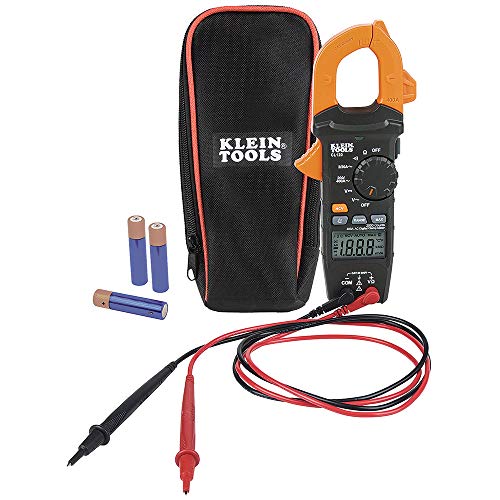
| Klein Tools CL800 | Daily electrical work | 600 A AC/DC; 1000 V AC/DC; TRMS; 6000 counts; CAT IV 600 V and CAT III 1000 V; low-impedance mode; frequency 1 Hz to 500 kHz; temperature -14 to 1000 degrees Fahrenheit as listed | Jaw listed at 1.38 inches |
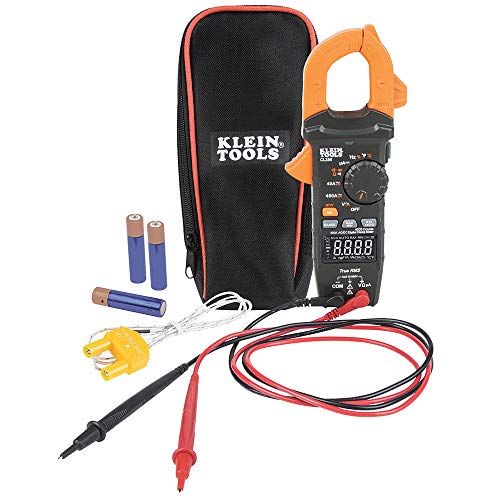
| Klein Tools CL390 | Tradespeople on a tighter budget | 400 A AC/DC; 600 V AC/DC; TRMS; 4000 counts; CAT III 600 V; non-contact voltage; thermocouple temperature; 1.6 inch jaw | Lower safety category and display resolution than the CL800 |
| Fluke 325 | Maintenance, HVAC, automotive | 400 A AC/DC; 600 V AC/DC; true-rms; CAT III 600 V and CAT IV 300 V; temperature -10 to 400 degrees Celsius with included thermocouple; 30 mm wire capacity; two-year warranty listed | No wireless features |
| Fluke 376 FC | Panel work, large conductors | 999.9 A AC/DC jaw; iFlex for AC to 2500 A; 1000 V; records min, max, average and inrush; wireless; 34 mm jaw | Premium tier; larger and heavier than entry clamps |
| Fluke 377 FC | Users who want non-contact voltage through the jaw | 999.9 A AC jaw range; included iFlex for AC to 2500 A; FieldSense measures voltage and current without touching the conductor; CAT III 1000 V and CAT IV 600 V | Premium tier; check the product page for exact weight |
How to choose
1. Decide on AC only or AC/DC
If you only work on household AC circuits, an AC clamp may be enough, but an AC/DC clamp is more flexible since it also handles vehicles, batteries, low-voltage control power and DC motors. All the models in the table read DC current through the jaws.
2. Match the current range to your work
Household branch circuits are small, so 400 A is usually plenty. Service conductors and industrial feeders push higher, which is where the CL800 at 600 A and the Fluke 376 FC at 999.9 A become useful. A flexible probe, such as the iFlex that Fluke lists for AC current to 2500 A, wraps around cables that will not fit a rigid jaw.
3. Check the safety category
Category ratings relate to where the meter can be used. A CAT III 600 V meter is intended for distribution-level work such as panels and branch circuits. CAT IV covers the service entrance. The Klein CL800 lists both CAT IV 600 V and CAT III 1000 V, and the Fluke 375, 376 and 377 FC list CAT III 1000 V and CAT IV 600 V. Use the lowest category you find in the manual as your working limit for any given meter, and do not use a meter beyond its stated voltage.
4. Look at display and resolution
Display counts tell you how finely the meter can show a reading. The CL800 lists 6000 counts and the CL390 lists 4000. More counts help when you read small numbers, such as milliamps through a clamp that has a finer range. A backlight, data hold and a clear layout matter more than the raw count if you work in dark panels.
5. Consider extra functions
- Non-contact voltage. Listed on the CL390 as a built-in feature, and on the Fluke 377 FC as a jaw-based measurement.
- Low-impedance mode. The CL800 lists LoZ for separating stray voltages from real supply voltage.
- Temperature. Included on the Fluke 325 and listed on the Klein models, using a thermocouple.
- Capacitance. Listed on the Fluke 325 to 1000 microfarads and the Klein CL800 to 6000 microfarads, per the makers.
- Wireless logging. Available on the FC series, which is useful if you want to read a meter from a distance or save measurements.
Budget, mid-range and premium tiers
| Tier | What to expect | Examples from this guide |
|---|---|---|
| Budget | AC-only or basic AC/DC clamps with fewer counts and a lower category | Not named here; look for a clear category listing |
| Mid-range | True-rms AC/DC to 400 A, temperature, basic electrical functions | Klein Tools CL390, Fluke 325 |
| Premium | Higher current, higher category, flexible probes, wireless logging | Klein Tools CL800, Fluke 376 FC, Fluke 377 FC |
Pick-by-need decision table
| If you … | Choose |
|---|---|
| Want an all-round electrician’s clamp with a high stated voltage category | Klein Tools CL800 |
| Want AC/DC current and non-contact voltage in one compact body | Klein Tools CL390 |
| Work on HVAC or vehicles and want an included thermocouple | Fluke 325 |
| Need to clamp large cables or record inrush | Fluke 376 FC |
| Want to read voltage and current without touching the conductor | Fluke 377 FC |
Using a clamp meter safely
- Follow the maker’s manual for your meter, including the instructions for batteries, leads and accessories.
- Use only the test leads and probes that come with the meter or that the maker lists for it, and inspect them before each use for cracks and exposed metal.
- Clamp one conductor at a time. If the jaw encloses both the live and neutral conductors in a cable, the fields cancel and the reading is close to zero.
- Keep the jaws clean and fully closed; a gap or dirt on the mating faces causes errors.
- Do not open panels, remove covers or touch live parts unless you are qualified and the work is allowed by local code. Hardwired repairs and installation work should be done by a licensed electrician.
- Never bypass a breaker, fuse or lockout device to take a measurement, and never rely on the meter alone to declare a circuit dead. Use the lockout and verification procedure appropriate to the work and your local rules.
Reading the numbers
Most manuals give accuracy as a percentage of reading plus a number of digits. For example, the Klein CL390 lists 2.0 percent plus 9 digits on its 40 A and 400 A current ranges, while the Fluke 325 lists 2 percent plus 5 digits for AC and DC current. The digit term is a fixed offset, so on small readings it makes up a bigger share of the error. If you often measure small currents, pick the range that gives the best resolution and consider a multimeter in series for tiny loads.
Frequency range also matters on variable-speed drives. Makers state accuracy for specific frequency bands, for example 45 to 65 Hz for AC current on the Fluke 325 and 45 to 66 Hz on the 377 FC. Outside the stated band, the accuracy figure no longer applies; read the data sheet for your model.
Alternatives to a clamp meter
- Plain digital multimeter. Better for voltage, resistance, continuity and small current, but current must be measured in series, which is limited by the meter’s fuse rating. A multimeter and a clamp meter complement each other.
- Clamp accessory for a multimeter. Useful if you already own a good multimeter. Match the accessory’s output to the meter’s input as the maker specifies.
- Plug-in energy monitor. For checking the power draw of a single plug-in appliance, a plug-in monitor is more suitable than a clamp, and it does not require access to wiring.
Frequently Asked Questions
What does true-rms mean on a clamp meter?
True-rms meters calculate the effective value of a waveform even when it is distorted, as in variable-speed drives and electronic loads. Meters without it can read low or high on non-sinusoidal signals. All the models in this guide list true-rms operation.
How many counts do I need?
Counts describe display resolution. A 4000-count display, as on the Klein CL390, is adequate for most trade work. A 6000-count display, as on the CL800, gives finer readings on small values.
Is a clamp meter safer than a multimeter?
For current it avoids breaking the circuit, which removes one hazard. Voltage measurements through leads carry the same risks as a multimeter, so the category rating and lead condition still apply, and the manual’s safety section governs how to use either.
Can I measure current in a cord by clamping the whole cord?
No, not with a standard clamp. The currents in the live and neutral conductors cancel, so the reading is near zero. Some makers sell line splitters for this purpose; use only those the maker lists and follow its instructions.
Do I need wireless features?
Only if you want to log or view readings away from the meter, for example when a panel is hard to see while you hold the jaws. The Fluke FC series offers this. For simple spot checks, a wired meter is perfectly adequate.
What does the jaw size tell me?
It sets the largest conductor you can enclose. The Fluke 325 lists 30 mm, the Klein CL390 1.6 inches, the CL800 1.38 inches, and the Fluke 376 FC 34 mm. Large cables need a flexible probe such as the iFlex that the FC models support.





