
Key takeaways
- Use impact-rated bits with a 1/4-inch hex shank. Standard bits can snap under impact loads.
- Wear eye protection. A bit tip or a screw head can fracture and fly.
- Hold the workpiece securely and keep hands out of the line of the bit.
- Remove the battery before changing accessories or storing the tool, and follow the manual for charging and storing lithium-ion batteries. Do not use a damaged or swollen battery.
- Impact drivers can strip soft-wood screw holes or overdrive screws in thin material; use the lower speed step where the tool has one.
For a general reader with a budget cap of under $100, the practical choices are a brushless bare tool from a value platform such as Ryobi ONE+ HP or Craftsman V20 if batteries are already on the shelf, or a brushed driver in a starter kit from Black+Decker if nothing is. The headline torque numbers on the box are higher on the brushless tools, but the real cost question is whether the battery and charger come with the tool. Several of the best-spec drivers are sold tool-only, so the cap often buys the driver and nothing to power it.
Our top picks


As an Amazon Associate we earn from qualifying purchases at no extra cost to you.
At a glance
| Model | Motor | Stated max torque | Stated speed | What the box holds | Best for |
|---|---|---|---|---|---|
| Ryobi ONE+ HP PBLID01B | Brushless | Up to 2,200 in-lbs | 0-2,900 rpm, 0-4,000 ipm | Tool only | Existing Ryobi 18V owners wanting the most torque |
| Craftsman V20 CMCF830B / CMCF830D2 | Brushless | 1,800 in-lbs | Three steps: 0-1,400, 0-2,400, 0-3,200 rpm; 4,200 ipm | Bare tool, or kit with two 2 Ah batteries and charger | Buyers who want a brushless driver with a kit option |
| Black+Decker BDCI20 (in the BD2KITCDDI combo) | Brushed | 1,375 in-lbs | 0-3,000 rpm, 0-3,900 ipm | Drill, impact driver, one 1.5 Ah battery, charger, two bits | First-time owners who need everything in one box |
| DeWalt ATOMIC DCF850 | Brushless | 1,825 in-lbs | 3,250 rpm, 3,800 ipm, three speeds | Tool only, or kits with battery | Step-up pick when tight spaces matter |
All specs above are the numbers the makers list on their own product pages. The DeWalt is included as a stretch option: its listings differ by kit and retailer, and a kit with a battery may land above the cap, so treat it as the next tier up rather than a guaranteed fit.
How an impact driver differs from a drill
An impact driver adds a hammering action along the rotation, which helps drive long screws and lag fasteners without the tool twisting in the hand. It takes 1/4-inch hex bits, not round-shank drill bits, and it is not designed for precise drilling or for delicate fastening where a clutch matters. If the jobs are deck screws, framing screws, cabinet installs and the odd stuck fastener, an impact driver is the right tool. If the jobs are mostly drilling holes and assembling furniture, a drill driver is a better first purchase.
The picks in detail
Ryobi ONE+ HP PBLID01B: most torque on paper, battery not included
The maker lists up to 2,200 in-lbs of torque, 0-2,900 rpm and 0-4,000 impacts per minute, a 1/4-inch hex collet, a die-cast gear case, an onboard LED and one-handed bit release. It ships with the tool and the manual only, so the battery and charger are separate. The maker backs it with a three-year warranty. Reviewers repeatedly name the Ryobi ONE+ HP line as the most common budget recommendation because the 18V ONE+ battery system spans a very large number of other tools, which matters if the plan is to add a drill, a saw or a light later.
The trade-off is simple: this is the right bare tool for someone who already owns ONE+ batteries, and a more complicated purchase for someone who does not. Before counting it as an under-the-cap buy, add the cost of at least one battery and a charger.
Craftsman V20 CMCF830: brushless with a kit option
The maker lists 1,800 in-lbs of maximum driving torque, a three-speed gearbox (0-1,400, 0-2,400 and 0-3,200 no-load rpm), up to 4,200 impacts per minute, a 1/4-inch quick-release chuck, onboard bit holders and an LED. The CMCF830B is the bare tool, and the CMCF830D2 kit adds two 2 Ah batteries and a charger. The maker states a three-year limited warranty and makes runtime and speed claims against its older CMCF800. Those are the maker’s own comparison conditions, so they are a guide to relative improvement rather than a promise for every job. Weight differs by source (about 2.1 to 2.4 lb for the bare tool).
Older Craftsman V20 impact drivers such as the CMCF800 are still sold in places, so match the full model number to the generation you want. Reviewers describe Craftsman as a lower-cost brushless entry in this tier, though listings and bundles differ, so the kit may or may not fit under the cap depending on the seller.
Black+Decker BD2KITCDDI: the complete starter box
This is a combination kit rather than a standalone impact driver. The maker lists an LDX120 drill/driver and a BDCI20 impact driver, one 20V MAX lithium-ion battery rated 1.5 Ah and 30 Wh, a charger and two driver bits. The impact driver is rated at 1,375 in-lbs with a quick-release 1/4-inch hex chuck, 0-3,000 rpm and 0-3,900 impacts per minute. Both tools are brushed and the kit weighs roughly 5.8 to 5.9 lb. Some retailer listings wrongly call the kit brushless, and the drill clutch is listed as 11 positions on the maker’s page, so check the maker’s page and the box for warranty terms.
The limits are the single small battery and brushed motors. Brushed motors are normally less efficient and wear brushes over time, so a homeowner who drives screws daily will outgrow this faster than someone who hangs a shelf a few times a year. Because both tools run on the same battery, a single battery means waiting on the charger during a long project.
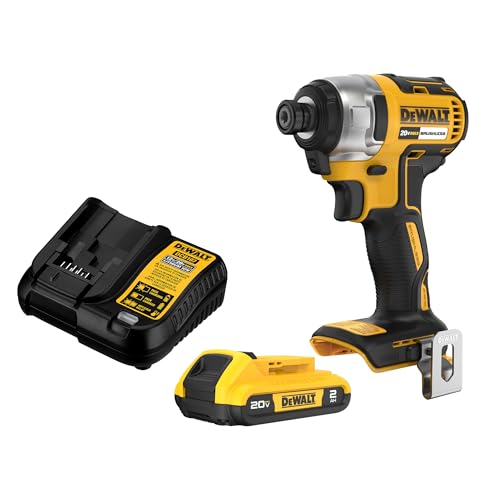
DeWalt ATOMIC DCF850: compact and capable, possibly over the cap
The maker lists 1,825 in-lbs, 3,250 rpm, 3,800 impacts per minute and three speed settings in a tool under four inches long (3.97 in.), with an LED. The DCF850B is tool-only, and the DCF850E1 kit adds a 1.7 Ah Powerstack battery and charger. Most retailers list about 2.1 lb for the bare tool, while a few show higher figures that look like shipping weights, so weights differ by listing.
Its short head helps in tight spots such as between joists or inside cabinets. As a value pick it is less certain: depending on which kit and retailer, the total may exceed the cap, so it belongs under alternatives for most readers.
What to look for
Torque numbers and what they mean
Maximum torque is a peak figure measured under the maker’s own conditions, and it is not directly comparable across brands. As a rule of thumb, a driver in the 1,400 to 2,200 in-lb range handles deck screws, cabinet screws and most framing fasteners. Beyond that, the difference shows up in how quickly the tool finishes large lag screws, not in whether it can drive common household fasteners at all.
Brushless versus brushed
Makers describe brushless motors as more efficient with longer runtime. Brushed motors are simpler and cheaper. Under this cap, brushless is realistic mostly as a bare tool; a brushed driver is realistic as a kit.
Battery platform
The battery is the long-term decision. A 20V MAX or 18V label describes the same class of battery (the 20V figure is the maximum initial voltage under no load; nominal voltage is 18V, which both Craftsman and DeWalt state). Batteries do not cross between brands, so choosing a driver is choosing a family. If a friend or family member already owns a platform, buying into it can save the most money.
Size and weight
A compact head lets the tool fit between studs and inside cabinets. A longer body usually sits better in the hand for all-day overhead work. For occasional home use, size matters more than the last 200 in-lbs of torque.
Safety and care notes
- Use impact-rated bits with a 1/4-inch hex shank. Standard bits can snap under impact loads.
- Wear eye protection. A bit tip or a screw head can fracture and fly.
- Hold the workpiece securely and keep hands out of the line of the bit.
- Remove the battery before changing accessories or storing the tool, and follow the manual for charging and storing lithium-ion batteries. Do not use a damaged or swollen battery.
- Impact drivers can strip soft-wood screw holes or overdrive screws in thin material; use the lower speed step where the tool has one.
Pick X if…
| If this describes the buyer | Choose | Why |
|---|---|---|
| Already owns Ryobi ONE+ batteries | Ryobi PBLID01B | Highest listed torque in this group, tool-only so batteries carry over |
| Owns Craftsman V20 batteries or wants a kit | Craftsman CMCF830B or CMCF830D2 | Brushless with a three-year limited warranty |
| Owns no cordless tools and wants one box | Black+Decker BD2KITCDDI | Drill and impact driver plus battery and charger |
| Works in tight spaces and can stretch the budget | DeWalt DCF850 | Under four inches long, 1,825 in-lbs listed |
| Drives a handful of screws per year | Any kit with a battery | Platform and warranty matter more than torque |
Alternatives to consider
- A drill/driver instead. If most work is drilling holes, assembling furniture or driving small screws, a drill with a clutch is the better first tool.
- A combo kit. Combining a drill and an impact driver in one kit shares the battery cost. Under this cap that means brushed tools; the next tier brings brushless combos.
- The next tier up. If the cap is flexible, a brushless kit with two batteries is a more durable first purchase than a brushed starter kit. DeWalt, for example, lists the DCF850 in several kit configurations.
Frequently Asked Questions
Is an impact driver or a drill better for a homeowner?
A drill driver is the more versatile first purchase because it drills clean holes and has a clutch for delicate fastening. An impact driver is better for long screws, deck work and stubborn fasteners. Many owners eventually end up with both.
Does a higher in-lb number always mean a better driver?
No. Torque ratings are peak figures from each maker’s own conditions, so they are only roughly comparable across brands. For common household fasteners, anything in the range of roughly 1,400 to 2,200 in-lbs is capable, and battery platform, size and warranty usually matter more.
Why do some impact drivers not include a battery?
Bare tools are aimed at people who already own batteries on the same platform. The Ryobi PBLID01B, for example, is listed as tool-only. If the plan is to buy into a platform, add a battery and charger to the cost before comparing with a complete kit.
Can I use regular drill bits in an impact driver?
Impact drivers take bits with a 1/4-inch hex shank. Round-shank bits do not fit the quick-release chuck, and standard driver bits can break under impact. Look for bits marked impact-rated.
What does 20V MAX mean compared with 18V?
Both labels describe the same class of battery. The makers explain that 20V MAX is the maximum initial voltage with no load, while the nominal voltage is 18V. It is a labelling difference, not a performance gap.
How should I store the battery?
Follow the manual. In general, keep lithium-ion batteries away from heat and moisture, do not charge a damaged battery, and stop using a battery that swells, leaks or overheats. Contact the maker for disposal guidance.





