
Key takeaways
- Wear a dust mask or respirator rated for fine dust, plus eye and hearing protection, and read the manual. Fine wood dust can irritate lungs and some woods are particularly irritating.
- Do not sand paint in homes built before 1978 without lead-safe practices; follow EPA guidance and consider a certified professional.
- Sanding dust is combustible. Empty the dust canister or bag outdoors, away from ignition sources, and follow the finish maker’s instructions on rag and dust disposal.
- Let the sander reach full speed before lowering it to the surface, and lift it off before switching off to limit gouges.
- Unplug the sander before changing discs, and keep the cord clear of the pad.
For most households, the Bosch ROS20VSC is the sensible sander under $100 because it pairs a variable-speed dial with an onboard dust canister, while the DeWalt DWE6423 suits buyers who want a stronger 3-amp motor and the Makita BO5041 suits those who sand for long stretches and will accept a price at or near the cap. All three are corded 5-inch random orbit sanders, which is the right type for furniture, doors, decks and wall prep. Cordless sanders from the same brands exist but generally sit above this cap once a battery is added.
Our top picks



As an Amazon Associate we earn from qualifying purchases at no extra cost to you.
At a glance
| Model | Motor | Stated speed | Orbit | Dust handling | Best for |
|---|---|---|---|---|---|
| Bosch ROS20VSC | 2.5 A | 7,500-12,000 OPM | 3/32 in. | Microfilter canister, hose adapter | General home projects, low vibration |
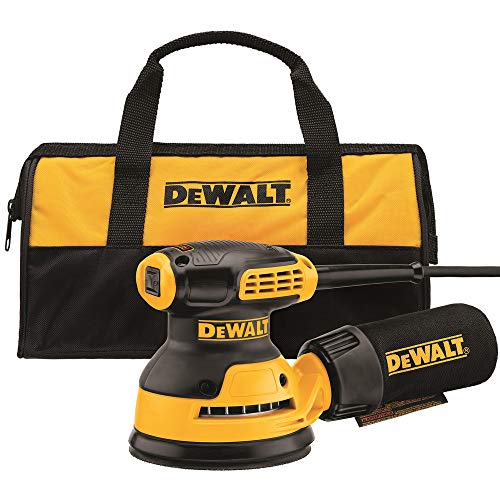
| DeWalt DWE6423 (also a K kit) | 3 A | 8,000-12,000 OPM | 3/32 in. | Locking dust bag, port fits DWV010 and DWV012 | Jobsite-style durability and vacuum hookup |
| Makita BO5041 (also a K kit) | 3 A | 4,000-12,000 OPM | 1/8 in. | Through-the-pad collection with bag | Heavy stock removal and long sessions |
The figures are those listed on the makers’ product pages. Reviewers’ price estimates differ widely between sources, which is why the Makita and DeWalt kits are treated as possibly at or above the cap.
Random orbit versus other sander types
A random orbit sander spins the pad while also moving it in small ellipses, which reduces the visible swirl marks that a simple spinning disc leaves. That makes it the standard first sander for wood furniture, cabinet doors and deck boards. A sheet or quarter-sheet palm sander uses square paper and gets into corners but leaves a more directional scratch. A detail sander handles tight corners. For one sander at a modest budget, the 5-inch random orbit is the most flexible.
The picks in detail
Bosch ROS20VSC: best balanced pick
Bosch lists a 2.5-amp, 120V motor with a variable-speed dial from 7,500 to 12,000 orbits per minute, a 3/32 inch orbit, a 5 inch pad and hook-and-loop disc, and a weight of 3.5 lb. It has a pad-dampening brake meant to prevent swirl marks when the sander is lifted, a microfilter dust canister, a carrying bag, a sanding disc and a vacuum hose adapter, and most listings give an 8 ft cord.
Reviewers call it the most common recommendation under this cap, and one comparison credits it with the best onboard dust collection among its group. The drawback that reviewers mention is a carrying bag that is less durable than a hard case.
Variable speed matters more than it appears. Lower speeds help on finishes and softer woods where a fast pad can burn or gouge, and higher speeds remove stock faster on raw wood.
DeWalt DWE6423: stronger motor, vacuum friendly
DeWalt lists a 3-amp brushed motor delivering 8,000 to 12,000 OPM, a 3/32 inch orbit and a hook-and-loop pad. A separate counterweight is intended to reduce vibration, the switch is dust-sealed, a rubber overmold gives a more comfortable grip, and a one-handed locking dust bag is included. The dust port fits the DWV010 and DWV012 dust collectors, which suits workshop use with a vacuum. Weight differs by listing, from about 2.9 lb to 3.4 lb. DeWalt lists a three-year limited warranty, and the DWE6423K is the kit version with the same motor.
Reviewer opinions differ: one places it in the middle of its group, while others rank it best overall for DIY or auto body use. Prices also differ from one source to another, so it may or may not fit under the cap, especially in kit form.
Makita BO5041: heavy sanding
Makita lists a 3-amp motor with oversized sealed ball bearings, a variable-speed dial from 4,000 to 12,000 OPM, a 1/8 inch orbit, a 5 inch disc and a pad brake. The page lists vibration at 3.5 m/s2, a two-finger trigger with lock-on, through-the-pad dust collection and an adjustable front handle. The dust bag and nozzle are included, and the BO5041K adds a tool case. Listings differ on weight (roughly 3.1 to 3.5 lb) and pad size (4-7/8 in. versus 4-13/16 in.).
The larger 1/8 inch orbit removes material more aggressively than the 3/32 inch orbit on the Bosch and DeWalt. That is useful for stripping old finish and flattening boards, but it can leave a rougher finish if used at full speed on fine work. Reviewers usually call it the professional-leaning choice and note that it often sits near or above the cap. The lower speed floor of 4,000 OPM is helpful for polishing and delicate work.
Cheaper single-speed sanders
Some cheaper random orbit sanders have a single speed. They are simpler but offer less control on finishes, so variable speed is worth prioritizing if the budget allows.
What to look for
Variable speed
Speed control prevents burning finishes and softer woods. If the budget allows only one feature, choose variable speed over extra amps.
Dust collection
No onboard canister catches all the dust. A vacuum hookup captures more, which matters for indoor work. Check that the dust port and hose adapter match the vacuum, as makers use different port sizes.
Orbit size
A larger orbit removes stock faster and leaves a rougher surface. A smaller orbit gives a finer finish. For furniture and trim, 3/32 inch is the common choice.
Vibration and weight
At around 3 to 3.5 lb, these sanders are manageable, but vibration adds fatigue on long jobs. Makita lists its vibration figure, while Bosch and DeWalt describe low-vibration designs without a comparable number on the pages reviewed.
Pad and disc costs
All three use 5 inch hook-and-loop discs. Discs are a recurring cost, and eight-hole and five-hole patterns must match the pad’s holes for the dust collection to work.
Safety and dust notes
- Wear a dust mask or respirator rated for fine dust, plus eye and hearing protection, and read the manual. Fine wood dust can irritate lungs and some woods are particularly irritating.
- Do not sand paint in homes built before 1978 without lead-safe practices; follow EPA guidance and consider a certified professional.
- Sanding dust is combustible. Empty the dust canister or bag outdoors, away from ignition sources, and follow the finish maker’s instructions on rag and dust disposal.
- Let the sander reach full speed before lowering it to the surface, and lift it off before switching off to limit gouges.
- Unplug the sander before changing discs, and keep the cord clear of the pad.
Pick X if…
| If this describes the buyer | Choose | Why |
|---|---|---|
| Wants one dependable sander for home projects | Bosch ROS20VSC | Variable speed, canister, bag included |
| Uses a shop vacuum and wants a rugged kit | DeWalt DWE6423K | Dust port fits listed DeWalt collectors, locking bag |
| Removes old finish or sands for long sessions | Makita BO5041 | 1/8 in. orbit, 4,000 to 12,000 OPM |
| Wants a case for storage | ROS20VSK, DWE6423K or BO5041K | Case versions are sold separately |
| Sands only occasionally | Lowest-cost variable-speed option | Speed control matters more than amps |
Alternatives
- A detail or quarter-sheet sander for corners and small projects.
- A cordless random orbit sander. Cordless 5-inch models exist from the same brands, but they need a battery and generally sit above this cap.
- A sanding block for light touch-up work where a power tool would be overkill.
Care and running costs
A corded sander has no battery to replace, so the ongoing cost is mostly abrasive discs and the occasional replacement pad. Clean the hook-and-loop face of the pad with a brush when it clogs, because a worn or dirty pad grips discs poorly and throws them at speed. Empty the dust canister or bag before it fills, since a full bag reduces collection and strains the motor. Store the sander in its bag or case, away from damp, and inspect the cord for cuts before each use. If the pad shows cracks or uneven wear, follow the maker’s manual for replacement rather than continuing to sand with a damaged pad.
Frequently Asked Questions
What does OPM mean?
OPM stands for orbits per minute, the number of times the pad completes its small oscillating motion each minute. Higher OPM removes material faster, and lower OPM gives better control on finishes.
Is a 5-inch or 6-inch sander better for home use?
Five inch is the common size for homeowners because discs are widely available and the tool is easier to control. Six-inch pads cover more area but are heavier and usually cost more.
Do I need a dust collection hookup?
A canister or bag captures some dust, but a vacuum connection captures more. For indoor work, connect a vacuum if the sander offers a port and wear a suitable respirator.
What grit should I start with?
Choose a coarse grit to remove old finish or level wood, then step up through medium to fine grits for smoothness. Skipping grits tends to leave visible scratches.
Why does my sander leave swirl marks?
Common causes are worn discs, too much pressure, tilting the pad, or a grit that is too coarse for the finishing step. A pad brake like the one Bosch and Makita list helps when lifting off the work.
Can I sand paint in an older home?
Paint in homes built before 1978 may contain lead. Follow EPA guidance on lead-safe work, and consider a certified professional rather than dry-sanding painted surfaces.





